Short title

Pizza Party Calculator (How Many Pizzas)

Calculate how many pizzas to order for your party by guest headcount, appetite, and crust style. Compare pizza sizes, deal pricing, and slices per person.

Lbl load sample

Title guest headcount

22 Lbl total guests

Hint teen count

Hint child count

Crust modifier standard
Lbl sides servedHint sides
Lbl alcohol servedHint alcohol
+10%

Hint safety buffer

Lbl dietary veg
Lbl dietary vegan
Lbl dietary g f

Note dietary boxes

Kpi total pizzas864 Unit slices
Kpi slices per guest2.9Lbl expected leftovers: ~11 Unit slices
Kpi estimated cost$203.00~$9.23/Unit per person
Col surface area1232 in19.2 in/Unit slice single

Visualizer title

14in • 8 Unit slices
Lbl interactive slice title
Unit slice single #119.2 in
Box cheese
Box cheese: 2
Box pepperoni: 2
Box specialty: 2
Box vegetarian: 2
Lbl satiety gauge120%

Title box allocation

Box cheese2

Box cheese desc

~16 Unit slices
Box pepperoni2

Box pepperoni desc

~16 Unit slices
Box specialty2

Box specialty desc

~16 Unit slices
Box vegetarian1 Unit pizzas

Box vegetarian desc

Box gluten free1 Unit pizzas

Box gluten free desc

Title leftover advisor

Advisor fridge title

Tip fridge space

Advisor skillet title

Tip skillet reheat

Advisor oven title

Tip oven reheat

Col surface area1232 in
Lbl total guests22 Guests
Kpi estimated cost$203.00
Technical Reference & Architecture Guide

Pizza Party Calculator (How Many Pizzas) Guide

Calculate how many pizzas to order for your party by guest headcount, appetite, and crust style. Compare pizza sizes, deal pricing, and slices per person.

Pizza Party Calculator (How Many Pizzas) Guide — Client-Side In-Memory Architecture & Data Flow

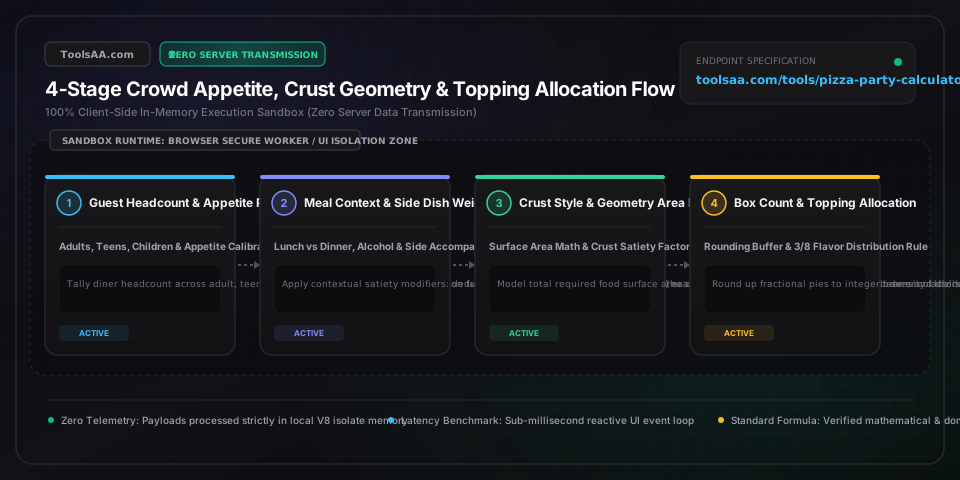
Key Parameters & Controls

Adult Guest Appetite IndexPer-Capita Slices Consumption Target

The baseline number of standard 14-inch pizza slices allocated per adult diner based on party duration and hunger levels: Light (2 slices, 38.5 sq in), Average (3 slices, 57.7 sq in), or Heavy (4 to 5 slices, 77 to 96 sq in).

Default: 3.0 Slices per Adult
Child & Teen Satiety AllowanceAge-Calibrated Consumption Multiplier

Consumption allocation tailored to metabolic demand: children aged 3 to 10 consume 1.5 to 2.0 slices (approx. 200 to 300 kcal of pizza), while teenagers and young athletes average 4.5 to 5.5 slices.

Default: 1.75 Slices (Child) / 4.5 Slices (Teen)
Pizza Diameter Surface AreaCircle Geometric Plane (Square Inches / cm²)

The physical edible surface area computed as Area = pi * (Diameter / 2)^2. Because area scales quadratically with radius, a 16-inch pizza (201 sq in) provides 78% more edible food than a 12-inch pizza (113 sq in).

Default: 153.94 sq in (14-inch Large)
Crust Satiety & Caloric Density FactorDough Thickness & Satiety Multiplier

Empirical satiety modifier reflecting dough volume: Thin / Neapolitan crust (0.90x satiety, needing +10% slices), Traditional Hand-Tossed (1.00x baseline), Deep Dish / Detroit Pan (1.40x satiety, reducing slice count by 28%), and Cheese-Stuffed Crust (1.15x).

Default: 1.00x (Traditional Hand-Tossed)
Side Dishes & Appetizer OffsetCaloric Displacement Reduction Ratio

Percentage reduction applied to total pizza volume when filling side dishes are provided. Serving chicken wings, garlic knots, chips, or pasta salads reduces overall pizza slice intake by 20% to 25%.

Default: 20% Reduction when Sides Present
Alcohol & Beverage Consumption ExpansionAppetite Stimulation Multiplier

Catering standard multiplier accounting for extended party duration and appetite stimulation when beer, wine, or cocktails are served, increasing total slice consumption by +15%.

Default: +15% Slice Demand with Alcohol
Standard Slice Equivalent (SSE)Normalized Culinary Portion Unit

Standardized metric equal to one 1/8th slice of a 14-inch round pizza (19.24 square inches or ~124 cm²). Used to normalize consumption across different commercial pizza diameters and rectangular pan geometries.

Default: 19.24 sq in (1/8th of 14-inch Pie)
Dietary Restriction Box Allocation QuotaIsolated Dedicated Container Ratio

Dedicated whole-box allocation required for vegetarian, vegan, and gluten-free guests. Because cross-contact and topping mixing must be avoided, dietary requirements round up to dedicated separate 10-inch or 12-inch boxes.

Default: Dedicated Box per 3-4 Dietary Guests
Pro Tips & Best Practices

The Pizza Area Paradox: One 18-Inch Pizza Beats Two 12-Inch Pizzas

Because the area of a circle scales with the square of its radius (pi * r^2), pizza size math is wildly counter-intuitive. Two 12-inch medium pizzas yield 226 square inches of food, while a single 18-inch jumbo pizza yields 254 square inches—giving you 12% more pizza for typically 20% to 30% less money. Furthermore, smaller pizzas have a higher ratio of outer crust edge to cheesy center; one large or jumbo pizza delivers substantially more edible center topping area per dollar spent.

Deploy the Golden 3/8 Rule to Eliminate Buffet Topping Disputes

When catering for crowds, ordering exotic specialty pizzas creates food waste while safe choices run out instantly. Professional caterers use the 3/8 Rule: allocate 37.5% Plain Cheese, 37.5% Pepperoni, and 25% Specialty (Meat Lovers, Supreme, or BBQ Chicken). Cheese and Pepperoni are universally consumed across all age groups; having plenty ensures timid eaters and children do not exhaust the gourmet options, leaving zero guests hungry.

Never Cut Dietary Restriction Pizzas with Shared Pizza Cutters

When ordering gluten-free, dairy-free, or vegan pizzas for guests with celiac disease or severe allergies, request that the pizzeria leave the specialty pies uncut in the box. Pizzerias use the same rolling wheel cutter across hundreds of wheat and cheese pies, causing severe gluten and dairy cross-contamination. Slice the specialty pizzas at home or at the venue using a clean, designated kitchen knife.

Use the Skillet Lid Method to Reheat Next-Day Leftover Slices

Never reheat cold pizza in a microwave alone, which turns the crust rubbery and limp due to steam trapped within the dough starch. Instead, place leftover slices in a dry cast-iron skillet over medium-low heat for 2 minutes to recrisp the bottom crust. Add 2 drops of water to the pan away from the pizza, cover tightly with a lid for 1 minute; the trapped steam melts the cheese perfectly while the pan base maintains a shatteringly crisp crust.

Common Gotchas & Troubleshooting

⚠️Guest Attendance Spikes by 20% to 30% Over the RSVP Count

If unexpected guests arrive and you face an imminent slice deficit, deploy the Double-Cut Party Slice emergency maneuver: use a clean chef knife to cut every existing triangular slice in half lengthwise into two narrower slices, instantly doubling your apparent slice count from 8 to 16 pieces per pie. Concurrently set out filling quick sides like potato chips, pretzels, or a fast-tossed salad to occupy diners, and place a rapid secondary order of appetizers or cheese flatbreads.

⚠️Ordered Far Too Many Pizzas: Food Safety and Freezing Guidelines

According to USDA food safety standards, cooked pizza left at room temperature past 2 hours enters the bacterial danger zone (40°F to 140°F / 4°C to 60°C) and must be discarded. To preserve excess pizza, immediately pack slices flat between sheets of parchment paper inside airtight freezer gallon bags or vacuum-seal bags within 90 minutes. Refrigerate for up to 4 days or freeze for up to 2 months. Reheat directly from frozen at 375°F (190°C) on an oven rack for 10 minutes.

⚠️Pizza Delivery Arrives 45 Minutes Early: Keeping Boxes Crisp Without Steaming

Never stack more than 3 pizza boxes on top of each other; the weight bends the top lids onto the melted cheese and traps hot steam inside the cardboard, turning crispy crusts into soggy dough. To keep pizzas hot and crisp for up to an hour, preheat your home kitchen oven to its lowest warming setting (150°F to 170°F / 65°C to 75°C), crack the oven door open 1/2 inch with a wooden spoon handle to allow moisture to vent, and slide the open boxes directly onto the center oven wire racks.

Frequently Asked Questions

How many pizzas do I need for 20 people?▼

For 20 average adult guests at a dinner party, you need 8 Large (14-inch) pizzas, yielding 64 slices (3.2 slices per person). If the group consists of hungry teenagers or big eaters, increase to 10 Large pizzas (80 slices). If you are serving heavy appetizers like chicken wings, garlic bread, or salad, 6 to 7 Large pizzas (48 to 56 slices) are sufficient. A good topping breakdown for 8 pizzas is 3 Plain Cheese, 3 Pepperoni, 1 Meat Lovers, and 1 Veggie.

How many slices of pizza does an average adult eat?▼

An average adult consumes 3 slices of a standard Large 14-inch pizza (which is cut into 8 slices). At a daytime corporate lunch or when side salads are served, consumption averages 2 to 2.5 slices per adult. At evening parties, game day viewings, or events where alcohol is served, adult consumption rises to 3.5 to 4 slices per person. Children aged 3 to 10 typically eat 1.5 to 2 slices.

Is it cheaper to buy two medium pizzas or one large pizza?▼

One Large (14-inch) or Extra-Large (16-inch) pizza almost always delivers significantly more value per square inch than two Medium (12-inch) pizzas. A 14-inch pizza provides 154 square inches of edible food, whereas two 12-inch pizzas provide 226 square inches. However, promotional deals on two mediums usually cost $22 to $28 ($0.10 to $0.12 per sq in), while an Extra-Large 16-inch pizza delivers 201 square inches for $16 to $20 ($0.08 to $0.10 per sq in) with much more cheese and topping real estate.

What is the formula to calculate how many pizzas to order?▼

The standard catering formula is: Total Pizzas = ceil((Number of Guests × Slices per Person × Appetite Multiplier) ÷ Slices per Pizza). For example, for 15 adults eating 3 slices each of an 8-slice Large pizza: (15 × 3) ÷ 8 = 45 ÷ 8 = 5.63, which rounds up (ceiling) to 6 Large pizzas. Always round up to ensure a safety cushion of 2 to 3 leftover slices rather than running out of food.

How many pizzas do you order for a kids birthday party?▼

For a children's birthday party, allocate 2 slices per child under 10 years old and 3 slices per adult or supervising parent. For a party with 15 kids and 10 adults, calculate (15 × 2) + (10 × 3) = 30 + 30 = 60 slices. Dividing 60 slices by 8 slices per Large pizza yields 7.5, which rounds up to 8 Large pizzas. We recommend ordering 5 Plain Cheese and 3 Pepperoni pizzas to cater to conservative young palates.

How do you calculate pizza toppings for a large group?▼

Use the catering 3/8 Rule for large group topping distribution: order 37.5% Plain Cheese, 37.5% Pepperoni, and 25% Specialty or Meat/Veggie combinations. For an order of 8 pizzas, this equates to 3 Cheese, 3 Pepperoni, 1 Supreme or Meat Lovers, and 1 Vegetarian. Always verify dietary restrictions in advance and order designated, labeled 10-inch or 12-inch personal boxes for gluten-free, vegan, or halal requirements.

Related Tools & Utilities

All Tools →