Short title

Coffee Brew Ratio Calculator & Water Ratio

Calculate exact coffee-to-water ratios, ground dose, and liquid yield. Scale pour-over, French press, espresso, and cold brew with SCA Golden Cup standards.

Badge sca100% Client-Side Privacy
Lbl load sample
Lbl mode selector
Mode dose desc
g
Lbl presets mugLbl exact fit
1 : 16.0
1:11:151:16.6 (SCA)1:25
2.0 g / g

Lbl retention desc

Lbl carafe cup notice

Desc carafe cup notice

Lbl coffee dose15 g0.53 oz
Lbl water poured240 gLbl kettle water hint
Lbl beverage yield210 ml-30g Lbl bed absorption short
Lbl ratio1 : 16.0Hario V60
Lbl strike temp95°CLight
Lbl grind sizeMedium-Fine500-650 µm
Lbl scale visualizer
Lbl strength zone: Lbl ideal extraction
240 gTARELbl bed absorption+30g Lbl bed absorption shortLbl beverage yield210 ml
Lbl syrupyLbl boldLbl golden cupLbl delicate
Tab cockpit
Lbl ideal extraction
Lbl tds1.36 %

Lbl tds guide

Lbl extraction yield19 %

Lbl ey guide

Lbl sensory forecast

Classic Golden Cup equilibrium with sparkling floral aromas, balanced crisp acidity, and clean caramel finish.

Badge sca • 100% Client-Side Privacy
Lbl coffee dose15 g
Lbl water poured240 g
Lbl beverage yield210 ml
Lbl ratio1 : 16.0
Lbl strike temp95°C
Lbl tds1.36%

Tip1 title

Tip1 desc

Tip2 title

Tip2 desc

Tip3 title

Tip3 desc

Lbl faq title

Faq1 q

Faq1 a

Faq2 q

Faq2 a

Faq3 q

Faq3 a

Faq4 q

Faq4 a

Technical Reference & Architecture Guide

Coffee Brew Ratio Calculator & Water Ratio Guide

Calculate exact coffee-to-water ratios, ground dose, and liquid yield. Scale pour-over, French press, espresso, and cold brew with SCA Golden Cup standards.

Coffee Brew Ratio Calculator & Water Ratio Guide — Client-Side In-Memory Architecture & Data Flow

Key Parameters & Controls

Coffee Grounds Dose (Dry Bean Mass)Mass in Grams (g) or Dry Avoirdupois Ounces (oz)

The exact dry weight of ground coffee beans loaded into the brewing basket or filter chamber. The Specialty Coffee Association (SCA) Golden Cup Standard specifies a baseline dose of 55g to 60g per 1,000ml water (approximately 15g to 18g for a single mug). Deviations as small as 0.5g alter slurry bed depth and extraction velocity, shifting total dissolved solids (TDS) outside the optimal 1.15% to 1.45% gold balance window.

Default: 15.0 g (Single Cup Standard)
Water-to-Coffee Brew Ratio (1:X Proportion)Dimensionless Weight Proportion Ratio

The mathematical weight proportion between dry coffee grounds and total brew water poured, expressed as 1:X (1g coffee to Xg water). SCA standards establish 1:15 (bold, full-bodied) to 1:18 (bright, delicate nuance) as the optimal extraction envelope, with 1:16.67 representing the canonical Golden Cup midpoint. Ratios tighter than 1:14 risk under-extracted sourness, while ratios wider than 1:19 introduce bitter woody astringency.

Default: 1:16.0 (SCA Golden Cup Baseline)
Total Water Poured (Kettle Dispense Mass)Fluid Mass in Grams (g), Milliliters (ml), or Fluid Ounces (fl oz)

The cumulative volume of hot water poured from the kettle across all brew stages, including the bloom and subsequent pulses. Because heated water has a density of approximately 0.997 to 1.000 g/ml at standard brewing temperatures (90°C to 96°C), grams and milliliters register 1:1 on precision digital scales.

Default: 240.0 g / ml (Standard Mug Pour)
Coffee Grounds Water Retention FactorAbsorption Coefficient (1.5g to 2.4g water / g dry coffee)

The physical mass of water permanently absorbed and trapped within the cellular cellulose matrix of the spent coffee bed after drawdown completes. Freshly roasted specialty Arabica beans absorb approximately 2.0 times their dry weight in liquid, meaning a 20g coffee dose traps roughly 40g of water that never reaches the drinking mug.

Default: 2.0 g water / g dry coffee
Brew Water Strike TemperatureThermal Measurement in Degrees Celsius (°C) or Fahrenheit (°F)

The thermal energy of the brewing water inside the kettle immediately prior to pouring onto the grounds bed. The SCA official brewing range is 92.0°C to 96.0°C (197.6°F to 204.8°F). Water below 90°C leaves flavorful aromatic compounds unextracted, whereas boiling water above 98°C burns delicate volatile oils and releases bitter tannins.

Default: 94.0°C / 201.2°F (Specialty Optimal)
Target Beverage Cup YieldNet Finished Beverage Mass in Grams (g) or Fluid Ounces (fl oz)

The actual volume of drinkable liquid coffee collected in the drinking mug or serving carafe below the filter, calculated as Total Water Poured minus Water Retained by the grounds. Standard mug targets include 240ml (8 fl oz regular mug), 355ml (12 fl oz commuter mug), and 473ml (16 fl oz travel tumbler).

Default: 210.0 ml (Net Finished Beverage)
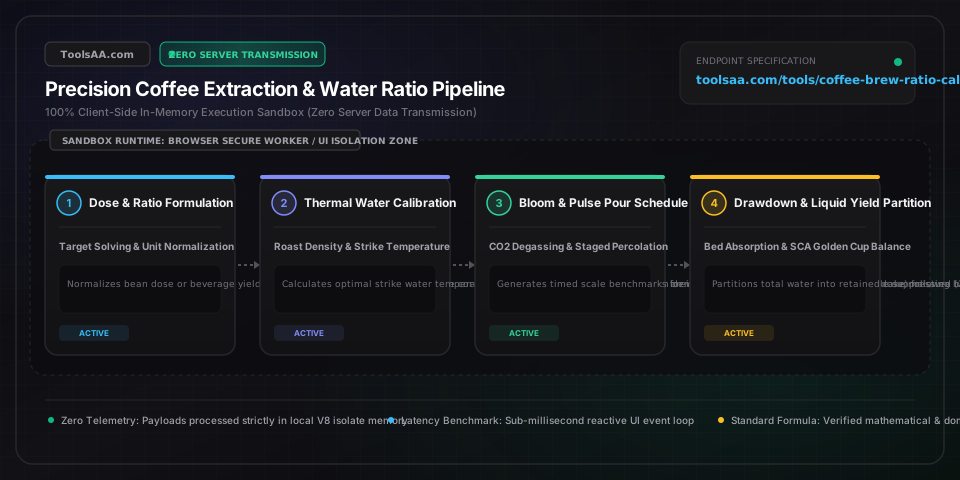
Pro Tips & Best Practices

The Grounds Retention Trap (Total Pour vs Finished Mug Yield)

Never confuse total kettle water with the final volume of coffee in your mug! Dry ground coffee acts like an organic sponge, universally absorbing approximately twice its weight in water (2.0g water per 1g coffee grounds). If you pour 300g of water over 20g of coffee, exactly 40g of water remains trapped in the filter bed, yielding only 260g of drinkable liquid. If you want a full 350ml travel mug, you must pour 350 + (Coffee Dose * 2.0) = 394g of water.

Thermal Calibration by Roast Degree (Light vs Dark Physics)

Matching water temperature to bean roast density is critical for avoiding astringency. Light roasts are dense and chemically intact, requiring high thermal energy (94°C-96°C / 201°F-205°F) to dissolve crisp malic and citric acids. Conversely, dark roasts have fractured cellular matrices that easily dissolve bitter pyrolytic compounds; brew dark roasts at lower temperatures (85°C-89°C / 185°F-192°F) with a coarser grind to maintain a sweet, smoky profile without harsh bitterness.

Mastering the Bloom Phase for Uniform Extraction

Freshly roasted specialty coffee contains trapped carbon dioxide gas that repels incoming brew water and causes channeling. Always begin your pour with a Bloom Phase using 2.5x to 3x the coffee weight in water (e.g., 45g water for a 15g dose). Gently swirl or stir the slurry and allow it to degas for 40 to 45 seconds before initiating main pours. This fully saturates every grain, ensuring even water percolation and sweet extraction.

Decoding Drip Coffee Maker Cups vs Imperial Fluid Ounces

The number markings on commercial drip coffee makers (Bonavita, Moccamaster, Mr. Coffee) do NOT represent standard 8 fl oz baking cups! An automated drip coffee maker cup is an industry standard of 5 fluid ounces (approximately 148 to 150 ml). If your machine carafe has an 8 cup line, you need 1,200 ml of water and approximately 75g of coffee (at 1:16 ratio), not 64 fluid ounces (1,892 ml), which would flood the filter basket.

Dialing in Extraction with the 4:6 Method

Developed by World Brewers Cup Champion Tetsu Kasuya, the 4:6 method divides total brew water into two distinct phases: 40% and 60%. The initial 40% (split into two pours) dictates the acid-to-sweet balance—a smaller first bloom pour increases sweetness, while a larger first pour highlights sparkling acidity. The remaining 60% of water is divided into three equal pours to calibrate final brew strength and body.

Common Gotchas & Troubleshooting

⚠️Coffee Tastes Harsh, Astringent, Chalky, and Bitter in the Finish

This is the classic signature of over-extraction, where water has dissolved heavy polyphenols and bitter tannins from the bean cellulose. Fix this by: 1) Coarsening your grinder by 2 to 3 clicks, 2) Lowering kettle water temperature by 2°C to 4°C, or 3) Shortening total brew contact time by pouring in faster, larger pulses.

⚠️Coffee Tastes Weak, Sour, Grassy, or Lacks Body

Sourness and vegetal thinness indicate under-extraction, meaning water failed to dissolve the sweet sugars and caramelized compounds that balance natural organic acids. Fix this by: 1) Grinding finer to increase total surface contact area, 2) Raising strike water temperature to 95°C-96°C, or 3) Increasing your brew ratio from 1:17 to 1:15 to increase total coffee concentration.

⚠️Water Stalls in the Dripper and Drawdown Takes Over 4 Minutes

Filter bed clogging occurs when coffee fines migrate downward and blind the microscopic pores of the paper filter, or when the bed collapses from aggressive center pouring. Fix this by: 1) Grinding slightly coarser, 2) Using a burr grinder with tighter particle distribution, and 3) Pouring gently in smooth spiral motions without disturbing the bottom filter bed.

⚠️French Press Cup Is Muddy with Excessive Sludge and Silt

Fine sediment in French press coffee results from an overly fine grind or aggressive plunging that forces coffee fines around the mesh filter. Use an extra-coarse sea salt grind, let the brew steep for 4 minutes, gently break the crust and skim off foam with two spoons, wait 5 minutes for fines to settle at the bottom naturally, and insert the plunger only as a surface screen without pressing down to the bottom.

Frequently Asked Questions

What is the standard golden ratio for brewing coffee?▼

The Specialty Coffee Association (SCA) Golden Cup Standard defines the benchmark coffee-to-water ratio as 55 to 60 grams of coffee per 1,000 grams (1 liter) of water, which translates to a ratio between 1:16.6 and 1:18. For home brewing, a 1:16 ratio (1g coffee to 16g water) is widely regarded as the universal sweet spot for manual pour overs, balancing vibrant origin acidity, sweetness, and pleasant mouthfeel.

How much ground coffee do I need for a 12 oz or 16 oz mug?▼

For a standard 12 fl oz mug (355 ml), accounting for 2.0g/g grounds water absorption, use 22.5 grams of coffee and pour 400 grams of water (1:16 ratio) to yield exactly 355 ml of brewed coffee. For a larger 16 fl oz tumbler (473 ml), use 30 grams of coffee and pour 533 grams of water, which leaves 60g in the spent grounds and fills your 473 ml tumbler perfectly.

Why does my final brewed coffee weigh less than the water I poured?▼

Dry coffee grounds absorb liquid like a sponge during extraction. On average, specialty roasted coffee grounds retain approximately 2.0 times their dry weight in water within the filter bed. If you brew with 20 grams of coffee and pour 320 grams of water, roughly 40 grams of water remains trapped inside the wet coffee grounds, yielding approximately 280 grams (or ml) of drinkable brewed coffee.

How many grams of coffee are in one standard coffee maker cup?▼

Most automatic drip coffee makers (such as Mr. Coffee, Cuisinart, and Moccamaster) define one cup on their carafe markings as 5 fluid ounces (148 to 150 ml), rather than a standard 8 fl oz imperial cup. Using the SCA recommended 1:16 ratio, you need approximately 9.3 to 9.5 grams of ground coffee per 5 oz carafe line. Therefore, brewing a 10-cup pot requires approximately 93 to 95 grams of coffee and 1,500 ml of water.

What is the best coffee ratio for French press vs pour over?▼

French press uses full immersion brewing where grounds steep continuously in water, typically calling for a richer 1:14 to 1:15 ratio (e.g., 30g coffee to 450g water) to produce a bold, heavy-bodied cup. In contrast, pour-over methods (like Hario V60 or Chemex) use percolation where fresh water constantly flushes through the bed, achieving optimal flavor clarity and delicate aromatics at a leaner 1:16 to 1:17 ratio.

How do I adjust my brew ratio if the coffee is too strong or too bitter?▼

If your coffee feels overly intense or thick in mouthfeel, increase your water ratio (for instance, move from 1:15 to 1:17) to dilute the concentration. However, if the coffee tastes bitter, astringent, and dry regardless of thickness, the issue is over-extraction rather than ratio: keep your ratio the same, but coarsen your grinder setting or reduce water temperature by 2°C to 3°C to decrease dissolved tannins.

Related Tools & Utilities

All Tools →