Lbl hydration status moderate
Lbl disclaimer
Calculate your cat's exact daily calorie needs (RER & DER), wet and dry food portion split, and safe weight loss goal. Includes BCS 1-9 guide and feeding schedules.
Lbl hydration status moderate
Lbl disclaimer
Calculate your cat's exact daily calorie needs (RER & DER), wet and dry food portion split, and safe weight loss goal. Includes BCS 1-9 guide and feeding schedules.
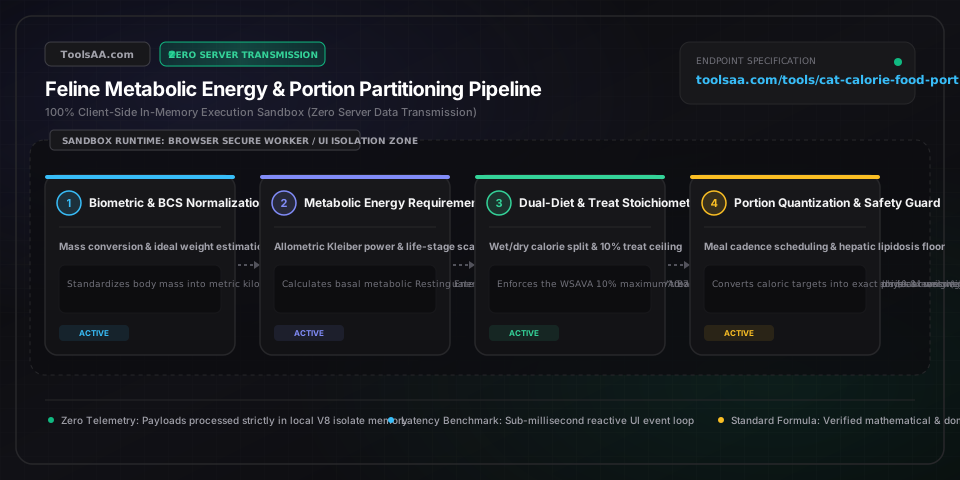
The basal energy consumed by a cat at complete physical rest in a thermoneutral environment. Calculated via the allometric Kleiber power equation RER = 70 * (BW in kg)^0.75, accounting for the non-linear relationship between mammalian body surface area and cellular metabolic mass.
Total daily metabolizable energy needed for maintenance, thermoregulation, digestion, and physical activity. Computed as RER multiplied by life-stage factors (1.0 for indoor/inactive, 1.2 for neutered adult, 1.4 for intact adult, 0.8 for safe weight loss, 2.0-3.0 for kittens).
Standardized veterinary scale evaluating subcutaneous fat cover over ribs, lumbar vertebrae, and abdominal fat pad. BCS 5 is optimal (ideal weight); each 1-point deviation above or below 5 represents approximately 10% excess or deficit in body mass.
The proportion of total daily non-treat calories sourced from commercial wet canned food versus dry extruded kibble. Wet food provides approximately 75-82% moisture, promoting urinary tract health, while dry food delivers concentrated energy density (3,200 to 4,200 kcal/kg).
World Small Animal Veterinary Association nutritional guideline establishing that treats, table scraps, and food toppers must not exceed 10% of total daily calories. Exceeding 10% risks diluting essential vitamins, minerals, taurine, and arachidonic acid, causing subclinical nutritional imbalances.
Safe clinical rate of weight reduction in overweight cats, calibrated between 0.5% and 2.0% of total body weight lost per week (ideal 1.0%/week). Restricting calories beyond 2.0%/week dramatically elevates the risk of life-threatening Feline Hepatic Lipidosis.
Unlike humans or canines, cats have a unique hepatic lipid metabolism that cannot mobilize peripheral fat stores safely under severe starvation. When an overweight cat experiences rapid calorie deprivation, excessive non-esterified fatty acids flood the liver, causing severe triglyceride accumulation, liver failure, and jaundice (Feline Hepatic Lipidosis). Never restrict a cat's daily intake below 70% of their Resting Energy Requirement (RER) or allow them to lose more than 2% of body weight per week.
Volumetric dry measuring cups introduce massive dosing errors of 20% to 35% due to varying kibble shapes, settling compaction, and rounded scoops. In a 10-lb cat whose entire daily maintenance allowance is only 200 calories, a surplus of just 10 grams of dry kibble (about 38 calories) amounts to a 19% caloric excess, causing steady weight gain of 1 to 2 pounds annually. Always weigh kibble in grams on a digital kitchen scale.
Cats evolved as desert carnivores with a naturally low thirst drive, obtaining over 70% of their hydration directly from prey. Cats fed exclusively dry kibble (which contains under 10% moisture) drink more water but still remain in a state of chronic sub-clinical dehydration compared to wet-fed cats. Feeding at least 50% wet canned food dilutes urine specific gravity, prevents crystal formation (struvite and calcium oxalate), and reduces FLUTD and idiopathic cystitis flare-ups.
High-palatability treats like Churu squeeze tubes (approx. 6 kcal per 14g tube) and Temptations crunchy treats (approx. 2 kcal per piece) add up quickly. Feeding three Churu tubes and ten crunchy biscuits adds 38 calories—nearly 20% of an indoor cat's total daily energy budget. Aside from weight gain, commercial treats lack complete and balanced AAFCO trace mineral profiles; keeping treats strictly below 10% of daily calories guarantees essential micronutrient adequacy.
Cats develop strong early dietary textural neophobia. Transition gradually over 10 to 14 days: warm the wet food slightly to body temperature (38°C / 100°F) to volatilize enticing meat aromas, stir in a teaspoon of warm water or low-sodium chicken bone broth, or sprinkle crushed freeze-dried chicken or nutritional yeast over the wet food. Never starve a cat to force them to eat wet food.
Caloric density reduction often leaves the stomach volume underfilled. Shift the mixed diet ratio toward higher wet canned food (which has 3 to 4 times the volume of dry kibble for the same calories due to 78% moisture content), increase feeding frequency to 3 or 4 small meals per day, or use puzzle feeders and lick mats to slow consumption and stimulate dopamine release from natural foraging behavior.
As a cat loses weight, their basal metabolic mass decreases and non-exercise activity thermogenesis (NEAT) drops, leading to an adaptive metabolic plateau. Recalculate RER using the cat's new lower weight, audit all hidden family treats and stolen food from other pets, and ensure you are measuring portions with a digital gram scale rather than visual cup estimates. If plateau persists for over 3 weeks, decrease daily calories by an additional 5% to 10% under veterinary supervision.
Separate feeding zones into different rooms with closed doors during scheduled meal times, or invest in microchip-activated selective pet feeders (such as SureFeed) that open only for the programmed pet's RFID collar tag or subcutaneous microchip. Avoid free-feeding dry food in multi-cat homes, as dominant cats will invariably overeat while submissive cats under-eat.
A typical indoor neutered adult cat weighing 10 pounds (4.5 kg) needs approximately 180 to 200 calories (kcal) per day to maintain healthy body weight. The exact requirement depends on lean body mass, age, and activity level, calculated using the veterinary formula: Daily Energy Requirement = 1.2 * [70 * (weight in kg)^0.75]. Inactive or obesity-prone indoor cats may only require 150 to 170 kcal/day (1.0 * RER), while active young cats may need 220 kcal/day.
To feed a balanced 50/50 mixed diet to an average 10-lb cat needing 200 kcal/day: allocate 100 kcal to wet food and 100 kcal to dry kibble. For a standard 3-ounce can containing 75 kcal, this equals approximately 1 and 1/3 cans of wet food per day, combined with about 26 grams (roughly 1/4 cup) of typical 380 kcal/cup dry kibble. Adjust these exact quantities based on the specific guaranteed caloric analysis on your pet food labels.
An overweight cat should lose between 0.5% and 2.0% of their total body weight per week, with 1.0% per week being the clinical gold standard. For example, a 14-pound cat should lose no more than 0.14 pounds (about 2.2 ounces or 63 grams) per week. Losing weight faster than 2.0% per week triggers rapid mobilization of peripheral body fat to the liver, predisposing the cat to life-threatening Feline Hepatic Lipidosis (fatty liver syndrome).
Resting Energy Requirement (RER) is calculated using Kleiber's exponential allometric equation: RER = 70 * (Weight in kg)^0.75. To find Daily Energy Requirement (DER), multiply RER by the cat's physiological life-stage factor: 1.2 for neutered adults, 1.4 for intact adults, 1.0 for inactive indoor cats prone to weight gain, 0.8 for overweight cats on a weight loss program, and 2.0 to 2.5 for growing kittens. For example, a 4 kg (8.8 lb) neutered cat has an RER of 70 * (4)^0.75 = 198 kcal, resulting in a DER of 198 * 1.2 = 237 kcal/day.
Measuring cat food in grams on a digital kitchen scale is significantly more accurate than using volumetric measuring cups. Dry kibble varies in shape, density, and air gaps, causing cup measurements to vary by up to 25% to 35% per scoop. Because an average cat only consumes around 40 to 50 grams of kibble per day, an error of just 10 extra grams adds nearly 40 calories—enough to cause a 10-lb cat to gain 1 to 2 pounds of excess body fat over a single year.
A standard 14-gram Churu puree squeeze tube contains approximately 6 calories (kcal). A Feline Greenies dental treat contains about 1.5 calories per piece, while crunchy treats like Temptations contain approximately 2 calories per piece. Freeze-dried pure meat treats (like PureBites chicken) average 3 calories per piece. To maintain nutritional balance and prevent micronutrient dilution, treats must never exceed 10% of your cat's total daily caloric allowance (under 20 kcal per day for an average adult cat).
Calculate optimal ergonomic desk and chair height for sitting or standing desks based on body height, posture angles, footwear, and armrest clearance.
Calculate caffeine half-life, bloodstream decay, and sleep impact. Track multi-dose intake, CYP1A2 metabolism, adenosine block, and bedtime cutoff times.
Calculate exact lawn fertilizer spreader settings, pounds per 1,000 sq ft, and bags needed based on N-P-K grade, turf area, and spreader calibration pass rates.
Calculate your bench press one rep max (1RM) instantly using Brzycki, Epley, and Lombardi formulas. Get your percentage chart, plate loading, and RPE goals.
Calculate your daily calorie deficit and target calories for healthy weight loss. Compute BMR, TDEE, macro splits, and projected goal timeline with precision.
Generate professional, client-ready freelance invoices in seconds with instant vector PDF download, multi-currency support, tax and reverse-charge calculations, embedded EPC payment QR codes, and a reverse net target solver.