Caffeine Half Life Calculator (Sleep) Guide
Calculate caffeine half-life, bloodstream decay, and sleep impact. Track multi-dose intake, CYP1A2 metabolism, adenosine block, and bedtime cutoff times.
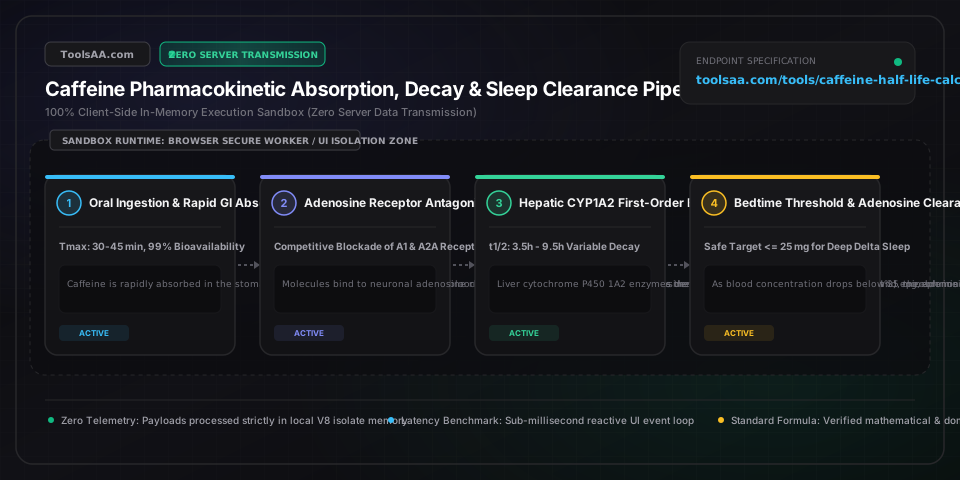
Key Parameters & Controls
The duration required for plasma caffeine concentration to be metabolized by 50% via hepatic cytochrome P450 1A2 (CYP1A2) enzymes. Normal healthy adult half-life averages 4.5 to 5.5 hours, but individual rates vary from 2.5 to over 10 hours based on genetics, medications, and pregnancy.
Total active caffeine quantity ingested per beverage or supplement. Standard reference values include: 8 oz brewed coffee (95 mg), 1 oz single espresso (63 mg), 12 oz energy drink (160 to 200 mg), 8 oz green tea (35 to 50 mg), and standard pre-workout scoops (200 to 350 mg).
Caffeine is rapidly and completely absorbed through the stomach and small intestine with 99% bioavailability. Peak plasma concentration (Tmax) is reached between 30 and 60 minutes post-ingestion on an empty stomach, or 60 to 90 minutes when consumed with a high-protein or fibrous meal.
The maximum permissible active bloodstream caffeine quantity at bedtime to avoid altering sleep architecture. Clinical polysomnography indicates levels above 25 mg can delay sleep latency by 20 to 40 minutes, while levels exceeding 50 mg significantly suppress deep slow-wave delta sleep.
Apparent volume of distribution representing how caffeine disperses throughout total body water. Hydrophilic and lipophilic properties give caffeine a mean Vd of 0.65 L/kg (approximately 45 to 50 liters in a 75 kg adult), allowing rapid crossing of the blood-brain barrier.
CYP1A2 accounts for approximately 95% of caffeine metabolism into paraxanthine (84%), theobromine (12%), and theophylline (4%). Oral contraceptives and selective serotonin reuptake inhibitors (fluvoxamine) competitively inhibit CYP1A2, whereas polycyclic aromatic hydrocarbons from smoking induce clearance.
Pro Tips & Best Practices
With an average 5-hour half-life, a single 100 mg morning cup of coffee requires 10 full hours (2 half-lives) to decay down to 25 mg, and 15 hours (3 half-lives) to reach an undetectable 12.5 mg. If your scheduled sleep time is 10:30 PM, consuming a 150 mg latte or energy drink after 1:00 PM ensures you go to bed with over 40 mg of active caffeine circulating through your brain, cutting restorative Stage 3/4 deep sleep by up to 30%.
Caffeine exhibits linear first-order elimination kinetics, meaning multiple doses throughout the day do not clear independently—they stack via superposition. An 8:00 AM coffee (150 mg) still leaves 37.5 mg in your blood at 2:00 PM; adding a 2:00 PM espresso (126 mg) pushes your peak afternoon level to 163.5 mg. By 10:00 PM, over 54 mg remains active, creating chronic evening restlessness.
Caffeine does not generate biological energy; it acts as a competitive antagonist that plugs adenosine receptors without activating them, while adenosine continues to accumulate behind the biochemical blockade. As liver CYP1A2 enzymes clear circulating caffeine, unblocked receptors are suddenly flooded by the backlog of accumulated adenosine, causing the notorious 3:00 PM energy crash. Hydrating and delaying your first cup 90 minutes after waking allows natural cortisol to clear baseline morning adenosine.
Exogenous estrogens and progestins present in combined oral contraceptive pills significantly downregulate hepatic CYP1A2 enzyme transcription. Clinical pharmacokinetics confirm that birth control pills extend caffeine half-life from 5.0 hours to 8.5–10.5 hours. Furthermore, during the third trimester of pregnancy, caffeine clearance can slow to a 11–15 hour half-life, meaning a morning coffee remains active in the maternal and fetal circulation overnight.
Common Gotchas & Troubleshooting
⚠️Feeling jittery and anxious despite drinking a normal single cup of coffee
You may possess the slow-metabolizing CYP1A2*1F allele or the ADORA2A (adenosine A2A receptor) genetic polymorphism associated with caffeine-induced anxiety. Switching to l-theanine co-administration (such as in ceremonial matcha) or reducing serving sizes to 40-50 mg avoids saturating central nervous system adenosine receptors while mitigating acute tachycardia.
⚠️Falling asleep easily after evening coffee but waking up exhausted and groggy
High caffeine tolerance can mask perceived wakefulness, allowing you to fall asleep even with 60 mg in your bloodstream. However, polysomnographic sleep studies prove that circulating caffeine actively suppresses delta-frequency slow-wave deep sleep and disrupts REM sleep architecture, leaving you physiologically unrecovered despite 8 hours in bed.
⚠️Pre-workout energy supplement causing insomnia even after intense evening gym training
High-stimulant pre-workout supplements typically contain 250 to 350 mg of anhydrous caffeine plus synergistic stimulants (synephrine, theacrine, yohimbine). Ingesting 300 mg at 5:30 PM with a standard 5-hour half-life leaves 140 mg in your body at 11:00 PM bedtime—the equivalent of drinking a full mug of black coffee right before shutting your eyes. Restrict pre-workouts to morning sessions or switch to non-stimulant nitric oxide pump formulas after 2:00 PM.
⚠️Calculated decay timeline does not match personal subjective alertness
Subjective alertness is driven by both caffeine pharmacokinetics (blood concentration) and pharmacodynamics (adenosine receptor density, circadian rhythm phase, and prior sleep debt). If sleep-deprived, adenosine pressure is drastically elevated, so even high caffeine levels provide only brief masking before overwhelming sleep pressure dominates.
Frequently Asked Questions
How long does caffeine stay in your system?▼
In healthy adults, caffeine has an average elimination half-life of 5 hours, with a normal clinical range between 3 and 7 hours. It takes approximately 5 half-lives (24 to 30 hours) for 97% of a single caffeine dose to be completely cleared from the human body. However, noticeable physiological and sleep-disrupting effects persist for 10 to 12 hours after consumption.
What is the formula to calculate caffeine half-life?▼
Caffeine elimination follows first-order decay modeled by the exponential equation: C(t) = C0 * (0.5)^(t / t1/2), where C(t) is the remaining caffeine amount in milligrams, C0 is the initial ingested dose, t is the elapsed time in hours, and t1/2 is your individual metabolic half-life (standard average is 5.0 hours). For example, 100 mg after 10 hours with a 5-hour half-life yields: 100 * (0.5)^(10 / 5) = 100 * 0.25 = 25 mg.
How much caffeine can I have before bed without ruining sleep?▼
Sleep medicine specialists recommend having no more than 20 to 25 milligrams of active caffeine in your bloodstream at bedtime. Controlled sleep lab trials show that active levels above 25 mg prolong sleep onset latency by 15 to 30 minutes, while levels exceeding 50 mg cut restorative Stage 3 slow-wave deep sleep by up to 30% and reduce overall sleep efficiency.
Why does caffeine affect some people longer than others?▼
Caffeine clearance is primarily controlled by the CYP1A2 gene in the liver. Individuals with the -163C>A 'rapid' AA genotype metabolize caffeine nearly twice as fast as those with the CC 'slow' genotype. Additionally, medications like oral birth control pills double half-life (up to 10 hours), pregnancy prolongs clearance up to 15 hours, while cigarette smoking accelerates liver enzyme activity and shortens half-life to 3 hours.
What is the reverse caffeine sleep cutoff time?▼
The reverse caffeine sleep cutoff time is the latest clock hour you can finish a caffeinated beverage and still reach a safe bedtime threshold (<= 25 mg). The formula is: Cutoff Time = Bedtime - [t1/2 * log2(Dose / 25)]. For an 11:00 PM bedtime with a 5-hour half-life, your cutoff is 1:00 PM for an 8 oz coffee (100 mg), 11:00 AM for a strong cold brew (200 mg), and 8:00 AM for a 300 mg pre-workout.
How do multiple cups of coffee stack in the bloodstream?▼
Disclaimer: This tool is provided strictly for educational and informational purposes only and does not constitute formal financial advice or a binding loan commitment. Please consult a qualified financial advisor before making decisions. Caffeine doses stack through pharmacokinetic superposition. When you consume a second beverage before the first is eliminated, the remaining caffeine adds directly to the new dose. For example, if you drink 100 mg at 8:00 AM (leaving 44 mg at 2:00 PM) and add a 100 mg espresso at 2:00 PM, your new bloodstream peak becomes 144 mg, pushing your complete clearance time well past midnight.
Related Tools & Utilities
All Tools →Calculate exact lawn fertilizer spreader settings, pounds per 1,000 sq ft, and bags needed based on N-P-K grade, turf area, and spreader calibration pass rates.
Calculate your bench press one rep max (1RM) instantly using Brzycki, Epley, and Lombardi formulas. Get your percentage chart, plate loading, and RPE goals.
Calculate your daily calorie deficit and target calories for healthy weight loss. Compute BMR, TDEE, macro splits, and projected goal timeline with precision.
Generate professional, client-ready freelance invoices in seconds with instant vector PDF download, multi-currency support, tax and reverse-charge calculations, embedded EPC payment QR codes, and a reverse net target solver.
Calculate mulch and gravel volume in cubic yards, tons, and bags. Features multi-zone area math, depth settling, compaction factors, and bulk vs bag cost solver.
Convert luggage weight instantly between kg, lbs, stone, and oz. Check 50 lb and 23 kg airline baggage limits, overweight fee risk, and packing allowances.