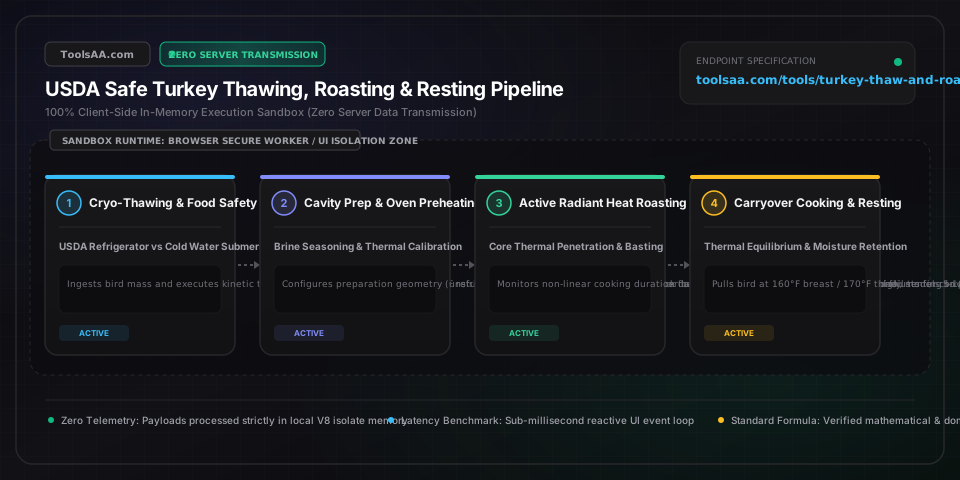
Title control deck
Hint resting
Lbl thermometer visual
Lbl usda safe target- • Tip1
- • Tip2
- • Tip3
Msg safety alert
Disclaimer text
Calculate USDA turkey thaw times, oven roast duration, resting carryover, and Thanksgiving dinner countdown schedule for stuffed, unstuffed, and spatchcock birds.
Hint resting
Msg safety alert
Disclaimer text
Calculate USDA turkey thaw times, oven roast duration, resting carryover, and Thanksgiving dinner countdown schedule for stuffed, unstuffed, and spatchcock birds.
Total gross weight of the whole raw or frozen turkey carcass as labeled from the grocery store or butcher, including bones and neck cavity.
Culinary cooking method impacting heat transfer rates: traditional unstuffed 325°F roasting, dense cavity stuffing, high-heat 425°F spatchcocking, or fan-assisted convection.
Safe method utilized to thaw poultry: continuous 40°F refrigerator holding (~24 hours per 4-5 lbs) or rapid cold water submersion (~30 minutes per lb with water changes).
Calibrated temperature of the oven cavity. The USDA standard reference temperature is 325°F (163°C), with spatchcock recipes utilizing 425°F (218°C).
Scheduled dinner time when guests sit down to eat, functioning as the zero-hour anchor to calculate all preceding prep, roasting, and thawing start times.
Essential resting interval post-oven where carryover residual heat raises internal temperatures 5°F to 10°F while allowing muscle fibers to relax and retain moisture.
Number of dinner attendees utilized by the yield engine to compute gross carcass requirements, net edible carved meat, and surplus leftover portions.
Optional salt seasoning treatment: dry salting 24-48 hours in advance for crisp skin and deep seasoning, or submerged liquid wet brining for 12-24 hours.
Never keep a turkey in the oven until the breast thermometer reads 165°F (74°C). Large poultry retains substantial thermal momentum; internal core temperatures continue rising 5°F to 10°F (3°C to 6°C) while resting tented under aluminum foil. Pull your turkey out of the oven when the thickest part of the breast registers 158°F to 160°F (70°C to 71°C) and the dark thigh meat hits 170°F (77°C). During the 30-minute rest, it will coast upward to a safe, impeccably juicy 165°F equilibrium.
Never thaw a frozen turkey at room temperature on the kitchen counter, in a garage, or in warm water. While the deep interior core remains frozen solid, the outer perimeter and skin enter the food safety Danger Zone (40°F to 140°F / 4.4°C to 60°C) within hours, allowing Salmonella and Campylobacter bacteria to multiply rapidly to dangerous levels. Always allocate 1 full calendar day in the refrigerator for every 4 to 5 pounds of turkey.
Spatchcocking (removing the backbone with poultry shears and flattening the breastbone) converts a bulky 3D sphere into a flat 2D plane. This exposes the dark thigh meat directly to radiant heat while tucking the delicate white breast meat into the cooler center. Roasted at 425°F (218°C), a 14-pound bird cooks completely in only 75 to 85 minutes, producing 100% shatteringly crisp skin and guaranteeing the white and dark meats reach doneness simultaneously.
If you are caught on Thanksgiving morning with a frozen bird, submerge the turkey in its original leak-proof plastic packaging inside a clean sink or large cooler filled with cold tap water. The water must be drained and replaced every 30 minutes to ensure it remains below 40°F (4.4°C). Budget exactly 30 minutes per pound (an 8-hour process for a 16-pound turkey), and transfer the bird directly into the roasting pan immediately upon completion.
To verify true doneness, test three distinct zones with an instant-read digital probe thermometer: (1) The deepest central muscle of the breast, avoiding bone contact; (2) The inner thigh joint near the body, which requires 175°F (79°C) to dissolve tough collagen and sinew; and (3) The exact geometric center of the cavity stuffing, which must register at least 165°F (74°C) to kill any bacterial drippings from raw poultry juices.
Do not panic or attempt to microwave the bird. Immediately switch to the USDA Cold Water Submersion protocol: place the turkey in cold tap water, weighing it down with a heavy bowl so it remains completely submerged, and change the water every 30 minutes. If running out of time, you can safely roast a partially frozen turkey at 325°F; expect cooking time to increase by approximately 25% to 50%, and remove the giblet bag with tongs as soon as the cavity thaws enough to access it.
This occurs when oven radiant heat or butter basting accelerates surface Maillard browning and sugar caramelization faster than internal heat penetrates. Create a loose shield of aluminum foil ('tenting') and drape it lightly over the breast and top of the drumsticks. This reflects direct radiant thermal rays while allowing convective airflow to continue cooking the deep interior meat until probe targets are reached.
Never serve undercooked cavity stuffing, as it has absorbed raw poultry drippings during cooking. Immediately remove the turkey from the oven, scoop the warm stuffing out of the bird cavity into a greased oven-safe casserole dish, cover with foil, and bake it independently at 350°F (177°C) for 15 to 20 minutes until the center safely hits 165°F (74°C). Meanwhile, allow the turkey to complete its mandatory resting window.
The bird was carved too quickly without adequate resting. High oven temperatures build internal hydraulic pressure, driving muscle cell moisture outward toward the periphery. Resting for 30 to 45 minutes tented with foil allows internal muscle proteins to relax, reabsorbing and redistributing moisture throughout the carcass. Always carve parallel to muscle grain and spoon any cutting board juices over the platter before serving.
According to USDA food safety guidelines, you must allow approximately 24 hours of refrigerator thawing time for every 4 to 5 pounds of whole frozen turkey when held at a constant temperature of 35°F to 40°F (1.7°C to 4.4°C). For example, a 12-pound turkey requires approximately 3 full days, a 15-pound turkey requires 3 to 4 days, and a 20-pound bird requires 4 to 5 full days. Once completely thawed, the bird can safely remain in the refrigerator for an additional 1 to 2 days before roasting.
In a conventional oven preheated to 325°F (163°C), an unstuffed whole turkey cooks at an average rate of 13 to 15 minutes per pound. Smaller birds (8 to 12 pounds) require approximately 15 to 16 minutes per pound (2.75 to 3.0 hours total), medium birds (12 to 16 pounds) require 13 to 15 minutes per pound (3.5 to 4.0 hours total), and large birds (16 to 20 pounds) require 12 to 14 minutes per pound (4.0 to 4.5 hours total). Always rely on a calibrated probe thermometer rather than strict clock time.
You should pull the turkey from the oven when the thickest part of the breast registers 158°F to 160°F (70.0°C to 71.1°C) and the thickest portion of the inner thigh registers 170°F (76.7°C). Because of thermal mass and carryover cooking, the internal temperature will rise an additional 5°F to 10°F during the 30-minute foil-tented resting period, settling cleanly at the USDA food safety threshold of 165°F (73.9°C) in the breast and 175°F (79.4°C) in the thigh without drying out.
The culinary standard for whole bone-in turkey is 1.25 pounds of raw carcass weight per person for a generous holiday dinner with modest leftovers. If your family loves day-after turkey sandwiches, pot pies, and turkey soup, budget 1.5 to 1.75 pounds per person. For example, a gathering of 10 adults requires a 12 to 15 pound turkey, while a large holiday party of 16 guests calls for a 20 to 24 pound bird (or two smaller 12-pound birds for faster, more uniform cooking).
Yes, cold water submersion is dramatically faster, thawing poultry in hours rather than days. Cold water defrosting requires approximately 30 minutes per pound, meaning a 16-pound turkey thaws in 8 hours compared to 4 full days in the refrigerator. However, cold water thawing requires continuous attention: the turkey must be sealed in a watertight plastic bag, fully submerged, and the water must be drained and refilled every 30 minutes to maintain safety. Once thawed, the turkey must be cooked immediately.
Calculate exact chilling times for beer, wine, cans, and bottles in the freezer, fridge, or ice bath. Features explosion safety timers and rapid chill hacks.
Compare grocery unit prices side-by-side across sizes, packs, and brands. Factor in BOGO deals, coupons, and spoilage waste to find the true lowest cost.
Calculate your cat's exact daily calorie needs (RER & DER), wet and dry food portion split, and safe weight loss goal. Includes BCS 1-9 guide and feeding schedules.
Calculate optimal ergonomic desk and chair height for sitting or standing desks based on body height, posture angles, footwear, and armrest clearance.
Calculate caffeine half-life, bloodstream decay, and sleep impact. Track multi-dose intake, CYP1A2 metabolism, adenosine block, and bedtime cutoff times.
Calculate exact lawn fertilizer spreader settings, pounds per 1,000 sq ft, and bags needed based on N-P-K grade, turf area, and spreader calibration pass rates.