Grocery Unit Price & Bulk Comparison

Grocery Unit Price & Bulk ComparisonBadge spec

Compare grocery unit prices side-by-side across sizes, packs, and brands. Factor in BOGO deals, coupons, and spoilage waste to find the true lowest cost.

Lbl presets prefix
Status off
Lbl velocity:
Kpi winner title$0.2675/oz

Family Size Box (28 oz)

Club Pantry Value • $7.49 Lbl net paid (28.00 oz)

Kpi savings worst+33.0%
Kpi savings median
+33.0%

Lbl vs winner Regular Box (12 oz)

Unit price spread$0.1317/oz
Lbl annual savings
$6.85/Unit year

$0.57/Unit month • $34.23 Lbl in five years

Lbl five year compounded$38.31

Chart title

Chart subtitle $/oz (Lbl effective cost)

Legend best valueLegend mid tierLegend worstLegend spoilage drag
Regular Box (12 oz)$0.3992/oz+49.2%Family Size Box (28 ...$0.2675/ozSvg winner badge

Lbl arena title (2/6)

1Regular Box (12 oz)
Lbl total volume:12.00 oz
Lbl spoilage0%
Lbl nominal cost
$0.3992/oz
+49.2%
2Family Size Box (28 oz)Best deal
Lbl total volume:28.00 oz
Lbl spoilage0%
Lbl nominal cost
$0.2675/oz
Badge best value
Col rankCol itemCol shelf priceCol net paidCol pack volume (oz)Col nominal unit costCol spoilage rateCol effective unit costCol delta vs winner
#1
Family Size Box (28 oz)
Club Pantry Value
$7.49$7.4928.00$0.26750%$0.2675Lbl baseline
#2
Regular Box (12 oz)
Standard Cereal Co.
$4.79$4.7912.00$0.39920%$0.3992+49.2%
Stat items compared2 Unit packages
Stat max spread+33.0%
Stat best unit cost$0.2675/oz

Client-Side Processing

High-performance calculation executed entirely in browser memory.

Zero Server Upload Privacy

All payloads remain strictly local with zero external server communication.

Production Ready Export

Clean, optimized output formats ready for immediate deployment.

Disclaimer title

Disclaimer text
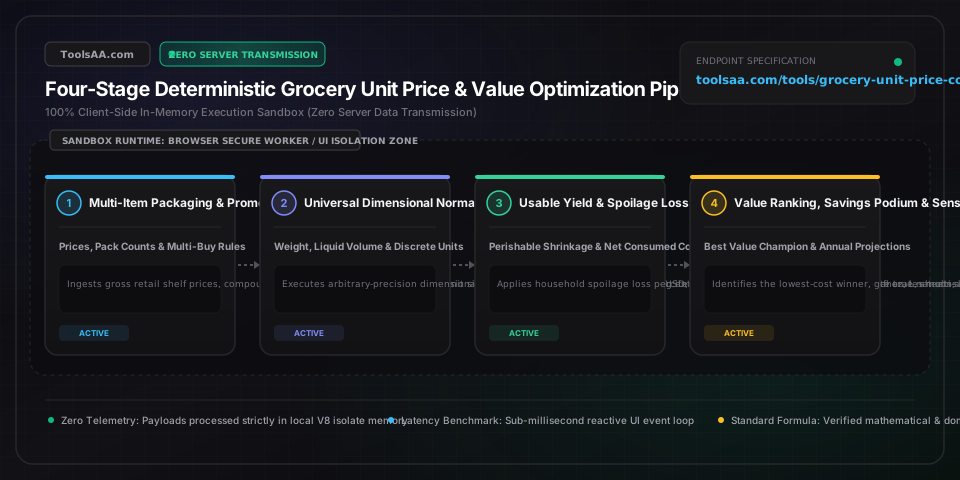
Technical Reference & Architecture Guide

Grocery Unit Price & Bulk Comparison Guide

Compare grocery unit prices side-by-side across sizes, packs, and brands. Factor in BOGO deals, coupons, and spoilage waste to find the true lowest cost.

Grocery Unit Price & Bulk Comparison Guide — Client-Side In-Memory Architecture & Data Flow

Key Parameters & Controls

Retail Shelf Price (P)currency amount ($ / € / £ / ¥)

Total monetary purchase price displayed on the store shelf tag or e-commerce listing prior to promotional discounts, coupons, or applicable sales taxes.

Default: $4.99 (Regime-Adaptive)
Package Measure Quantity (Q)numerical unit magnitude (oz, lb, g, kg, fl oz, L)

Net weight, fluid volume, or piece count of consumable product contained within an individual retail container, excluding packaging tare weight.

Default: 16.00 oz / 500.00 g
Multi-Pack Container Count (N_pack)integer multiplier (units / cases)

Number of individual units packaged together in a bundled or case purchase (e.g., 6-pack of 12 fl oz cans = 72 fl oz total net volume).

Default: 1 (Single Container Baseline)
Promotional Deal Structure (D_promo)discount architecture (BOGO / % / $)

Contractual retail promotion applied at checkout, including Buy One Get One Free (BOGO), Buy 1 Get 1 50% Off, manufacturer coupons, and store loyalty club markdowns.

Default: None (Standard Shelf Price)
Perishable Spoilage & Waste Factor (W_spoil)loss percentage rate (%)

Estimated proportion of food or perishable merchandise discarded before consumption due to expiration, rotting, or inedible trim (such as meat bones or fruit rinds).

Default: 0.00% (Non-Perishable Baseline)
Normalized Standard Unit Price (UP_norm)currency per standard unit ($/oz, $/lb, $/100g, $/load)

True economic cost expressed per standardized baseline unit of measure, enabling objective side-by-side financial comparison regardless of packaging size differences.

Default: $0.312 / oz ($4.99 / lb)
Effective Consumed Unit Cost (UP_eff)currency per consumed unit ($)

Realized unit price adjusted for perishable waste: Effective Cost = Net Price Paid / (Total Quantity * (1 - Spoilage Rate)). Measures actual money spent per eaten ounce.

Default: $0.312 / oz (Zero Spoilage Baseline)

Pro Tips & Best Practices

The 'Double Roll' Illusion: Always Standardize Paper Goods to Price Per 100 Sheets or Square Feet

Paper towel and toilet paper manufacturers use arbitrary marketing buzzwords like 'Double Roll', 'Mega Roll', and 'Super Mega Roll' that vary drastically between brands. A 'Mega Roll' from one manufacturer may contain 284 sheets, while a competitor's contains 360 sheets. Always ignore roll counts and calculate the price per 100 sheets or price per total square foot. When comparing 1-ply vs 2-ply, divide the 2-ply sheet count by 2 to determine the true normalized fiber density per dollar.

The Perishable Bulk Discount Paradox: How 20% Food Waste Wipes Out a 15% Bulk Savings

Buying bulk produce, dairy, and bakery items at wholesale clubs frequently creates a negative return on investment. If a 1 lb package of fresh spinach costs $3.00 ($0.187/oz) and a 2.5 lb bulk clamshell costs $6.00 ($0.150/oz), the bulk pack appears to offer a 20% discount. However, if your household discards just 25% of the bulk spinach due to slime and wilting, your effective usable volume drops to 1.875 lbs (30 oz). You paid $6.00 for 30 consumed ounces, or $0.200/oz—making the 'discount' bulk pack 7% more expensive than the small container.

Decode Supermarket BOGO Promos: 'Buy 1 Get 1 Free' vs 'Buy 1 Get 1 50% Off'

Never assume all BOGO promotions are equal. 'Buy 1 Get 1 Free' provides an exact 50% discount per unit (provided you need both units), reducing unit cost by half. In contrast, 'Buy 1 Get 1 50% Off' provides only a 25% overall discount (paying 150% of retail for 2 items). Furthermore, check store policy: in many grocery chains (such as Publix in select states), BOGO items ring up individually at half price, meaning you can buy just one item and still receive the full 50% unit discount without overbuying.

Concentrated Formulas Distort Volume: Measure Laundry Detergent by Cost Per Load, Not Fluid Ounces

Liquid and powder laundry detergents are formulated at different concentration ratios (e.g., 2X, 4X, or ultra-concentrated). Comparing two detergents by price per fluid ounce is fundamentally misleading because a 100 fl oz bottle of 2X detergent might wash 64 loads (1.56 fl oz/load), whereas a 60 fl oz bottle of 4X detergent washes 80 loads (0.75 fl oz/load). Always calculate unit price as Cost per Wash Load (Price / Recommended Loads) to determine actual cleaning cost per cycle.

Common Gotchas & Troubleshooting

⚠️Comparing liquid volume to dry weight creates inaccurate cost comparisons (fluid ounces vs dry ounces)

Fluid ounces (fl oz) measure volumetric capacity (liquid space), whereas dry ounces (oz) measure physical mass/weight. A fluid ounce of water weighs approximately one dry ounce, but denser liquids (honey, maple syrup, cooking oils) have significantly different mass-to-volume ratios. Never compare a product labeled in fluid ounces directly to one labeled in net weight ounces without converting through density, or ensure you select the Liquid Volume category for beverages and Weight for solid foods.

⚠️Package claims 'Double Roll' or 'Mega Roll' with inconsistent sheet counts between brands

Manufacturers do not adhere to any standardized legal definition for 'Double' or 'Mega' rolls. A single roll benchmark can range anywhere from 70 to 100 sheets depending on the brand and ply count. To eliminate marketing distortion, switch the Unit selector to 'Sheets' and enter the compound calculation: Multi-Pack Count (number of rolls) multiplied by Sheets per Roll (found on the front package fine print), then compare based on price per 100 sheets.

⚠️Supermarket shelf tags display conflicting reference units (such as $/lb vs $/each or $/100g vs $/kg)

Grocery retailers frequently display unit prices using disparate metrics across competing brands to make price comparison difficult (e.g. pricing bulk apples at $1.99/lb while pre-bagged apples are priced at $4.99/bag with no weight prominent, or displaying €/100g on brand names and €/kg on store brands). Input the total package weight into this calculator to normalize both items to the identical standard baseline unit ($/lb, $/oz, or $/kg).

⚠️Warehouse club bulk savings fail to offset annual membership renewal fees

To justify a $65.00 annual Costco or $50.00 Sam's Club membership, your annual unit price savings across all purchased items must exceed the annual fee. If buying bulk paper towels saves you $0.02 per 100 sheets ($3.00 per 12-pack), you must purchase 22 bulk packs per year on that item alone to break even. Use the Warehouse Club Membership Break-Even tab to audit your annual purchase volume and ensure your cumulative savings surpass membership dues.

Frequently Asked Questions

How do you calculate grocery unit price?▼

Grocery unit price is calculated by dividing the total retail price of the item by the total quantity or volume of product it contains: Unit Price = Total Price / Total Quantity. For example, if a 24-ounce box of cereal costs $4.80, the unit price is $4.80 / 24 oz = $0.20 per ounce. If comparing across different units (such as pounds and ounces), first convert all items to the same measurement unit (1 lb = 16 oz).

What is the formula to compare two grocery prices of different sizes?▼

To compare two different sizes, convert both packages to the same reference unit (such as price per ounce or price per 100 grams): Unit Price A = Price A / Quantity A, and Unit Price B = Price B / Quantity B. The Percentage Savings of the cheaper item is calculated as: Savings (%) = ((Higher Unit Price - Lower Unit Price) / Higher Unit Price) * 100. For example, if Brand A is $0.25/oz and Brand B is $0.20/oz, Brand B saves (($0.25 - $0.20) / $0.25) * 100 = 20.0%.

Is buying bulk groceries always cheaper than regular sizes?▼

No. While bulk packages often have a lower unit price, two common factors negate the savings: (1) Perishable spoilage: if you buy a 5 lb bulk bag of produce or dairy at a 15% discount but throw away 20% due to spoilage, your effective consumed unit price is higher than buying the smaller container; and (2) Supermarket sales cycles: a standard-size item on promotional sale (or with a coupon/BOGO offer) frequently beats the everyday wholesale club price per unit.

How do you calculate cost per load for laundry detergent?▼

Cost per load is calculated by dividing the total bottle price by the manufacturer's stated number of wash loads: Cost Per Load = Bottle Price / Number of Loads. For example, a $13.99 bottle formulated for 64 medium loads costs $13.99 / 64 = $0.219 per load. This metric is far more accurate than price per fluid ounce because concentrated formulas (2X, 4X, or pods) require significantly less liquid volume per wash cycle.

How do you calculate the unit price for Buy One Get One (BOGO) deals?▼

For 'Buy 1 Get 1 Free', the effective unit price is calculated by dividing the single item price by double the quantity: Effective Unit Price = Regular Price / (2 * Single Quantity), which equals an exact 50% discount per unit. For 'Buy 1 Get 1 50% Off', the combined price for two items is 1.5 * Single Price, so the effective unit price is (1.5 * Single Price) / (2 * Single Quantity) = 0.75 * Regular Unit Price (a 25% discount).

How do you find the unit price of toilet paper with different roll sizes?▼

Disclaimer: This tool is provided strictly for educational and informational purposes only and does not constitute formal financial advice or a binding loan commitment. Please consult a qualified financial advisor before making decisions. To find the true unit price of toilet paper, ignore roll descriptors ('Mega' or 'Double') and calculate the Cost per 100 Sheets or Cost per Square Foot: Total Sheets = Number of Rolls * Sheets per Roll, and Cost per 100 Sheets = (Total Price / Total Sheets) * 100. For example, a 12-pack with 284 sheets per roll for $14.99 has 3,408 sheets, costing ($14.99 / 3,408) * 100 = $0.440 per 100 sheets. This eliminates deceptive roll packaging marketing.

Related Tools & Utilities

All Tools →