Chilled Drink Freezer Timer (Beer & Wine)

Chilled Drink Freezer Timer (Beer & Wine)

Calculate exact chilling times for beer, wine, cans, and bottles in the freezer, fridge, or ice bath. Features explosion safety timers and rapid chill hacks.

Load Example
Sec control deck
72°F
38°F
Lbl sound chimeDesc sound chime
Kpi estimated duration44 minLbl ready at --:--
Kpi safe window65 min21 Hint safe window
Kpi freezing point27.9°F5% Hint abv depression
Kpi explosion riskStatus zero riskLbl pop after 142Unit mins
00:00Lbl timer paused
Lager / Pilsner (5% ABV)
12 oz (355 ml)
Lbl current environmentStandard Home Freezer (0°F / -17.8°C)
Lbl starting temperature72°F
Lbl target serving38°F
Lbl freeze threshold27.9°F
Lbl safe window heading 21 minHint remove before --:-- Hint to prevent slush
Primary Metric12.5 oz
Efficiency / Capacity10.8 W/m²K
Net Output0.0146 min⁻¹
Kpi freezing point27.9°F
Kpi safe window65 min
Kpi estimated duration44 min
Technical Reference & Architecture Guide

Chilled Drink Freezer Timer (Beer & Wine) Guide

Calculate exact chilling times for beer, wine, cans, and bottles in the freezer, fridge, or ice bath. Features explosion safety timers and rapid chill hacks.

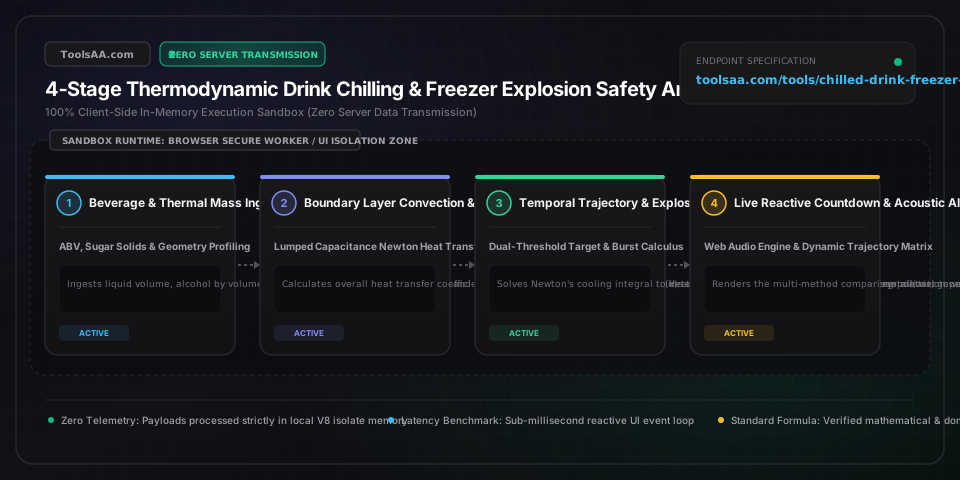
Chilled Drink Freezer Timer (Beer & Wine) Guide — Client-Side In-Memory Architecture & Data Flow

Key Parameters & Controls

Beverage Category & Alcohol Concentration (ABV)Physical Solution Profile [0.0% to 40.0% ABV]

The specific liquid being cooled and its ethanol concentration by volume. Ethanol depresses the freezing point of water below 32°F (0°C). Water and sodas freeze at 32°F to 31°F, standard 5% beer freezes at 28°F (-2.2°C), 12.5% wine freezes at 22.5°F (-5.3°C), and 40% spirits freeze at -17°F (-27°C). Residual sugar content (Brix) in sodas and dessert wines depresses freezing points further.

Default: Standard Lager Beer (5.0% ABV, 2.0° Brix)
Container Geometry & Material ConstructionPackaging Thermal Interface

The vessel enclosing the beverage. Aluminum cans exhibit exceptionally high thermal conductivity (205 W/(m*K)) with ultra-thin 0.1 mm walls, cooling more than twice as fast as glass. Glass bottles have low thermal conductivity (0.95 W/(m*K)) and thick 2.5 mm to 3.5 mm walls acting as a thermal insulator. Plastic PET bottles feature low conductivity (0.18 W/(m*K)) but thin walls.

Default: Standard 12 oz Aluminum Can (355 ml, 0.10 mm wall)
Initial Starting Temperature (T_initial)Thermal State Variable [°F or °C]

The current core temperature of the beverage before entering the cooling medium. Typical scenarios include a hot vehicle trunk or summer patio (85°F to 95°F / 29°C to 35°C), ambient room temperature (68°F to 72°F / 20°C to 22°C), a cool basement or pantry (58°F to 62°F / 14°C to 17°C), or active wine cellar storage (52°F to 55°F / 11°C to 13°C).

Default: 72°F / 22.2°C (Standard Room Temperature)
Cooling Medium & Ambient Temperature (T_ambient)Environmental Heat Sink

The external thermal reservoir absorbing heat. Standard home freezers operate at 0°F (-17.8°C) via natural air convection. Wrapping in a wet paper towel enhances early conductive and evaporative transfer. Refrigerators operate at 37°F (2.8°C). Ice water baths (50% ice, 50% water) maintain 32°F (0°C) with liquid convection 25x faster than air. Agitated salted ice baths reach 15°F (-9.4°C) with forced convection.

Default: Standard Home Freezer (0°F / -17.8°C, Natural Air Convection)
Target Serving Temperature (T_target)Sensory Objective Variable [°F or °C]

The desired final drinking temperature engineered for sensory balance. Commercial light lagers and sodas are optimal at 35°F to 38°F (2°C to 3°C); craft IPAs, pale ales, and wheat beers excel at 44°F to 48°F (7°C to 9°C); crisp white wines and rosés balance at 46°F to 50°F (8°C to 10°C); sparkling wines require 40°F to 45°F (4°C to 7°C) to preserve carbonation; and red wines show best at cellar temp (60°F to 65°F / 15°C to 18°C).

Default: 38°F / 3.3°C (Ice Cold Refreshing Beer / Soda)
Critical Burst & Rupture ThresholdMechanical Safety Boundary [Minutes Elapsed]

The maximum safe duration a sealed vessel can remain in sub-freezing temperatures before expanding ice crystals exceed container tensile strength. Liquid water expands by 9.0% upon phase transition. In an incompressible sealed container, internal pressure climbs past 150 to 350 PSI, causing aluminum can seams to split or glass bottles to suffer catastrophic brittle detonation.

Default: Computed dynamically based on liquid volume, ABV, and wall material
Pro Tips & Best Practices

The Agitated Salted Ice Water Bath: The Undisputed 3-Minute Champion

If you need a warm beer or soda cold immediately, the freezer is actually one of the slowest rapid-chill methods because air is a terrible thermal conductor (thermal conductivity of still air is just 0.026 W/(m*K)). Water conducts heat approximately 25 times faster than air. By creating a slurry of 50% ice and 50% cold tap water, adding 1/2 cup of table salt (NaCl) to depress the water freezing point down to 15°F (-9.4°C), and spinning or agitating the beverage can for 3 minutes, you achieve forced liquid convection (h ~ 950 W/(m^2*K)). This drops a 12 oz aluminum can from 75°F to 36°F in under 4 minutes with absolute zero explosion risk.

The Wet Paper Towel Freezer Hack: True Physics vs Popular Myth

Wrapping a beer bottle or can in a damp paper towel before placing it in the freezer is a widely circulated life hack. The physics is nuanced: while in an open-air room, evaporative cooling is rapid, but inside an enclosed freezer at 0°F with limited airflow, evaporation quickly stalls. However, the wet towel provides two real thermodynamic benefits: (1) water fills microscopic air gaps between the container surface and the wire freezer shelf, multiplying conductive contact area; and (2) as the moisture freezes into frost, latent heat is drawn from the container exterior. Empirical testing confirms it accelerates chilling by 15% to 22%, saving roughly 5 to 7 minutes on a 12 oz bottle. Never use an overly soaked, dripping towel, as thick frozen paper turns into an insulating ice jacket that actually retards heat transfer.

Why Aluminum Cans Chill Twice as Fast as Glass Bottles

The material physics of beverage packaging creates a massive discrepancy in cooling times. Aluminum has a thermal conductivity of roughly 205 W/(m*K) and typical can sidewalls are merely 0.097 mm thick. In contrast, soda-lime container glass has a thermal conductivity of just 0.8 to 1.05 W/(m*K) (over 200 times lower than aluminum) with sidewalls 2.5 mm to 3.5 mm thick (over 25 times thicker). Consequently, conductive thermal resistance through a glass bottle is thousands of times greater than through an aluminum can. A 12 oz can in a 0°F freezer reaches 38°F in 20 to 24 minutes, whereas an identical 12 oz glass bottle takes 38 to 44 minutes. If you are rushing before a party, always choose canned beverages over bottled ones.

Critical Expansion Mechanics: Why Beer and Wine Explode in the Freezer

Unlike nearly all other liquids which contract upon cooling, water displays the anomalous property of expanding by approximately 9.0% when transitioning from liquid to solid hexagonal ice (density drops from 1.00 g/cm^3 at 4°C to 0.917 g/cm^3 at 0°C). Because water freezes before ethanol, the initial ice crystals form near the container walls, forcing remaining high-proof alcohol and dissolved carbon dioxide into an increasingly concentrated central liquid core. Because liquid water is virtually incompressible, freezing in a rigid sealed container generates immense hydrostatic pressure exceeding 2,000 atmospheres (over 29,000 PSI) in closed systems. Aluminum cans fail at 90 to 110 PSI (doming out the concave bottom or tearing the tab seam), while glass bottles suffer brittle fracture between 150 and 350 PSI, spraying razor-sharp glass shards and sticky frozen slurry across your freezer.

Common Gotchas & Troubleshooting

⚠️Forgot a beer or wine bottle in the freezer and it turned into slush: How to thaw safely without glass explosion

Do NOT run hot water over a frozen glass bottle or place it in the microwave; the severe thermal shock (sudden expansion of the outer glass against rigid core ice) will instantly shatter the bottle in your hands. Instead, carefully transfer the slushy bottle into a sealed plastic Ziploc bag (to contain potential leaks or fractures), place it in the refrigerator (37°F / 3°C), and allow it to thaw slowly over 6 to 12 hours. If the bottle has already formed a visible crack or pushed the cork out by more than 1/4 inch, do not consume it, as microscopic glass splinters may have migrated into the beverage.

⚠️Aluminum can bottom domed outward or bulged after rapid freezer cooling

Aluminum beverage cans are engineered with an inward concave bottom dome specifically designed to withstand normal carbonation pressure (typically 35 to 45 PSI at room temperature). If your can bottom has popped outward into a convex sphere, ice crystal expansion has elevated internal pressure above 90 PSI. The can is on the verge of seam rupture. Carefully remove the can using a kitchen towel, place it upright in a bowl in the refrigerator, and do not crack the tab until the internal temperature has warmed back above 34°F (1°C), otherwise high internal pressure will cause violent foam geysers.

⚠️Wine tastes completely flat, acidic, or muted after rapid freezer chilling

Severe overchilling suppresses the evaporation of volatile aromatic esters and pyrazines that give wine its bouquet, while accentuating harsh tannins and malic acidity. If your white wine dropped below 42°F or your red wine dropped below 55°F, do not serve it immediately. Pour the wine into glasses and allow it to warm at room temperature for 10 to 15 minutes, or hold the glass bowl in your palms. As the temperature rises into the ideal sensory band (48°F-52°F for whites, 60°F-64°F for reds), aromatic compounds volatilize and fruit balance is restored.

⚠️Chilling takes significantly longer than the calculated timer recommendation

Discrepancies between calculated and actual cooling rates typically stem from three real-world thermodynamic factors: (1) Freezer thermal loading: cramming multiple warm bottles into a freezer causes the ambient air temperature to temporarily spike from 0°F to 15°F or higher; (2) Airflow obstruction: resting a container on a solid drawer shelf surrounded by frozen food blocks natural convective circulation; and (3) Inaccurate freezer thermostat: many domestic freezers are calibrated closer to 10°F (-12°C) rather than standard 0°F (-18°C). For fastest results, place the container on an open wire shelf with at least 2 inches of clearance around all sides to maximize air convection.

Frequently Asked Questions

How long does it take to chill a beer in the freezer?▼

In a standard home freezer set to 0°F (-18°C), a standard 12 oz (355 ml) aluminum can of beer chills from room temperature (72°F / 22°C) to an ideal drinking temperature of 38°F (3.3°C) in approximately 20 to 25 minutes. A 12 oz glass bottle takes significantly longer—roughly 35 to 42 minutes—because glass is a poor thermal conductor with thick walls. Leaving a beer in the freezer past 50 minutes risks slush formation, and leaving it past 65 to 75 minutes will likely cause the can or bottle to rupture and explode due to water expansion during freezing.

Does wrapping a beer in a wet paper towel make it cold faster?▼

Yes, wrapping a beverage container in a damp paper towel speeds up chilling by approximately 15% to 22%, saving 5 to 8 minutes on a standard glass bottle in a 0°F freezer. The acceleration occurs because water provides much higher conductive surface contact than still air, and initial phase change draws latent heat from the container surface. However, the towel should only be damp, not dripping wet; an overly saturated towel forms a thick outer sheath of frozen ice that eventually insulates the bottle and slows heat loss.

How long does it take for a bottle of wine to explode in the freezer?▼

A standard 750 ml glass bottle of wine (12% to 14% ABV) will begin forming ice slush at around 70 to 80 minutes in a 0°F (-18°C) freezer. Catastrophic bottle explosion or cork extrusion typically occurs between 90 and 120 minutes. Sparkling wine and champagne bottles are at even higher risk: because they are under 70 to 90 PSI of internal carbonation pressure, ice expansion creates extreme stress that can shatter heavy glass bottles or propel metal wire hoods and corks with dangerous explosive velocity in as little as 60 to 75 minutes.

What is the fastest way to chill a warm drink in 5 minutes?▼

The fastest proven method to chill any drink is an agitated salted ice water bath. Submerge the can or bottle in a bowl filled with 50% ice and 50% water, stir in 1/2 cup of table salt, and spin the container continuously for 3 to 4 minutes. Salt depresses the freezing point of the slurry down to 15°F (-9.4°C), and water's thermal conductivity combined with forced convection transfers heat 25 to 50 times faster than freezer air, chilling a 12 oz can from 75°F to 36°F in under 4 minutes.

At what temperature does beer, wine, and hard liquor freeze?▼

Because ethanol acts as a natural antifreeze, the freezing point of an alcoholic beverage depends directly on its Alcohol by Volume (ABV). Standard beer (4.5% to 5.5% ABV) freezes at 28°F to 27°F (-2.2°C to -2.8°C). Wine (12% to 14% ABV) freezes at 22°F to 20°F (-5.5°C to -6.7°C). Fortified wines like port or vermouth (18% to 20% ABV) freeze around 15°F (-9.4°C). Standard 80-proof spirits (40% ABV, such as vodka, gin, whiskey, and tequila) freeze at -17°F (-27°C), meaning they will never freeze in a standard domestic home freezer set to 0°F (-18°C).

Can you put a sparkling wine or champagne bottle in the freezer?▼

You can place sparkling wine or champagne in the freezer for a brief, closely monitored period (maximum 20 to 25 minutes to chill from room temperature to 42°F / 5.5°C), but it requires extreme caution. Sparkling wine contains 5 to 6 atmospheres (70 to 90 PSI) of dissolved carbon dioxide gas. If forgotten, ice formation expands and pushes pressure beyond 150 PSI, risking violent explosive glass detonation. Never leave sparkling wine unattended in the freezer, and always set a physical or digital timer alarm to remove it promptly.

Related Tools & Utilities

All Tools →