Appliance Running Cost & kWh Calculator

Appliance Running Cost & kWh Calculator

Calculate electric appliance running costs per hour, day, month, and year. Compare wattage, duty cycles, standby power, TOU rates, and energy payback ROI.

Lbl scenarios
Card title appliance specsPortable Ceramic Space Heater
39 Lbl models
Lbl power rating
Watts
= 1.5 kW
8 Unit hours per day (480 mins)
Lbl days per week
60% (900W eff)

Hint duty cycle explanation

Desc standby off

Lbl tariff structure
$
$
Card title energy cockpitCOCKPIT
Kpi hourly
$0.15
0.900 kWh/hr
Kpi daily
$1.21
7.20 kWh/day
Kpi monthly
$36.82
219.2 kWh/mo
Kpi annual
$441.50
2,628 kWh/yr
Lbl24h load distribution8h active • 16.0h standby/idle
Lbl active draw900W eff • $1.21/day)
Lbl standby draw0W • $0.00/day)
Lbl carbon modeling0.386 kg CO2e / kWh
46.6 Trees

Hint tree equiv

2,511 Miles

Hint car miles equiv

219,000

Hint phone charges

Tip energy saving title

Tip energy saving body1Portable Ceramic Space HeaterTip energy saving body28Tip energy saving body3219.2 kWhTip energy saving body4$4.60Tip energy saving body5

Stat hourly active$0.15
Stat monthly bill$36.82
Stat annual projection$441.50
Stat annual kwh2,628 kWh
Stat vampire share0.0%
Stat tree offset46.6 Trees
Technical Reference & Architecture Guide

Appliance Running Cost & kWh Calculator Guide

Calculate electric appliance running costs per hour, day, month, and year. Compare wattage, duty cycles, standby power, TOU rates, and energy payback ROI.

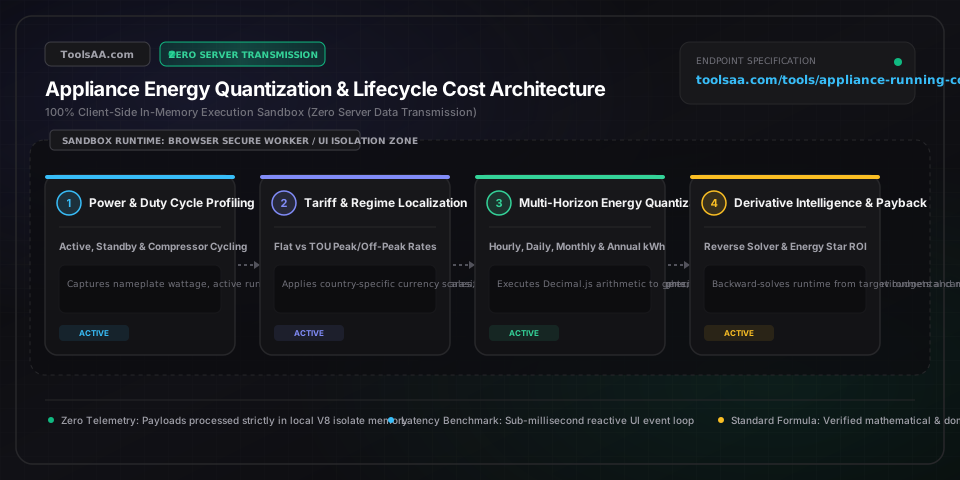
Appliance Running Cost & kWh Calculator Guide — Client-Side In-Memory Architecture & Data Flow

Key Parameters & Controls

Rated Power Consumption (ratedWatts)Power Metric (Watts [W] or Kilowatts [kW])

The electrical power drawn by the appliance under active load, stamped on the manufacturer specification label (nameplate rating). For devices labeled in volts (V) and amperes (A), wattage equals Volts * Amps (e.g. 120V * 12.5A = 1500W). 1,000 Watts equals 1 Kilowatt (kW).

Default: 1,500 W (Standard 120V portable space heater / hair dryer rating)
Daily Operating Duration (dailyHours)Temporal Metric (Hours & Minutes per 24-hour cycle)

The active duration an appliance is actively energized or functioning during a typical day. Multiplied by operational days per week to derive weekly and monthly runtime aggregates. For continuous appliances like refrigerators or routers, set to 24 hours.

Default: 8.0 Hours / Day
Thermostat & Compressor Duty Cycle (dutyCyclePercent)Fractional Operational Multiplier (10% to 100%)

The percentage of energized time an appliance's high-wattage compressor, heating coil, or cooling element is actively drawing maximum power. Refrigerators only cycle their compressor ~30-40% of the time; space heaters on thermostats cycle ~50-65%. Calculating without duty cycle leads to 200-300% cost overestimations.

Default: 100% (Continuous resistive load) / 35% (Refrigeration) / 60% (Thermostatic HVAC)
Standby / Vampire Power Draw (standbyWatts)Parasitic Load Metric (Watts [W])

The continuous phantom power consumed by electronic devices while plugged in but turned 'off' or in sleep/standby mode (e.g. smart TVs, gaming consoles, microwave clocks, smart plugs, AC adaptors). Evaluated over all remaining non-active hours (24 - dailyHours) each day.

Default: 0 W (Resistive heating) to 15 W (Connected electronics / OLED TVs)
Electricity Tariff Rate (tariffRatePerKwh)Monetary Unit Cost (Currency / Kilowatt-hour [kWh])

The marginal utility price charged per unit of electrical energy (1 kWh = 1,000 Watt-hours = running a 1,000W load for 1 hour). In Flat Rate mode, a single uniform rate applies; in Time-of-Use (TOU) mode, differentiated Peak and Off-Peak rates reflect variable grid generation pricing.

Default: $0.168 / kWh (US National Average) / £0.245 / kWh (UK Ofgem Cap)
Regional Grid Carbon Emission Intensity (gridCarbonIntensity)Environmental Metric (kg CO2 equivalent / kWh)

The mass of greenhouse gas emissions generated per kilowatt-hour of electricity delivered from the regional utility grid. Varies significantly based on generation fuel mix: clean hydro/nuclear grids (~0.05-0.15 kg/kWh), US average (~0.386 kg/kWh), and coal-heavy grids (~0.65-0.85 kg/kWh).

Default: 0.386 kg CO2e / kWh (US Grid Average)
Pro Tips & Best Practices

Eliminate Vampire Power with Smart Master-Slave Surge Protectors

Standby 'phantom' power accounts for 5% to 10% of the average residential electric bill, costing $100 to $200 annually. Entertainment centers and home computer desks are the primary culprits—AV receivers, subwoofers, gaming consoles, and monitors continue pulling 5W to 25W even when idle. Installing an auto-switching smart power strip that detects when your primary PC or TV powers down cuts parasitic phantom draw from peripheral accessories completely to zero.

Use Heat Pumps Instead of Resistive Space Heaters for 3x Energy Efficiency

Standard electric space heaters, baseboards, and portable ceramic heaters rely on electric resistance, which has a Coefficient of Performance (COP) of exactly 1.0 (1 watt of electricity creates 1 watt of thermal heat). Modern mini-split inverter heat pumps have a COP of 3.0 to 4.5 down to freezing temperatures, moving 3 to 4.5 units of heat for every 1 unit of electricity consumed. Switching primary supplemental heating to a heat pump reduces heating electricity running costs by 65% to 75%.

Vacuum Refrigerator Condenser Coils Annually to Cut Compressor Runtime by 15%

Dust and pet hair insulating your refrigerator condenser coils prevent heat dissipation, forcing the compressor to cycle on 15% to 30% longer per day to maintain internal temperatures. Pull your refrigerator out and vacuum or brush the rear/underbody condenser coils every 12 months. Ensure food containers don't block internal cold air return vents, and verify door gaskets seal tightly by closing the door on a dollar bill—if it pulls out easily with no resistance, replace the gasket.

Shift Heavy Laundry and Dishwashing Cycles to Off-Peak Overnight Windows

If your electric utility enrolls you in a Time-of-Use (TOU) billing rate, running clothes dryers (3,000W-5,000W) or dishwashers (1,400W) during afternoon peak demand windows (typically 4 PM to 9 PM) can cost 2x to 3x more per load compared to off-peak periods. Utilize the delay-start timer on your dishwasher or washing machine to schedule cycles between 10 PM and 6 AM, saving up to $150-$250 annually without changing your appliance hardware.

Verify True Real-World Wattage with a Plug-In Wattmeter (Kill-A-Watt)

Nameplate wattage on appliance serial plates indicates maximum peak power consumption, not average operational draw. For example, a microwave rated at '1,000W cooking power' actually pulls 1,450W from the wall due to magnetron conversion losses, while a desktop PC with an 850W power supply might only draw 120W during web browsing and 420W during 4K gaming. Plug high-use appliances into a $20 digital kill-a-watt meter for 48 hours to discover your precise average watt draw and duty cycle before estimating annual budgets.

Common Gotchas & Troubleshooting

⚠️Calculated monthly cost is significantly higher than actual electric bill

This discrepancy almost always stems from assuming an appliance draws its 100% rated nameplate wattage continuously for 24 hours. Thermostatically controlled devices like refrigerators, chest freezers, water heaters, and air conditioners cycle their compressors on and off. A refrigerator rated at 180W only runs its compressor ~35% of the time, consuming ~1.5 kWh/day, not 4.3 kWh/day. Adjust the Duty Cycle slider from 100% down to realistic cycling percentages (30-40% for refrigeration, 50-65% for cycling heating/cooling).

⚠️Electric bill reflects higher tier rates than the calculator baseline rate

Many municipal utilities operate on a Tiered Incline Block Rate (IBR) structure rather than a flat rate. Under tiered billing, your first 500 kWh each month may cost $0.12/kWh (Tier 1 Baseline), while usage exceeding 1,000 kWh triggers Tier 2 ($0.22/kWh) or Tier 3 ($0.35/kWh). Adding a new high-consumption appliance (like an EV charger or portable AC unit) consumes marginal electricity at your highest marginal tier rate. Always input your utility highest marginal tariff rate rather than your bill average rate.

⚠️Microwave or air fryer electricity cost does not match the front-panel wattage rating

Consumer microwave and kitchen appliance ratings advertise thermal cooking output, not electrical input draw. A 1,000W microwave requires approximately 1,400W to 1,500W of actual electrical grid power to operate the magnetron, cooling fan, and interior lighting. Check the technical specifications label on the back or door jamb for the true Input Power rating in Amps or Watts.

⚠️Inverter-driven heat pump or air conditioner wattage fluctuates constantly

Older single-stage appliances operate in a binary ON (100% power) or OFF (0% power) cycle. Modern variable-capacity inverter appliances ramp compressor motor speed smoothly between 20% and 110% capacity to precisely match ambient thermal load. To model inverter appliances accurately, set the duty cycle to 100% and enter the average operational wattage (typically 40% to 60% of the peak rated wattage) rather than the peak nameplate value.

⚠️Monthly electricity cost varies wildly between summer and winter seasons

Thermal appliances are heavily dependent on outdoor weather and Heating/Cooling Degree Days (HDD/CDD). A central heat pump or window AC unit will run 12-14 hours per day in July or January but remain completely idle in April and October. Use our days-per-week frequency selector and create separate seasonal scenarios to calculate a realistic annualized monthly blended average rather than extrapolating a single peak-season month across 365 days.

Frequently Asked Questions

How do I calculate the running cost of an electrical appliance?▼

To calculate the running cost of any appliance: (1) Find its power rating in Watts (stamped on the serial plate or manual); (2) Multiply the Watts by the daily runtime hours to get Watt-hours per day; (3) Divide by 1,000 to convert to kilowatt-hours (kWh); (4) Multiply the daily kWh by your electric utility price per kWh (found on your electric bill). For example, a 1,500-watt space heater running 8 hours per day consumes (1,500 * 8) / 1,000 = 12 kWh per day. At an average rate of $0.16 per kWh, it costs 12 * $0.16 = $1.92 per day, or approximately $58.40 per month.

How much does a 1500 watt space heater cost to run per hour?▼

A standard 1,500-watt electric space heater uses 1.5 kilowatt-hours (kWh) of electricity for every full hour of continuous heating. At the US national average residential electricity rate of $0.168 per kWh, a 1,500W heater costs approximately $0.25 per hour to run continuously. In higher-rate states like California, New York, or Massachusetts (averaging $0.28 to $0.34 per kWh), running cost increases to $0.42 to $0.51 per hour. If the heater is equipped with a functioning thermostat that cycles off once the room is warm, typical cycling costs are 30% to 50% lower.

What appliances use the most electricity in a typical home?▼

According to the US Energy Information Administration (EIA), heating and cooling (HVAC) represent the largest household energy expense, accounting for 40% to 50% of total residential electricity usage. Water heaters rank second, responsible for 14% to 18% of consumption (averaging 3,000 to 4,500 kWh annually). Major motor and thermal appliances follow: clothes dryers (5%), refrigerators/freezers (4% to 7%), lighting (4%), and dishwashers/cooking appliances (3%). Entertainment systems, computers, and phantom loads collectively account for roughly 6% to 10% of total consumption.

What is vampire power and how much does standby electricity cost?▼

Vampire power (also known as phantom load or idle standby power) is the electrical energy consumed by consumer electronics and appliances while turned off or in standby mode. Common culprits include smart TVs, game consoles, audio systems, microwave clocks, smart home hubs, and plugged-in chargers. The Lawrence Berkeley National Laboratory estimates standby power accounts for 5% to 10% of total residential electricity use, averaging 50 to 100 Watts of continuous silent draw per home, costing typical households between $75 and $180 every year.

How does a time-of-use (TOU) electricity plan affect appliance costs?▼

Time-of-Use (TOU) utility rate plans charge different electricity prices depending on the time of day and overall grid demand. Peak hours (usually weekday late afternoons and evenings, such as 4 PM to 9 PM) feature the highest prices—often 2x to 3x higher than base rates. Off-peak hours (nights, mornings, and weekends) offer discounted rates. Running high-wattage appliances like clothes dryers, dishwashers, pool pumps, and EV chargers during off-peak windows rather than on-peak hours can reduce appliance operational costs by 40% to 60% on TOU rate plans.

Is it worth replacing an old refrigerator to save on electricity?▼

Replacing a refrigerator manufactured before 2001 is almost always financially rewarding. A 1990s refrigerator consumes 1,000 to 1,400 kWh per year (costing $170 to $235 annually at $0.168/kWh). A modern Energy Star certified refrigerator consumes only 350 to 450 kWh annually (costing ~$60 to $75/year), yielding direct savings of $110 to $160 every year. Over a 10-year lifespan, the new unit saves $1,100 to $1,600 in electricity, fully recouping an $800 to $1,000 purchase price while providing quieter operation and modern features.

Related Tools & Utilities

All Tools →