Room AC BTU Calculator & Sizing Guide

Room AC BTU Calculator & Sizing Guide

Room AC BTU calculator and air conditioner sizing tool by room square footage, ceiling height, and sunlight. Get instant cooling capacity, tonnage, and power.

Lbl quick presets

Title control deck

180Unit sq ft
Hint small bedroomHint living roomHint open floor
8.0 Unit feet
Hint standard ceilingHint nine foot ceilingHint cathedral ceiling
Lbl regular occupantsHint occupant base
2
Lbl continuous live computeLbl conditioned area 180 Unit sq ft
Lbl recommended ac size
5,000Unit btu per hour
1.47 Unit kw•0.42 Unit tons•165 Unit cfm
Lbl exact calculated load
3,600Unit btu per hour
Badge short cycle trap139%
Lbl power draw circuit
~435Unit watts
Circuit standard115 v
Title thermal cross section8 Unit feet Lbl clearance
Svg ceiling: 8 Unit feet5,000 Unit btuSvg sensible balance: OVER
Lbl sizing envelope gauge139% Lbl capacity ratio
Sr under
Sr optimal
Sr over
< 90% (Lbl under cooled)90% - 115% (Lbl comfort sweet spot)> 115% (Lbl short cycling danger)
Desc oversized warning
Lbl dehumidification safeLbl recommended model 5,000 Unit btu per hour
Stat sensible load1,440 Unit cubic feet (180 Unit sq ft)
Stat human heat+0 Unit btu per hour
Stat seasonal savings$16.24 / Lbl season

Client-Side Processing

High-performance calculation executed entirely in browser memory.

Zero Server Upload Privacy

All payloads remain strictly local with zero external server communication.

Production Ready Export

Clean, optimized output formats ready for immediate deployment.

Footer note

Technical Reference & Architecture Guide

Room AC BTU Calculator & Sizing Guide Guide

Room AC BTU calculator and air conditioner sizing tool by room square footage, ceiling height, and sunlight. Get instant cooling capacity, tonnage, and power.

Room AC BTU Calculator & Sizing Guide Guide — Client-Side In-Memory Architecture & Data Flow

Key Parameters & Controls

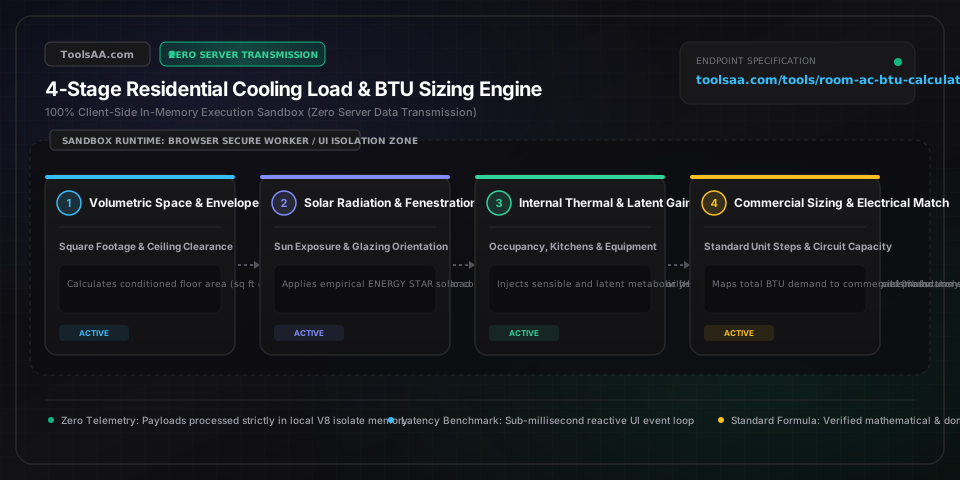
Conditioned Floor Area & Volumetric AirspaceThermal Boundary Dimension (Square Feet / Cubic Feet)

Primary floor surface area multiplied by vertical clear height. Standard residential baselines assume 20 BTU/hr per sq ft for 8-foot (2.44 m) ceilings. Rooms with ceiling heights exceeding 8 feet require a proportional volumetric multiplier (Ceiling Height / 8.0) to account for additional air mass and thermal stratification.

Default: 150 to 400 sq ft (14 to 37 m²) for standard residential rooms
Solar Heat Gain Coefficient & Fenestration ExposureSolar Thermal Radiation Multiplier

Accounts for solar radiation through glazed windows and exterior walls. Rooms with dense tree cover or north-facing orientation receive a -10% deduction (0.90x multiplier). Conversely, rooms with unshaded south- or west-facing windows encounter afternoon solar peaks requiring a +10% capacity boost (1.10x multiplier).

Default: Baseline 1.00x (Average sun exposure with interior blinds)
Continuous Human Occupancy & Metabolic Heat RateInternal Sensible & Latent Heat Dissipation

Human bodies release sensible heat (dry warmth) and latent heat (respiratory moisture and perspiration). Standard residential cooling loads allocate baseline capacity for up to 2 continuous occupants. Every additional person adds +600 BTU/hr (approx. 400 BTU sensible + 200 BTU latent moisture).

Default: +600 BTU/hr per person for each occupant beyond 2
Kitchen Cooking Appliance & Refrigerator Thermal LoadContinuous Kitchen Heat Rejection Allowance

Standard ENERGY STAR and ACCA Manual J residential sizing protocols mandate an automatic +4,000 BTU/hr addition for air conditioners installed in or cooling open-plan kitchens to counteract heat from cooking ranges, ovens, dishwashers, and continuous refrigerator condenser heat rejection.

Default: +4,000 BTU/hr (ENERGY STAR residential kitchen standard)
Building Envelope Insulation & Glazing GradeThermal Conduction & Infiltration Coefficient

Evaluates wall cavity insulation (R-13 to R-21) and window performance (single-pane vs double/triple Low-E). Modern airtight construction reduces cooling demand by -10% (0.90x), standard construction represents 1.00x baseline, while uninsulated structures with single-pane glass require a +20% surge (1.20x).

Default: 1.00x baseline (Standard double-pane residential construction)
Seasonal Energy Efficiency Ratio (CEER & SEER2)Electrical Energy Efficiency Metric

Combined Energy Efficiency Ratio (CEER) for window units (modern baseline 11.0 to 12.0) and Seasonal Energy Efficiency Ratio 2 (SEER2) for mini-splits (18.0 to 24.0). Running electrical wattage is computed as BTU/hr divided by CEER. Inverter-driven units modulate capacity to save 30% to 45% annual power.

Default: 11.5 CEER for modern window AC; 20.0 SEER2 for mini-splits

Pro Tips & Best Practices

The Short-Cycling Cold & Clammy Humidity Trap

Never oversize an air conditioner under the assumption that more BTU equals faster cooling. An oversized unit drops dry-bulb room temperature within 10 minutes and shuts off its compressor before running long enough to condense moisture on the evaporator coils. The result is a cold, clammy, 70%+ relative humidity environment that promotes toxic mold growth and destroys compressor relays through rapid on/off cycling.

The Single-Hose Portable AC Negative Pressure Infiltration Penalty

Single-hose portable air conditioners expel indoor conditioned air through the exhaust duct to cool their condenser coils. This creates a severe negative air pressure vacuum inside the room, forcing hot, unconditioned outdoor air to leak inward through door cracks, windows, and electrical outlets. This effect degrades effective cooling capacity by 30% to 40% compared to dual-hose portables or window units (reflected in DOE SACC ratings).

The Afternoon Western Glazing Solar Peak Multiplier

West-facing windows generate up to 2.5 times more peak thermal heat gain than east-facing windows because solar radiation peaks between 3:00 PM and 6:00 PM when outdoor ambient temperatures are already at their maximum daily crest. If a room has unshaded west-facing glass, always calculate sizing using the +10% sunny multiplier or install exterior solar shades to avoid mid-afternoon cooling stalls.

Inverter Variable-Speed Compressors Eliminate Sizing Cliff Edge

Traditional rotary compressors operate on a binary 100% on or 0% off cycle, making precise BTU sizing critical. Modern variable-speed inverter compressors modulate motor frequency down to 25% capacity once setpoint is approached. This enables continuous dehumidification at whisper-quiet sound levels (under 25 dB) and provides an elastic buffer that safely tolerates moderate load variations without short-cycling.

Common Gotchas & Troubleshooting

⚠️Air Conditioner Runs Non-Stop but Room Temperature Fails to Drop

Continuous operation during peak outdoor heat without reaching setpoint indicates either a severe BTU deficit (undersizing by >20%), a clogged air filter restricting CFM airflow, or extreme air leakage through unsealed window slider panels. Seal all perimeter gaps with closed-cell neoprene foam weatherstripping and verify that room square footage has not exceeded the unit's thermal rating.

⚠️Room Air Feels Chilly but Humid, Sticky, and Clammy

This classic symptom confirms an oversized air conditioner short-cycling on sensible temperature. Because the cooling cycle lasts fewer than 15 minutes, latent heat removal is nearly zero. Solution: Run the unit on low fan speed to force air across the evaporator coil more slowly (maximizing condensation runoff) or upgrade to an inverter unit that runs continuously at lower output.

⚠️15-Amp Residential Circuit Breaker Trips on Compressor Startup

Standard window units above 10,000 BTU draw a brief Locked Rotor Amperes (LRA) inrush current 4 to 6 times higher than running amps during compressor startup. If shared on a 15A branch circuit with lamps, TVs, or computers, the circuit will trip. Relocate other appliances to separate circuits, ensure no extension cords are used, or install a dedicated 20A 115V or 230V circuit for units 12,000 BTU and above.

⚠️Portable AC Unit Shows 12,000 BTU but Cannot Cool a 300 Sq Ft Room

Check whether the unit's rating is advertised under obsolete ASHRAE 128 testing standards rather than modern DOE SACC (Seasonally Adjusted Cooling Capacity). A 12,000 BTU ASHRAE single-hose unit typically delivers only 7,000 to 8,000 BTU of net usable cooling due to case radiation and negative-pressure outdoor air suction. For rooms over 250 sq ft, only install dual-hose models or dedicated window units.

Frequently Asked Questions

How many BTU do I need for a room air conditioner?▼

As an official baseline established by the U.S. Department of Energy and ENERGY STAR, residential rooms require approximately 20 BTU per square foot of living space with standard 8-foot ceilings. A 150 sq ft room requires a 5,000 to 6,000 BTU unit, a 250 sq ft room needs 7,000 to 8,000 BTU, a 400 sq ft room requires 10,000 BTU, and a 550 sq ft space requires a 12,000 BTU (1-ton) air conditioner. If ceilings exceed 8 feet, add 10% for sunny rooms, add 600 BTU per extra person beyond two, and add 4,000 BTU if cooling a kitchen.

What happens if an air conditioner has too many BTU for a room?▼

An oversized air conditioner short-cycles, meaning it cools the indoor air temperature down to the thermostat setpoint so rapidly (within 8 to 12 minutes) that it shuts off before running long enough to remove ambient moisture and humidity. This leaves the room cold, sticky, and clammy with relative humidity often remaining above 65%, creating an ideal breeding ground for mildew and mold. In addition, frequent compressor starts and stops sharply increase electricity consumption and cause premature mechanical failure.

What size air conditioner do I need for a 12x12 or 150 to 200 sq ft bedroom?▼

A 12x12 foot bedroom measures 144 square feet, which falls directly into the 150 to 200 sq ft category. For standard conditions (8-foot ceiling, moderate sun, 1-2 occupants), a 6,000 BTU window or mini-split air conditioner is the ideal engineering match. If the room has heavy morning or afternoon sun with large unshaded windows, upgrade to an 8,000 BTU unit. If the room is heavily shaded on a ground floor, a 5,000 BTU unit provides sufficient cooling while maintaining excellent humidity control.

What is the difference between BTU, Tons, and Kilowatts for air conditioning?▼

BTU/hr (British Thermal Units per hour) measures thermal heat extraction rate, where 1 BTU is the energy required to raise or lower the temperature of one pound of water by 1°F. One Ton of refrigeration (TR) equals exactly 12,000 BTU/hr, derived from the latent heat required to melt one short ton (2,000 lbs) of ice in 24 hours. In metric countries, cooling is measured in Kilowatts (kW), where 1 kW of thermal cooling capacity equals 3,412 BTU/hr, or in Frigorías/hr where 1 Frigoría equals 3.968 BTU/hr.

Why do portable air conditioners have two different BTU ratings (ASHRAE vs SACC)?▼

Older portable AC ratings used the ASHRAE 128 laboratory standard, which measured only the raw thermal absorption at the cooling coil without penalizing heat radiating from the plastic exhaust hose or the hot outdoor air sucked into the room by exhaust air pressure. The U.S. Department of Energy (DOE) introduced SACC (Seasonally Adjusted Cooling Capacity) to account for these real-world losses. Consequently, a portable AC advertised as 14,000 BTU ASHRAE typically has a true SACC rating of only 9,000 to 10,000 BTU.

How much electricity does a 8,000 to 12,000 BTU air conditioner use per month?▼

A modern 8,000 BTU window AC with a 11.5 CEER rating draws approximately 695 running watts. Running the unit 8 hours per day consumes 5.56 kWh daily, or about 167 kWh per month. At the US national average residential electricity rate of $0.16 per kWh, this costs approximately $26.70 per month. A larger 12,000 BTU unit (drawing ~1,040 watts) operated for 8 hours daily consumes 250 kWh per month, costing roughly $40.00 per month. High-efficiency inverter models reduce these costs by 30% to 40%.
Related Tools & Utilities

All Tools →