Short title
Lbl regime selectorBadge tier

Screen Time 20-20-20 Timer & Eye Break

Prevent digital eye strain with our screen time 20-20-20 timer. Follow the 20-20-20 rule with automated audio alerts, blink cues, and ergonomic rest intervals.

Lbl quick presets

Lbl timer controls

20:00
20 Lbl minutes abbr
20 Lbl seconds abbr
Lbl optical infinity0.16 Unit diopters
32 Unit years
Lbl reserve 8.9 Unit diopters
55 Unit cm
Lbl screen load 1.82 Unit diopters
Lbl env risks
Lbl kpi focus time00:000 Lbl cycles completed
Lbl total rest time00:0091% Lbl ciliary strain
Lbl kpi strain level0.16 Unit dioptersLbl zero target
Lbl kpi tear stability9.8Lbl seconds abbrhigh Lbl risk tier suffix
Status focus
20:00Lbl remaining20 Lbl minutes abbr Lbl focus block

Lbl kpi summary

Lbl anatomical ray traceLbl effort ratio 20%
55 cm (1.82 D)Lbl lens curvedLbl retinal fovea
Lbl ciliary strain

Desc ciliary explanation

Lbl tear breakup risk

Desc tear explanation

Lbl disclaimer

Technical Reference & Architecture Guide

Screen Time 20-20-20 Timer & Eye Break Guide

Prevent digital eye strain with our screen time 20-20-20 timer. Follow the 20-20-20 rule with automated audio alerts, blink cues, and ergonomic rest intervals.

Screen Time 20-20-20 Timer & Eye Break Guide — Client-Side In-Memory Architecture & Data Flow

Key Parameters & Controls

ciliary_muscle_accommodation_demandDioptric Refractive Power (0.00 to 3.00 Diopters)

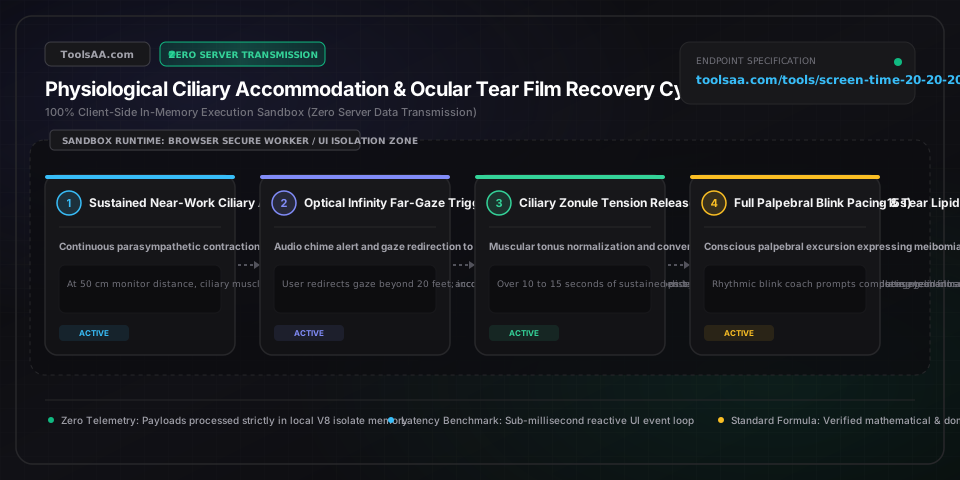
The active optical power exerted by the eye's intraocular ciliary muscle to alter crystalline lens curvature for near vision. At a standard 50 cm computer monitor distance, accommodation demand is 2.00 Diopters; at 20 feet (6 meters / optical infinity), light rays arrive parallel and demand drops below 0.16 Diopters, allowing complete muscular relaxation.

Default: 2.00 Diopters (Screen) / 0.16 Diopters (Rest)
optical_infinity_distanceFocal Distance (Feet / Metres)

The biological threshold beyond which the human ocular optical system no longer requires ciliary accommodation or convergence effort to maintain sharp retinal focus. In clinical optometry, 20 feet (6.096 meters) serves as optical infinity because wave-front divergence becomes negligible (vergence < 0.16 D).

Default: 20 feet (6.0 meters)
palpebral_blink_frequency_deficitBlink Rate & Incomplete Closure (Blinks/Minute)

The physiological drop in spontaneous blink frequency from a normal resting baseline of 15 to 20 blinks per minute down to only 5 to 7 blinks per minute during screen-based cognitive tasks. Furthermore, over 60% of computer blinks are incomplete (partial eyelid excursion), preventing meibomian lipid spreading over the cornea.

Default: 18 blinks/min (Normal) / 6 blinks/min (Screen)
tear_film_breakup_time_tbutCorneal Exposure Latency (Seconds)

The clinical standard measuring tear film stability before dry spots appear on the corneal epithelium after a blink. Healthy TBUT exceeds 10 seconds; prolonged computer use combined with reduced blink frequency causes TBUT to collapse below 5 seconds, precipitating evaporative dry eye syndrome and ocular surface inflammation.

Default: >= 10.0 seconds (Normal) / < 5.0 seconds (Deficient)
screen_gaze_depression_angleDownward Ocular Inclination (Degrees)

The ergonomic vertical angle of the monitor center relative to the horizontal eye axis. Positioning the display 15 to 20 degrees below horizontal eye level narrows the palpebral fissure, reducing exposed ocular surface area by approximately 30% and significantly retarding tear evaporation.

Default: 15 to 20 degrees below eye level
macro_rest_interval_ratioErgonomic Work-to-Rest Ratio (Minutes)

The occupational health benchmark mandated by OSHA and NIOSH requiring a 10 to 15 minute continuous non-screen macro break after every 2 hours of continuous VDT operation, addressing cumulative upper-extremity musculoskeletal strain in conjunction with 20-20-20 ocular micro-breaks.

Default: 15 min macro break / 120 min work
Pro Tips & Best Practices

The Incomplete Blink Trap: Why 60% of Screen Blinks Fail to Lubricate Corneas

During intense visual focus, your blink rate does not merely drop by 66% (from 18 down to 6 blinks per minute); high-speed infrared pupillometry proves that over 60% of blinks while reading screens are incomplete micro-twitches where upper and lower eyelids never physically touch. This fails to compress the meibomian glands along the lid margins, starving the tear film of its critical lipid seal and accelerating aqueous evaporation within 3 seconds. During your 20-second break, consciously perform 10 deliberate, slow, full-contact blinks: close gently, pause for 1 second, squeeze softly, and reopen.

Optical Infinity Physics: Why 20 Feet (6 Metres) Is the Biological Tipping Point

The 20-foot distance is not an arbitrary rule of thumb—it is dictated by the optical physics of human ocular vergence. The vergence of light entering the pupil from an object is calculated as V = 1 / distance (in meters). At a 50 cm monitor distance, light rays diverge at -2.00 Diopters, forcing your ciliary muscle to maintain continuous contraction. At 20 feet (6.096 meters), divergence drops to -0.16 Diopters. Because human depth of focus is approximately ±0.25 Diopters, anything beyond 20 feet is optically indistinguishable from infinity, allowing your ciliary muscle fibers and zonules to achieve complete, zero-energy mechanical relaxation.

Screen Height Ergonomics: The 15-Degree Gaze Angle That Cuts Tear Loss by 30%

Never align the center of your computer screen directly at eye level. When looking straight ahead, your interpalpebral fissure (eyelid opening) exposes approximately 2.2 square centimeters of delicate corneal surface to air currents and evaporative drying. Lowering your monitor so the top edge is at or slightly below eye level forces a 15 to 20 degree downward gaze angle. This downward posture partially lowers the upper eyelid, reducing exposed ocular surface area by nearly 30% and significantly lowering evaporative dry eye symptoms without requiring additional artificial tear drops.

The 20-Second Window: Neurological Latency for Pupillary and Accommodation Triad Disengagement

A quick 5-second glance away from your screen is insufficient to break ciliary muscle spasm. The human near-point accommodation triad (lens accommodation, pupillary constriction, and ocular convergence) is governed by parasympathetic autonomic pathways that exhibit a physiological hysteresis curve. Electromyographic studies show that ciliary smooth muscle requires between 12 and 18 seconds of continuous optical infinity fixation to transition from sustained tetanic contraction back to baseline tonus. Cutting your rest break short at 5 or 10 seconds aborts this neuromuscular release, returning you to near work with residual accommodative fatigue.

Common Gotchas & Troubleshooting

⚠️Eye strain, burning, and blurry text persist despite strictly following the 20-20-20 timer

If symptoms persist despite consistent micro-breaks, rule out uncorrected low-grade astigmatism (+0.50D) or latent hyperopia, which forces ciliary muscles to overcompensate even during breaks. Secondly, inspect your workstation for unshielded overhead LED lighting or window reflections creating disability glare (luminance ratios exceeding 10:1 between monitor and surroundings). Finally, evaluate meibomian gland dysfunction (MGD): use a preservative-free lipid-based lubricating drop 5 minutes before long screen sessions and apply a warm compress for 10 minutes nightly.

⚠️Browser audio chimes do not play or interval timers freeze when switching tabs or locking screen

Modern Chromium, WebKit, and Gecko browsers aggressively throttle background tab timers (capping setInterval to 1 execution per minute) and block Web Audio playback if audio context was not unlocked by an initial user gesture. Ensure you click 'Start' once inside the active tab to initialize the AudioContext. This tool utilizes high-precision timestamp drift compensation (comparing performance.now() across elapsed intervals) so remaining time instantly reconciles upon tab focus, alongside native Web Notification API alerts that bypass background tab throttling.

⚠️Working in a windowless room or compact cubicle without 20 feet of clearance

If your physical office lacks a 20-foot sightline, utilize an optical mirror trick: placing a small mirror on your desk or wall reflects distant hallway objects, effectively doubling your visual focal distance. Alternatively, step into a corridor or look out a breakroom window during the 20-second break. If no distance is accessible, perform the 'Palming' technique: cup your warm palms over closed eyes without pressing the globes for 20 seconds, completely occluding light to allow photopigment rhodopsin regeneration and ciliary rest.

⚠️Afternoon tension headaches and neck stiffness accompanied by ocular soreness

This triad indicates convergence insufficiency coupled with forward head posture ('tech neck'). When monitors are positioned too far or text scaling is too small (< 100% DPI), users unconsciously crane their necks forward by 2 to 3 inches, increasing cervical spine load from 12 lbs to over 40 lbs while forcing excessive ocular convergence. Increase system display scaling to 125%, bring your monitor within 20 to 28 inches (arm's length), and ensure your chair's lumbar support maintains an upright 100-110 degree recline.

Frequently Asked Questions

How does the 20-20-20 rule work to prevent computer eye strain?▼

The 20-20-20 rule—formulated by optometrist Dr. Jeffrey Anshel and endorsed by the American Academy of Ophthalmology (AAO) and American Optometric Association (AOA)—prevents Computer Vision Syndrome (CVS) by periodically resetting the eye's ciliary muscle and tear film. Every 20 minutes of near-screen work, you shift your gaze to an object at least 20 feet (6 meters) away for at least 20 seconds. Looking at 20 feet reaches optical infinity where light rays enter the pupil almost parallel, dropping accommodation demand from 2.00 Diopters down to nearly zero and relieving continuous ciliary muscle spasm, while the 20-second pause provides sufficient time to blink and restore the evaporative lipid tear layer.

Why is 20 feet chosen instead of 10 or 15 feet for eye rest?▼

Twenty feet (approximately 6.1 meters) is selected because it represents the biological definition of optical infinity in human clinical optometry. The refractive power required to focus light is measured in diopters, defined as the reciprocal of distance in meters (D = 1 / d). At 10 feet (3.05 m), the eye must still exert 0.33 Diopters of active accommodation; at 20 feet (6.1 m), accommodation drops to 0.16 Diopters. Because the human eye's natural depth of field is roughly ±0.25 Diopters, any distance of 20 feet or greater allows the intraocular ciliary muscle and zonular fibers to achieve complete mechanical relaxation without focusing effort.

20-20-20 rule vs blue light glasses: which is more effective for eye strain?▼

Clinical trials, including a major 2023 Cochrane Systematic Review analyzing multiple randomized controlled trials, confirm that blue light blocking glasses do not significantly reduce digital eye strain, improve visual performance, or protect retinal health compared to standard clear lenses. Digital eye strain is primarily caused by prolonged ciliary muscle contraction, convergence stress, and reduced blink rate (evaporative dry eye)—not blue light wavelengths. The 20-20-20 rule directly targets the physiological root causes by releasing muscular accommodation and restoring tear film stability, making it vastly more clinically effective than blue light glasses.

What should you do during the 20-second break if there is no window?▼

If your workspace lacks windows or 20 feet of clearance, you can achieve equivalent ocular relief through three clinically proven alternatives: (1) Look down a long hallway or open office corridor where a 20-foot sightline exists; (2) Use the Palming technique by cupping warm, clean palms over gently closed eyes without applying pressure to the eyeballs, blocking 100% of incoming light for 20 seconds to allow photoreceptors and ciliary muscles to reset; or (3) Use a desktop optical mirror to view objects behind you, which doubles the effective focal distance.

Can the 20-20-20 rule cure dry eyes or blurry vision from screens?▼

The 20-20-20 rule significantly alleviates temporary asthenopia (eyestrain) and episodic blurry vision caused by transient ciliary accommodative spasm. However, if chronic dry eye is caused by underlying Meibomian Gland Dysfunction (MGD), systemic blepharitis, or autoimmune conditions, the 20-20-20 rule must be combined with proactive medical interventions. These include conscious full-blink exercises during breaks, maintaining indoor relative humidity between 40% and 50%, applying nightly warm compresses, and using preservative-free lipid-based artificial tears to replenish the tear film's outer barrier.

How often should you take a longer macro break from your computer screen?▼

Disclaimer: This tool is provided strictly for educational and informational purposes only and does not constitute formal financial advice or a binding loan commitment. Please consult a qualified financial advisor before making decisions. In addition to 20-second micro-breaks every 20 minutes, occupational health guidelines from OSHA (Occupational Safety and Health Administration) and NIOSH recommend taking a 10 to 15 minute macro break after every 2 hours of continuous screen work. While 20-20-20 micro-breaks relax the internal intraocular muscles of the eye, 15-minute macro breaks allow you to stand up, alter spinal posture, release neck and shoulder trapezius tension, hydrate, and engage in systemic cardiovascular circulation that promotes retinal perfusion.

Related Tools & Utilities

All Tools →