Jet Lag Sleep Schedule & Shift Planner

Jet Lag Sleep Schedule & Shift Planner

Plan your jet lag sleep schedule and circadian shift with precision light exposure, melatonin timing, sleep shift intervals, and timezone adaptation tables.

Load Example:

Parameters & Inputs

+5h (Lbl eastbound advance)
Lbl flight duration7h
Lbl days abbrev7d
Lbl pre adapt days2 Lbl days abbrev
Lbl reverse solver toggle
Lbl net time delta+5hPhase Advance (East)
Lbl estimated recovery4 Lbl days abbrev@ 1.25h / day rate
Lbl tmin marker04:30Day -3 baseline

Lbl circadian clock

00:0006:0012:0018:00Day -30% Sync
Lbl optimal sleep:
23:00 → 07:00
Lbl bright light:
04:30 → 08:30
Lbl avoid light:
00:30 → 04:30
Lbl melatonin:
18:30 (0.5mg)
Lbl tmin marker:
04:30
Lbl multi day gantt0h → 24h
Day -3
0%
Day -2
20%
Day -1
40%
Travel Day
65%
Day +1
90%
Day +2
100%
Day +3
100%
Day +4
100%
Chronological sequence for Day -3 (2026-11-12)6 actions scheduled
Lbl avoid light

Protect retina from bright rays. Prevents unwanted circadian phase drift in opposite direction.

00:30 - 04:30
Lbl bright light

Primary phototherapy window. 30-45 mins outdoors or 10,000-lux lamp resets pacemaker.

04:30 - 08:30
Lbl wake time

Wake up naturally or with sunrise alarm. Sip 300ml of water to activate digestion.

07:00
Lbl caffeine cutoff

Zero coffee, energy drinks, or black tea after this hour to allow adenosine build-up.

16:00
Lbl melatonin (0.5mg)

Phase advance catalyst: take 4.5h before target bedtime to signal the suprachiasmatic nucleus.

18:30
Lbl bedtime

Room temp 18-19°C (65-68°F), 100% blackout blinds, earplugs, zero phone screens.

23:00
Primary Metric10,000 Lux sunlight after Tmin (04:30)
Efficiency / Capacity1.25 hours daily shift capability
Net Output0.5mg Melatonin Active
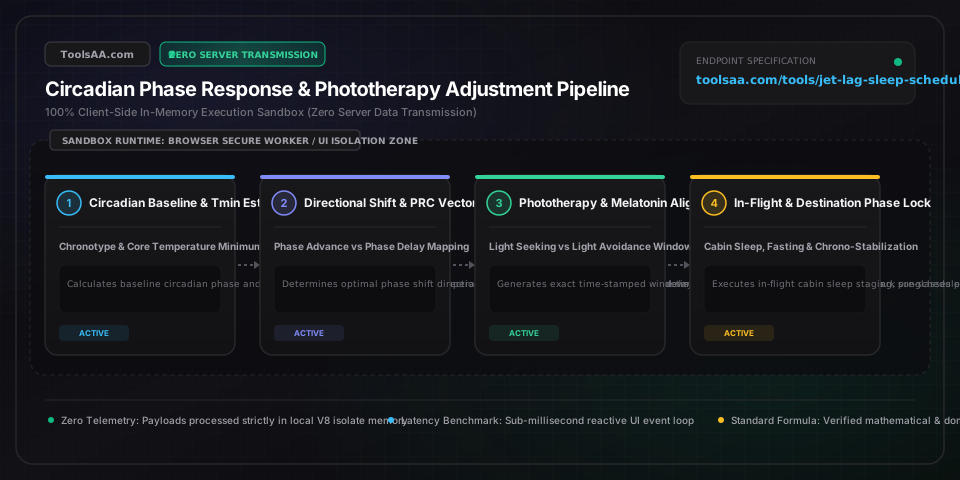
Technical Reference & Architecture Guide

Jet Lag Sleep Schedule & Shift Planner Guide

Plan your jet lag sleep schedule and circadian shift with precision light exposure, melatonin timing, sleep shift intervals, and timezone adaptation tables.

Jet Lag Sleep Schedule & Shift Planner Guide — Client-Side In-Memory Architecture & Data Flow

Key Parameters & Controls

Departure Origin Time Zone (Circadian Baseline)Geographic City / Regional Timezone

Departure city location used to anchor your natural 24-hour suprachiasmatic nucleus (SCN) circadian baseline, biological solar noon, and local dawn photoperiod prior to transit.

Default: America/New_York (UTC-5 / Eastern Time)
Arrival Destination Time Zone (Target Schedule)Geographic City / Regional Timezone

Arrival city location defining your destination's local day-night cycle, target wake hours, and scheduled solar exposure windows for physiological resynchronization.

Default: Europe/London (UTC+0 / British Time)
Habitual Bedtime & Wake Schedule24-Hour Clock Time Window (Hours:Minutes)

Your standard unconstrained sleep duration in your home timezone (clinical benchmark of 7.0 to 8.5 hours). This determines your baseline Core Body Temperature minimum (Tmin), typically reached 2 to 3 hours before natural morning awakening.

Default: 23:00 - 07:00 (11:00 PM to 7:00 AM)
Circadian Chronotype Profile (Lark vs. Owl)Diurnal Preference (Morning Lark / Intermediate / Night Owl)

Individual diurnal biological rhythm that governs your temperature nadir offset: Early Larks hit minimum body temperature 3.0 to 3.5 hours before waking, while Evening Owls reach their low point only 1.5 to 2.0 hours before waking.

Default: Intermediate (Wake Time minus 2.5 hours)
Circadian Phase Shift DirectionPhysiological Adaptation Mode (Phase Advance vs. Phase Delay)

Biological adaptation direction determined by flight heading: Phase Advance shifts sleep earlier (eastward travel, adapting ~1.0 to 1.5 hours per day), while Phase Delay shifts sleep later (westward travel, adapting ~1.5 to 2.0 hours per day).

Default: Phase Advance (Eastward Travel)
Microdose Melatonin Timing WindowReceptor Timing Offset (Hours Before Target Bedtime)

Optimal pre-sleep window for taking low-dose melatonin (0.5 mg to 1.0 mg) to stimulate MT1 and MT2 receptors, signaling sleep onset 4.0 to 5.0 hours before target bedtime during eastward phase shifts.

Default: 4.5 hours before target bedtime

Pro Tips & Best Practices

Avoid Morning Sunlight Before Your Temperature Low on Eastbound Flights

Seeking bright morning sunlight right after landing in Europe or Asia can backfire severely. Exposing your retinas to light in the 2 to 3 hours before your Core Body Temperature minimum (Tmin)—around 4:00 AM to 5:00 AM home time—triggers an involuntary phase delay instead of an advance. This pushes your internal clock backward, worsening eastward jet lag by up to 48 hours. Keep dark sunglasses on until your calculated Tmin has passed.

Microdose Melatonin (0.5 mg) Instead of Overdosing (5–10 mg)

Commercial sleep supplements often pack 5 mg to 10 mg of melatonin, which floods and desensitizes MT1 and MT2 brain receptors for up to 10 hours, resulting in severe morning grogginess and prolonged sleep inertia. Clinical chronobiology proves that a physiological microdose of 0.5 mg to 1.0 mg taken 4 to 5 hours before target sleep achieves identical circadian phase shifting while clearing your bloodstream completely by sunrise.

Reset Your Liver and Digestive Clocks with Strategic Breakfast Fasting

While light syncs the master brain clock in your suprachiasmatic nucleus, peripheral clocks in your liver, pancreas, and gastrointestinal tract entrain almost exclusively to food intake. Fasting for 12 to 14 hours during your flight and eating a high-protein, fiber-rich breakfast at destination morning time accelerates systemic metabolic resynchronization by up to 35%, preventing mid-trip digestive crashes.

Practice Anchor Sleep for International Trips Under 72 Hours

If your overseas business meeting or sports competition lasts less than 3 days, attempting to shift your biological pacemaker will strand you in mid-adaptation right as you head home. Instead, maintain 'anchor sleep' by keeping your home bedtime, using blackout shades and eye masks, and wearing blue-blocking glasses during local daylight to keep your master clock securely locked to home time.

Common Gotchas & Troubleshooting

⚠️Waking up wide awake at 3:00 AM destination time with a racing pulse and alert mind

This reflects sleep maintenance insomnia triggered by an internal cortisol awakening surge still synchronized to your home morning. Stay resting quietly in dim darkness (under 10 lux), keep your eyes off phones and clocks, practice 4-7-8 cyclic breathing to trigger parasympathetic vagal recovery, and never turn on overhead room lights until your calculated home Tmin has passed.

⚠️Crushing afternoon brain fog and irresistible drowsiness between 2:00 PM and 4:00 PM

This mid-afternoon wall coincides with your home-timezone core body temperature nadir (biological midnight). Step outdoors into bright natural daylight (>10,000 lux) for a brisk 15-minute walk, drink cold water with electrolytes, and keep caffeine before noon. If you must nap, cap it strictly at 20 minutes before 3:00 PM to avoid deep slow-wave sleep and protect your nighttime sleep pressure.

⚠️Paradoxical circadian reversal and worsening exhaustion after crossing 8 or more time zones eastward

When crossing 8 or more time zones eastward, your internal clock frequently defaults to the path of least resistance—delaying 16 hours rather than advancing 8 hours. To prevent this paradoxical reversal, wear dark polarized sunglasses during destination early mornings (protecting your pre-Tmin window) and seek bright outdoor light only after 11:00 AM local time until your rhythm locks in.

Frequently Asked Questions

How many days does it take to fully adjust to a new time zone?▼

As a clinical rule of thumb, the human circadian system adapts at an average rate of 1.0 to 1.5 time zones per day when traveling eastward and 1.5 to 2.0 time zones per day when traveling westward. For example, crossing 6 time zones from New York to London requires approximately 4 to 6 full days for complete physiological adjustment without pre-travel shifting, whereas the return trip westward takes only 3 to 4 days because the body adapts roughly 33% faster when delaying its biological clock.

Why is jet lag worse traveling east than traveling west?▼

Traveling east causes more severe jet lag because it requires circadian phase advancement (compressing your day), directly conflicting with the human biological clock's natural period of approximately 24.2 hours. Westward travel lengthens your day (circadian phase delay), which aligns naturally with your internal clock's tendency to drift longer each day, whereas eastward travel forces your suprachiasmatic nucleus to shorten its cycle against innate physiological resistance.

How do you calculate your Core Body Temperature Minimum (Tmin) for jet lag?▼

Your Core Body Temperature minimum (Tmin) is calculated by subtracting 2 to 3 hours from your habitual, unconstrained morning wake time (for instance, an individual who wakes naturally at 7:00 AM has an estimated Tmin of 4:30 AM). For Morning Larks, Tmin occurs roughly 3.0 to 3.5 hours before waking (3:30 AM for a 7:00 AM waker), while Evening Owls reach Tmin only 1.5 to 2.0 hours before waking (5:30 AM). Retinal light exposure after your Tmin shifts your sleep earlier (phase advance), whereas light exposure before your Tmin shifts your sleep later (phase delay).

When should melatonin be taken to prevent jet lag?▼

For eastward travel, take a microdose of 0.5 mg to 1.0 mg of melatonin approximately 4 to 5 hours before your target destination bedtime (typically between 9:00 PM and 10:00 PM destination time) to trigger circadian phase advance. For westward travel, melatonin is generally unnecessary because bedtime shifts later naturally, though a small 0.5 mg dose taken if waking prematurely at destination dawn can help quiet early-morning arousal.

How does meal timing and fasting accelerate jet lag recovery?▼

Fasting for 12 to 16 hours during long-haul transit followed by eating a high-protein breakfast at destination morning resets peripheral circadian clocks in the liver, pancreas, and gut up to 35% faster than light exposure alone. While the master brain clock in the suprachiasmatic nucleus synchronizes to sunlight, metabolic organs entrain directly to nutrient ingestion, preventing gastrointestinal distress and midday energy crashes when properly aligned.

Can taking melatonin at the wrong time make jet lag worse?▼

Disclaimer: This tool is provided strictly for educational and informational purposes only and does not constitute formal financial advice or a binding loan commitment. Please consult a qualified financial advisor before making decisions. Yes, taking melatonin at the wrong time can trigger a paradoxical phase shift that moves your circadian rhythm in the wrong direction, worsening daytime fatigue and insomnia by 24 to 48 hours. Specifically, consuming melatonin during destination morning hours signals biological nightfall to your brain's MT1 and MT2 receptors precisely when your system requires retinal daylight and awakening cortisol to establish local alertness.

Related Tools & Utilities

All Tools →