Shoe Size International Converter & Chart

Shoe Size International Converter & Chart

Convert international shoe sizes across US, EU, UK, and JP with precision foot measurement, brand fit adjustments, width charts, and printable sizing matrices.

Regime label
Load sample:
Source system label27.3 Unit cm / 10.75 Unit in
Source size label10
2A
Sock buffer label+2 mm
Kids growth label+0 mm
Toe ease margin: 15 mmShoe last length: 28.8 Unit cm
Tab instant
Kpi title u s
9.5
Sys u s men
Kpi title e u
43
Exact calculated: 43.2
Kpi title u k
8.5
Exact calculated: 8.7
Kpi title j p
27.5
273 mm Sys mondo
Cockpit titleNike (10)
Sys u s men
9.5
Sys u s women
11
Sys u k
8.5
Sys e u
43
Sys j p
27.5 Unit cm
Sys a u
8.5
Sys c n
27.5 Unit cm
Sys b r
41
Sys mondo
273 mm
Brand profile label: Nike

Runs narrow & 0.5 size small. Size up for running/sports.

Card holder: MENKpi title brand: Nike (10)
Stat1 value
Stat1 label
Stat2 value
Stat2 label
Stat3 value
Stat3 label
Client-Side Processing

High-performance calculation executed entirely in browser memory.

Zero Server Upload Privacy

All payloads remain strictly local with zero external server communication.

Production Ready Export

Clean, optimized output formats ready for immediate deployment.

Technical Reference & Architecture Guide

Shoe Size International Converter & Chart Guide

Convert international shoe sizes across US, EU, UK, and JP with precision foot measurement, brand fit adjustments, width charts, and printable sizing matrices.

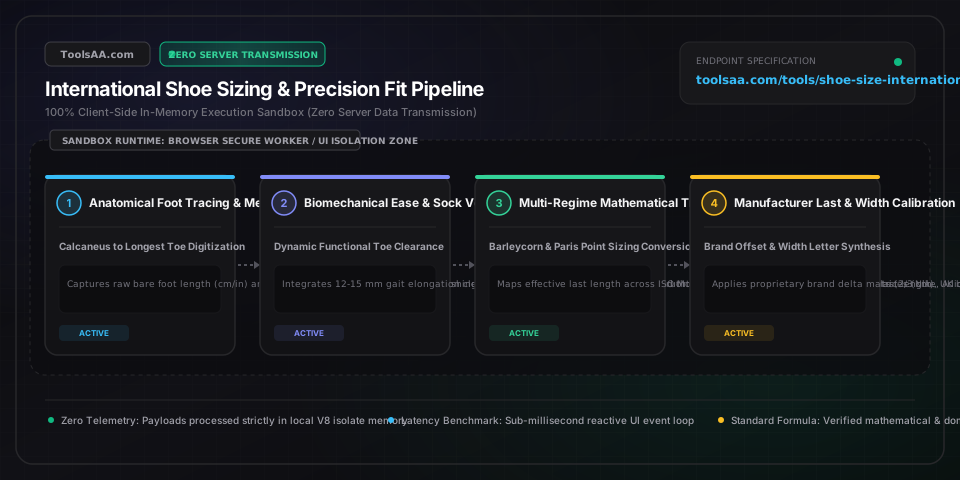
Shoe Size International Converter & Chart Guide — Client-Side In-Memory Architecture & Data Flow

Key Parameters & Controls

Demographic & Category StandardDemographic Sizing Scale

Defines the target demographic group (Adult Men, Adult Women, Unisex, Big Kids, Little Kids, Toddlers, Infants). In US sizing, Women sizes are indexed 1.5 sizes higher than Men sizes for the identical foot length, while UK and European sizing maintain a unisex adult progression.

Default: Adult Men
Source Sizing StandardGeographic Footwear System

The national or regional sizing convention used as the input baseline: US (FIA/Brannock), UK (English Barleycorn), EU (Continental Paris Points), JP (ISO 9407 Mondopoint in cm), AU (Australian), CN (Chinese GB), BR (Brazilian), or MX (Mexican).

Default: US Men
Anatomical Foot LengthPhysical Metric / Imperial Length (cm / inches)

The exact physical distance from the rearmost curve of the calcaneus (heel) to the tip of the longest toe (either the hallux or second toe). Serves as the fundamental invariant ground truth across all international sizing conversion calculations.

Default: 27.1 cm (10.67 in)
Toe Allowance & Functional Ease MarginBiomechanical Clearance (mm)

The necessary internal clearance space inside the footwear last beyond anatomical foot length. During walking and running, the foot elongates under body weight and moves forward inside the shoe; standard footwear requires 10 mm to 15 mm (approx. 0.5 inch) toe allowance.

Default: 12.0 mm to 15.0 mm
Foot Width & Ball Girth FittingJoint Circumference Classification (Letter Code)

The circumference of the foot measured around the first and fifth metatarsophalangeal joints (the ball of the foot). Standard width is D for Men and B for Women; letter ratings extend from 4A/AAAA (extra narrow) through 2E, 4E, and 6E (extra wide).

Default: D (Standard Men) / B (Standard Women)
Brand-Specific Sizing OffsetManufacturing Last Calibration (Half-Sizes)

Empirical calibration adjustment accounting for proprietary shoe last profiles. Brands like Nike and Puma typically construct narrower lasts requiring a half-size increase (+0.5), whereas Converse Chuck Taylors and Clarks run roomy (-0.5).

Default: 0.0 Size Delta (True to Size)
Sock & Insole Thickness BufferInterior Volume Allowance (mm)

Additional millimeter thickness introduced by footwear accessories. Thin dress socks add 0.5 mm, cushioned athletic socks add 2.0 mm, thick wool hiking socks add 4.0 mm, and custom orthopedic insoles require 3.0 mm of interior volume adjustment.

Default: 2.0 mm (Athletic Socks)
Pro Tips & Best Practices

The Afternoon Foot Swelling and Biomechanical Elongation Rule

Human feet naturally expand between 4% and 8% in total volume and can elongate up to 5 mm by late afternoon due to gravity, standing pressure, and increased blood flow. Always measure your foot length or try on new shoes between 3:00 PM and 6:00 PM. Measuring your feet first thing in the morning is the single most common cause of ordering tight footwear.

Always Fit to the Larger Foot (The Asymmetry Factor)

Over 60% of the world population has one foot that is slightly longer or wider than the other (frequently by a quarter to a half size). Always trace and measure both feet while standing with full body weight evenly distributed, and select your shoe size based strictly on the larger foot. A slightly loose shoe can easily be adjusted with an insole, but a tight shoe causes blisters and ingrown toenails.

Heel-to-Ball Arch Length vs Heel-to-Toe Length on Brannock Devices

Standard Brannock measuring devices record two distinct lengths: Heel-to-Toe (total foot length) and Heel-to-Ball (arch length from heel to first metatarsal joint). If you have long toes, your heel-to-ball measurement may indicate a larger shoe size than heel-to-toe. Always choose the larger of the two sizes to ensure the shoe flex point aligns perfectly with the natural ball bend of your foot.

Navigating the European Unisex Last Ambiguity

Unlike US sizing, which assigns different numerical values to men and women for the same length (e.g., US Men 7 = US Women 8.5), Continental European (EU) sizes are numerically unisex (an EU 40 is always based on a 26.6 cm last length). However, European women shoe lasts are constructed narrower through the heel and ball. Men buying EU womens shoes or vice versa should check width fittings.

Common Gotchas & Troubleshooting

⚠️Heel Slipping While Toes Feel Pinched in the Toe Box

This classic fitting issue usually indicates a shoe that is too narrow rather than too large. When a shoe width is too narrow across the metatarsal ball, the foot cannot slide fully forward into the toe pocket, forcing the heel backward and causing slippage. Instead of sizing up a full length (which worsens heel lift), switch to a Wide fitting (EE/2E for Men or D for Women) in your true length.

⚠️Confusion Converting Women Shoe Sizes to Men or Youth Sizes

In the United States and Canada, the standard conversion rule is: US Men Size = US Women Size - 1.5 (e.g., US Women 8.5 equals US Men 7.0). Youth and Big Kids sizes (ending in Y) share the exact same scale as US Men sizes. Therefore, a woman wearing US 7.0 can comfortably wear a Big Kids 5.5Y, which is often $20 to $40 cheaper for the identical sneaker model.

⚠️European Shoe Size Discrepancies Across Different Brands (EU 42 vs 43)

Because one Paris Point is 6.67 mm, European sizes do not align 1:1 with English Barleycorn half-sizes (4.23 mm). Consequently, some brands map US Men 9 to EU 42, while others map US 9 to EU 42.5 or 43. When buying international footwear online, ignore arbitrary regional conversions and check the manufacturer Mondopoint or JP size in centimeters (CM/MM), which represents invariant physical foot length.

⚠️Numbness or Tingling on the Top of the Foot (Instep Pressure)

Pressure on the superficial peroneal nerve across the dorsal instep occurs when shoe volume or throat height is insufficient, common in people with high arches. Alleviate this by adopting window lacing (parallel skip lacing over the sensitive instep zone) or choosing footwear constructed with an open-throat Derby lacing system rather than a closed Oxford bal-type construction.

Frequently Asked Questions

How do you convert US shoe size to EU and UK?▼

To convert US shoe sizes to EU and UK: For Men, subtract 1 from your US size to get your UK size (e.g., US 10 Men = UK 9), and add approximately 32.5 to 33 to get your EU size (US 10 Men = EU 43). For Women, subtract 2 to 2.5 from your US size to get your UK size (US 8 Women = UK 5.5 to 6), and add approximately 30 to 30.5 to find your EU size (US 8 Women = EU 38.5 to 39). For the most accurate cross-border fit, check the shoe length in centimeters (JP/Mondopoint).

What is a women's size 8 in men's shoe size?▼

A women size 8 in US footwear is equivalent to a men US size 6.5. In North American sizing, the standard conversion offset is 1.5 sizes: Men Size = Women Size - 1.5. In European sizing, a US Women 8 corresponds to an EU 38.5 to 39, while in the UK it corresponds to a UK 5.5. Women with wider feet often find men sizing more comfortable, as standard men shoes are built on a wider D-width last compared to standard women B-width lasts.

What shoe size is 25 cm or 10 inches in US and EU?▼

A bare foot length of 25.0 cm (approx. 9.84 inches) corresponds to a US Men 7.5, US Women 9.0, UK 6.5 to 7.0, and EU 40. A foot length of 10.0 inches (25.4 cm) equates to a US Men 8.0, US Women 9.5, UK 7.5, and EU 41. In the Japanese metric system (JP), 25.0 cm is designated directly as size 25.0. Footwear lasts add approximately 1.2 to 1.5 cm of toe allowance beyond bare foot length.

Why do Nike and Adidas shoe sizes fit differently?▼

Nike and Adidas use different proprietary shoe lasts. Nike models are generally built on narrower, form-fitting athletic lasts with a snugger midfoot and taper, often leading shoppers to size up by a half size (+0.5). Adidas tends to construct shoes with a slightly wider, squarer toe box and truer longitudinal length. Furthermore, Converse Chuck Taylors run a full half-size large, while Doc Martens are built on roomy whole-size lasts without half sizes.

What does shoe width D, EE, and 4E mean?▼

Shoe width letters indicate the joint ball girth circumference of the foot relative to its length. For Men: B is Narrow, D is Medium/Standard, 2E (or EE) is Wide, and 4E is Extra Wide. For Women: 2A (or AA) is Narrow, B is Medium/Standard, D is Wide, and 2E is Extra Wide. Each incremental width letter step adds roughly 3/16 inch (4.76 mm) of circumference around the ball of the foot, accommodating broader bone structure and bunions without increasing shoe length.

How do kids and toddler shoe sizes work compared to adult sizes?▼

Children shoe sizing is split into three distinct stages: Infant/Toddler (sizes 0C to 10C, roughly 0 to 4 years), Little Kids/Preschool (sizes 10.5C to 3Y, ages 4 to 8), and Big Kids/Youth (sizes 3.5Y to 7Y, ages 8 to 12). Big Kids sizes seamlessly transition into adult sizing: a Big Kids 7Y has the identical physical length and width as an adult US Men 7.0 (or adult US Women 8.5). Pediatricians recommend leaving 5 mm to 10 mm of toe room in children shoes for rapid growth.

Related Tools & Utilities

All Tools →