Title prefix Title highlight
Badge convection model

Air Fryer Converter & Oven Calculator

Convert oven cooking times and temperatures to air fryer in seconds. Factor in convection airflow, food density, basket crowding, and flip reminder intervals.

Lbl regime selector
Lbl quick presets
Title control deck
Lbl mode forwardDesc mode forward
400Unit fahrenheit
45 Unit minutes short
Lbl high order title
Lbl preheated stateDesc preheated true
Title converted cockpit
Kpi target temp
375Unit fahrenheit
Lbl exact raw 375Unit fahrenheit
Kpi target duration
22 Unit minutes short
20 - 24 Unit minutes short Lbl window
Kpi flip reminder
Lbl at minute 11 Unit minutes short
Lbl halfway turn
Kpi safe core
165°F
Lbl food safety standard
Title airflow simOpt oven conventional ➔ Opt af drawer
Svg airflow optimal
Lbl stopwatch titleLbl timer idle
22:00
Title pro tips

High convective air velocity strips the thermal boundary layer, ensuring fast and even cooking without drying the interior.

Lbl oil recommendation

Oil zero tip

Lbl shake interval technique

Shake single tip

Advisory safety title

Advisory safety desc

Stat target setting375Unit fahrenheit / 22Unit minutes short
Stat mid cook actionLbl at minute 11Unit minutes short
Stat energy saved79%
Stat money saved$0.38
Stat safe temp165°F
Stat local memory100% Client-Side Privacy
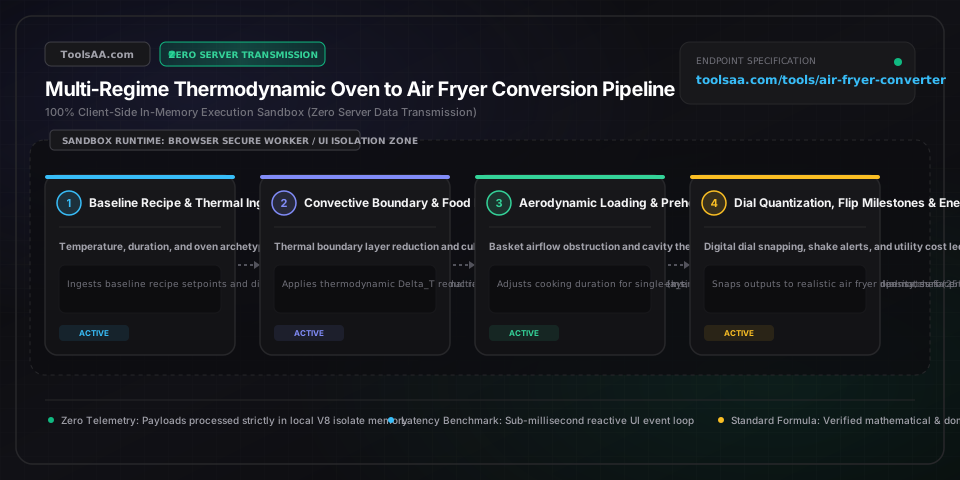
Technical Reference & Architecture Guide

Air Fryer Converter & Oven Calculator Guide

Convert oven cooking times and temperatures to air fryer in seconds. Factor in convection airflow, food density, basket crowding, and flip reminder intervals.

Air Fryer Converter & Oven Calculator Guide — Client-Side In-Memory Architecture & Data Flow

Key Parameters & Controls

source_cooking_temperatureThermal Intensity Magnitude (°F / °C)

The original recipe oven setpoint; standard air fryer conversion reduces this by 25°F (15°C) to compensate for intense convective heat transfer rates.

Default: 400°F (200°C)
source_cooking_durationTemporal Exposure Window (Minutes)

The original oven cooking time; converted air fryer duration is reduced by 20% to 25% due to high-velocity cyclonic air velocity stripping moisture and transferring thermal energy rapidly.

Default: 25 Minutes
source_oven_typeHeat Transfer Mechanism Category

Distinguishes between Conventional Radiant Ovens (requiring standard 25°F drop) and Convection/Fan-Forced Ovens (which already incorporate fan airflow and only require a 0°F to 10°F drop).

Default: Conventional Radiant Oven
air_fryer_cavity_topologyAppliance Architectural Geometry

Compact pull-out drawer baskets concentrate airflow within a smaller volume, cooking faster than larger multi-rack toaster-oven style air fryers which exhibit lower convective velocity.

Default: Compact Drawer Basket with Vortex Fan
food_matrix_density_profileThermodynamic Food Matrix Class

Categorizes food by moisture content, fat rendering needs, and thermal mass (e.g., thin frozen items require rapid crisping, while dense whole roasts require lower heat to avoid exterior charring).

Default: Poultry & Wings
basket_loading_densityAerodynamic Permeability Level

Air fryers rely on uninterrupted 360° air circulation; crowding or stacking food restricts boundary airflow, requiring up to 25% additional cooking time and frequent shaking.

Default: Single Layer with Perimeter Spacing
preheating_conditionInitial Thermal Steady State

Starting with an unpreheated cold air fryer requires adding 2 to 3 minutes to the total converted cooking duration to account for heating coil ramp-up.

Default: Preheated Basket
appliance_wattage_ratingElectrical Power Draw (Watts / Kilowatts)

Electrical power capacity used for energy audit calculations; typical full-size electric ovens draw 3,000W to 5,000W, whereas countertop air fryers draw only 1,400W to 1,800W.

Default: Air Fryer: 1,500W | Oven: 3,000W

Pro Tips & Best Practices

The 25°F and 20% Baseline Rule (and When to Modify It)

The universal culinary baseline for converting any conventional oven recipe to an air fryer is: reduce the set temperature by 25°F (15°C) and reduce the cooking time by 20% (multiply total minutes by 0.8). However, for delicate foods that brown easily (such as cookies, cakes, or sweet glazes with high sugar content), drop the temperature by 30°F to 35°F to prevent surface burning before the internal structure solidifies. Conversely, for quick-searing proteins like steaks or pork chops, keep the temperature identical to the oven broiler setpoint to lock in juices with a crusty sear.

The Convection Baseline Trap (Never Double-Dip Convection Drops)

If your recipe originates from a modern cookbook, British recipe source, or appliance manual that explicitly specifies cooking temperatures for a 'Fan-Forced' or 'Convection' oven, that recipe has already been reduced by 20°C / 25°F from conventional oven temperatures! Applying a second 25°F drop for the air fryer will undercook your dish. When converting from a convection oven recipe to an air fryer, keep the temperature exactly the same (or reduce by at most 5°F to 10°F) and reduce only the cooking time by 10% to 15%.

The Overcrowding Airflow Deficit (Why Crowded Baskets Steam)

An air fryer is essentially a supercharged countertop convection chamber. It creates crisp textures through convective evaporation and rapid Maillard browning driven by high air velocity. When food is piled high or overlapping in the basket, the moisture evaporating from lower layers becomes trapped, creating a micro-steaming environment. Stacking chicken wings or french fries can increase required cooking time by 25% and leave food limp and soggy. Always cook in a single layer with air gaps, or split large quantities into two successive batches.

The Wet Batter Aerosol Hazard (Wet Batter vs Dry Dredge)

Never place wet, drippy liquid batter (such as traditional British fish-and-chip beer batter or tempura) into an air fryer. The ferocious 2,000+ RPM cyclonic vortex fan will blow wet batter right off the food onto the heating coil before it sets, causing burnt smoke and ruined textures. Air fryers require dry dredges (flour, cornstarch, panko breadcrumbs) lightly spritzed with high-smoke-point oil (avocado or refined olive oil) from a non-aerosol pump mister.

Common Gotchas & Troubleshooting

⚠️Food is charred or overly browned on the outside but raw or cold in the center

This occurs when the thermal gradient is too steep, commonly seen with dense items like bone-in chicken breasts, thick pork chops, or dense baked goods. The air fryer's intense convective airflow browns the exterior faster than heat can conduct to the core. To resolve: reduce the air fryer temperature by an additional 25°F (15°C), extend cooking time by 4 to 6 minutes, and tent the top with a small piece of perforated aluminum foil (weighed down so it cannot fly into the heating element) during the initial cooking phase.

⚠️Air fryer generates billowing white smoke during high-fat cooking (e.g., bacon, burgers, lamb chops)

White smoke is caused by rendered animal fat dripping into the bottom collection pan beneath the basket and smoking when heated past its smoke point by radiant heat. To fix immediately: pull the basket out, drain the accumulated pool of liquid grease from the drawer, and place a slice of bread or 2 tablespoons of water in the bottom outer basin beneath the perforated crisper tray to absorb falling grease droplets and extinguish smoke production.

⚠️French fries or roasted vegetables turn out limp, dry, or rubbery instead of crisp

Limpness stems from either excess surface moisture or insufficient oil. If frozen fries thaw slightly before cooking, surface ice turns to steam; if fresh cut potatoes are not soaked in cold water to remove surface starch and patted bone-dry with paper towels, they will not crisp. Ensure food is dry, toss with 1 teaspoon of high-smoke-point oil per pound of vegetables to conduct convective heat, and shake the basket vigorously every 4 to 5 minutes to redistribute contact points.

⚠️Lightweight items (kale chips, pepperoni slices, tortilla wraps, parchment paper) flying into heating element

Air fryers generate powerful air velocities (often exceeding 15 to 25 CFM in compact chambers). Unanchored items can be suctioned upward against the bare glowing heating element, creating immediate fire hazards and burnt odors. Never preheat an air fryer with loose parchment paper inside. Always weigh down lightweight toppings or parchment liners with heavier food, use metal cocktail toothpicks to pin wrap edges, or place a stainless steel wire trivet over delicate items.

Frequently Asked Questions

How do I convert oven cooking time and temperature to an air fryer?▼

The universal rule for converting conventional oven recipes to an air fryer is: reduce the oven temperature by 25°F (15°C) and reduce the cooking time by 20%. For example, if a recipe calls for baking at 400°F (200°C) for 25 minutes in a conventional oven, set your air fryer to 375°F (190°C) for 20 minutes. Start checking doneness at the 16-minute mark (or 75% of the converted time) because air fryers cook significantly faster due to concentrated cyclonic air circulation.

Do I need to preheat my air fryer before converting an oven recipe?▼

Preheating is recommended for foods that require an immediate high-heat sear or rapid crisping, such as steaks, chicken wings, and frozen french fries. Most air fryers preheat in just 2 to 3 minutes (compared to 15 to 20 minutes for a standard oven). If you choose not to preheat your air fryer, simply add 2 to 3 minutes to the total converted cooking duration to allow the heating elements and cavity to reach steady-state temperature.

Why did my food cook too fast or burn when following an air fryer conversion chart?▼

Burning typically happens for three reasons: (1) The recipe was already formulated for a convection oven, in which case applying another 25°F drop or full 20% time cut was too aggressive; (2) The food contains high sugar or sauce content (like barbecue sauce or honey glazes), which caramelizes and burns rapidly under direct convective coils—apply glazes only during the final 3 to 5 minutes of cooking; or (3) The air fryer basket has a very compact drawer size where heating coils sit only 2 inches above the food surface, requiring a lower temperature setting.

How do I convert a convection oven recipe to an air fryer?▼

Convection ovens already feature a fan and operate at temperatures 25°F (20°C) lower than conventional radiant ovens. Because an air fryer is essentially an ultra-compact convection oven with faster air speed, keep the cooking temperature exactly the same as the convection recipe (or drop by at most 5°F to 10°F), and reduce the cooking time by only 10% to 15%. For example, a convection recipe specifying 375°F for 20 minutes converts to 375°F for 17 to 18 minutes in an air fryer.

How do I convert an air fryer recipe back to a regular oven?▼

To convert an air fryer recipe for a standard conventional oven, reverse the formula: increase the air fryer temperature by 25°F (15°C) and increase the cooking time by 25% (or divide air fryer minutes by 0.80). For example, an air fryer recipe calling for 375°F (190°C) for 16 minutes converts to 400°F (200°C) for 20 minutes in a standard conventional oven. Use a dark-colored metal baking sheet or preheated cast iron skillet to replicate the air fryer's crispy bottom.

Does an air fryer actually use less electricity than a conventional oven?▼

Yes, substantially less. A standard domestic electric oven is rated between 3,000 and 5,000 Watts and requires 15 to 20 minutes of preheating plus a longer cook time. A standard air fryer draws only 1,400 to 1,800 Watts and preheats in under 3 minutes with 20% shorter cooking times. In typical cooking scenarios, an air fryer consumes 50% to 75% less kilowatt-hours (kWh) of electricity, saving households between $0.20 and $0.60 per meal and keeping kitchens substantially cooler in summer.

Related Tools & Utilities

All Tools →