Aquarium Volume & Stocking Calculator
Hero categoryHero sub

Aquarium Volume & Stocking Calculator

Calculate exact aquarium gross and net water volume, allometric fish stocking bioload, substrate displacement, filtration turnover, and total floor weight.

Lbl quick presets
US
Sec tank geometry
56.73 Unit gal
Sec displacement
-10.2 Unit gal lost
Lbl substrate depth2" (-5.01 Unit gal)
Lbl hardscape displacement12% (-5.22 Unit gal)
Hs bareHs moderateHs heavy
Sec filtration
9.1 Unit per hour Lbl turnover
Sec quick add fish
Kpi gross vol48.55Unit gal
Kpi net vol38.31-10.2 Unit gal deductions
Kpi bioload475.7%Status overstocked
Kpi total weight629145.2 lbs/ft²
Barometer titleLbl ceiling
475.7%281.4 / 59.15 Unit pts

Desc overstocked

Stratification titleLbl strata layers
Strata top12%
Strata mid19%
Strata bottom68%
Warn bottom overcrowd
Ledger titleLbl prevents overdose
Led gross tank48.55 Unit gal578.8 Unit sq in area
Led substrate-5.01 Unit gal63.6 Unit lbs (Sub gravel)
Led hardscape-5.22 Unit gal12 Unit rock wood
Led net water38.31 Unit gal145 Unit liters
Solver title0 Lbl max safe units

Solver desc

Lbl simulate adding 5 Lbl fish units484.9% Lbl saturation
Solver result lead Neon Tetra, Solver result mid 0 Solver result end
Primary Metric38.31 Unit gal (145 Unit liters)
Efficiency / Capacity475.7% (Status overstocked)
Net Output629 Unit lbs (145.2 Unit lbs sq ft)

Client-Side Processing

High-performance calculation executed entirely in browser memory.

Zero Server Upload Privacy

All payloads remain strictly local with zero external server communication.

Production Ready Export

Clean, optimized output formats ready for immediate deployment.

Disclaimer text

Technical Reference & Architecture Guide

Aquarium Volume & Stocking Calculator Guide

Calculate exact aquarium gross and net water volume, allometric fish stocking bioload, substrate displacement, filtration turnover, and total floor weight.

Aquarium Volume & Stocking Calculator Guide — Client-Side In-Memory Architecture & Data Flow

Key Parameters & Controls

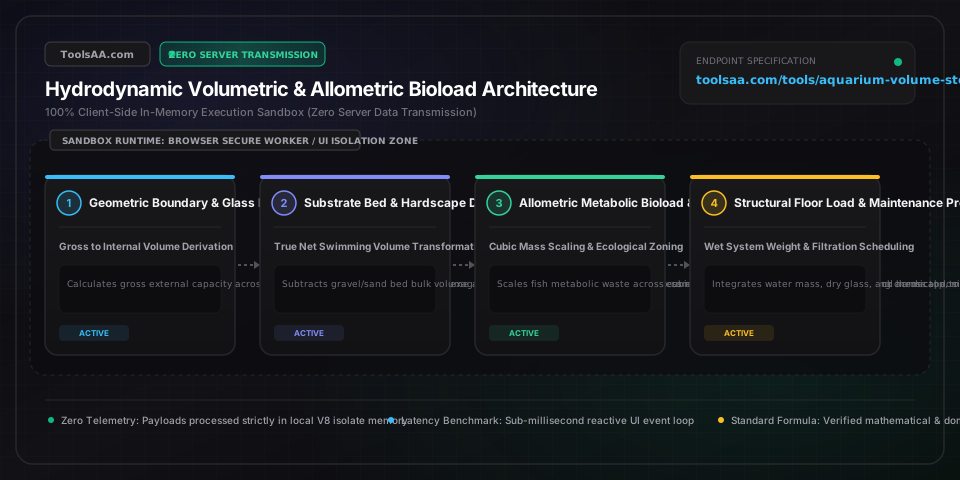
Gross External vs Net Swimming Water Volume (Gallons / Liters)Hydrodynamic Volumetric Measurement

Gross volume represents the total geometric boundary capacity calculated from external glass dimensions. Net water volume subtracts glass wall thickness (6mm to 19mm), the top air gap between the rim and waterline, substrate displacement (gravel/sand volume), and hardscape rocks and driftwood. In typical home aquariums, net swimming volume is 15% to 25% LESS than advertised gross volume. Calculating fish stocking, medication dosages, or water conditioner based on gross volume leads to toxic chemical overdosing and severe biological overstocking.

Default: 55 Gallons Gross / ~43.5 Gallons Net Water
Allometric Metabolic Bioload Index (Mass vs Linear Length)Biochemical Waste Production Metric

A scientific replacement for the outdated 'one inch of fish per gallon' guideline. Fish waste production (ammonia excreted via gills and feces) scales with metabolic body mass (proportional to length cubed, L^2.65 to L^3.0) rather than linear length. A single 10-inch Oscar possesses over 200 times the metabolic tissue mass and waste output of a 1-inch Neon Tetra, despite being only 10 times longer. The allometric bioload index weights fish by their adult length and volumetric body girth (slender, medium, chunky, deep-bodied).

Default: Bioload Saturation: 65% to 85% (Optimal Community Range)
Water Column Vertical Stratification (Top, Mid, Bottom Zones)Ethological Spatial Distribution

Aquatic species naturally inhabit distinct horizontal strata based on their anatomical adaptations (mouth orientation, fin structure, and swim bladder physiology). Surface dwellers (Hatchetfish, Bettas, Killifish) feed with upturned mouths; midwater schooling fish (Tetras, Rasboras, Barbs) cruise open water; benthic bottom-dwellers (Corydoras, Plecos, Loaches) forage along the substrate. Overcrowding a single stratum leads to intense territorial fighting, chronic stress, suppressed immune function, and fin-nipping even if total tank gallonage seems adequate.

Default: Balanced Community (20% Top / 50% Mid / 30% Bottom)
Substrate & Hardscape Displacement VolumetricsPhysical Displacement Calculation

Aquarium gravel, silica sand, and aqua-soil occupy physical space that displaces water. Every inch of substrate in a standard 55-gallon tank displaces approximately 2.7 gallons of water (bulk density ~12 to 15 lbs per gallon). Dense hardscape materials such as Seiryu stones, Dragon stone, and mopani driftwood displace an additional 10% to 25% of water volume. Accurately deducting displacement is critical for determining correct filtration turnover and buffering capacity.

Default: 2.0 in Gravel Bed + 12% Hardscape (~11.5 Gallons Displaced)
Filtration Turnover Capacity & Biological Media FactorMechanical & Biological Flow Rate

The rate at which the aquarium filter circulates the entire water volume, expressed in turnover cycles per hour (Turnover = Pump GPH / Net Gallons). Standard freshwater community aquariums require a minimum of 4x to 5x turnover per hour; messy cichlid or predator tanks demand 8x to 10x turnover. Higher turnover and larger filter media volumes (porous sintered glass, ceramic biomedia) expand the nitrifying bacterial colony (Nitrosomonas and Nitrospira), directly enhancing the tank's bioload carrying capacity.

Default: 350 GPH on 45 Net Gallons (~7.8x Turnover per Hour)
Live Plant Biomass Nitrate Assimilation CreditPhytoremediation Biological Factor

Living aquatic plants (e.g. Anubias, Java Fern, Rotala, Amazon Swords, floating Salvinia) directly absorb ammonium and nitrate ions through their foliage and root systems, bypassing or augmenting the biological nitrogen cycle while oxygenating the water column during photoperiods. In densely planted aquascapes, plant nutrient uptake buffers water chemistry, safely boosting the aquarium's bioload carrying headroom by 10% to 25% compared to bare or artificial plastic tank setups.

Default: Moderate Live Plants (+10% Bioload Headroom Credit)
Structural Wet System Weight & Floor Joist Load PressureStructural Architectural Engineering Limit

Water weighs exactly 8.34 lbs per US gallon (1.0 kg/L). When combined with heavy silicate glass (typically 50 to 120 lbs dry), damp substrate (100 to 150 lbs), hardscape stones, and wooden cabinet stands, a standard 55-gallon aquarium easily weighs over 600 lbs (272 kg), and a 125-gallon setup exceeds 1,400 lbs (635 kg). This generates floor footprint pressures between 120 and 220 lbs/sq ft. Placing large tanks parallel to floor joists or on upper apartment floors without spanning multiple structural load-bearing beams poses serious structural deflection and floor collapse hazards.

Default: 625 lbs Total Wet Weight (~145 lbs/sq ft Floor Pressure)
Pro Tips & Best Practices

The Myth of the '1-Inch-Per-Gallon' Rule and Allometric Mass Scaling

Never stock an aquarium using the outdated 'one inch of fish per gallon' rule. That rule was popularized in the 1960s for slender 1-inch Neon Tetras and fails catastrophically for deep-bodied or adult fish. Fish metabolism and waste production scale allometrically with body mass, which follows a cubic power curve (Length^3). Ten 1-inch Neon Tetras produce approximately 15 grams of total biological mass. A single 10-inch adult Oscar weighs roughly 350 grams—meaning one Oscar produces over 23 times more organic waste and oxygen demand than ten Neons, despite both representing '10 inches' on paper. Always evaluate adult body girth and mass, never linear length alone.

The Net Water Volume Trap in Medication and Dechlorinator Dosing

Commercial aquarium medications, anti-parasitic treatments, and concentrated water conditioners specify dosages based on actual water volume. When hobbyists calculate dosages using the tank's advertised gross capacity (e.g. 20 gallons on a 20-gallon tank) without deducting the 1.5-inch waterline gap, 2-inch substrate bed, and hardscape stones, they inadvertently overdose their tank by 20% to 30%. In sensitive species like freshwater shrimp, scaleless loaches, and wild-caught tetras, chemical overdosing often causes acute osmotic shock and gill burn. Always measure and dose according to calculated Net Water Volume.

Water Column Stratification and Stress-Induced Fin Nipping

An aquarium may be mathematically at only 70% bioload capacity, yet suffer severe behavioral stress and fish deaths if all species occupy the exact same water level. Surface-dwelling Hatchetfish will not interfere with bottom-foraging Corydoras, but crowding ten Tiger Barbs and six Angelfish into the midwater stratum creates constant territorial disputes and shredded fins. When planning livestock, distribute your bioload across all three vertical zones: 20-25% top dwellers, 45-55% midwater schooling fish, and 25-30% bottom scavengers.

Filter Pump GPH vs Biological Media Sintered Surface Area

High pump flow rate (gallons per hour) does not automatically equal high biological filtration capacity. A filter that pushes 400 GPH through a tiny coarse sponge merely provides mechanical water polishing. True biological capacity is dictated by the total colonized surface area of porous sintered glass or ceramic biomedia (measured in m²/L), where nitrifying bacteria convert toxic ammonia into nitrite and nitrate. When stocking messy species (Goldfish, African Cichlids, Plecostomus), prioritize filters with large media baskets (canisters or sumps) and ensure water passes through mechanical pre-filters before hitting biomedia to prevent detritus clogging.

Structural Floor Joist Orientation for Aquariums Exceeding 55 Gallons

Any aquarium 55 gallons or larger creates a concentrated static point load exceeding 600 pounds. Residential timber floor joists (typically 2x10 lumber on 16-inch centers) are engineered to support uniform live loads of 30 to 40 lbs per square foot. To prevent floor sagging and joint separation in the glass tank, always position large aquariums perpendicular across multiple floor joists against a load-bearing exterior wall, rather than running the tank parallel to a single joist. If installing a 100+ gallon tank on a second story, inspect basement beam supports and reinforce subfloor joists with adjustable screw jacks.

Common Gotchas & Troubleshooting

⚠️Water turns milky white and hazy 48 to 72 hours after introducing new fish to an established tank

Milky white haze is a heterotrophic bacterial bloom caused by a sudden surge in dissolved organic carbon and ammonia exceeding the established biofilter's processing capacity. Do NOT perform massive 80% water changes or replace filter cartridges, as this strips beneficial nitrifying bacteria and prolongs the bloom. Immediately test ammonia and nitrite levels. Increase surface agitation with an air stone to maximize dissolved oxygen (bacteria consume massive oxygen), feed sparingly once every other day, dose a concentrated nitrifying bacterial starter (such as Seachem Stability or Fritz TurboStart 700), and allow the bacterial population to self-stabilize over 4 to 7 days.

⚠️Fish are gasping at the water surface, hovering near filter outflows, or showing rapid gill movement despite normal stocking

Surface gasping indicates acute oxygen deprivation, gill damage from toxic ammonia/nitrite, or excessive carbon dioxide (in planted tanks with CO2 injection). First, check tank temperature—warmer water holds significantly less dissolved oxygen (84°F water holds 18% less O2 than 72°F water). Second, verify that surface agitation is actively breaking the water-air interface to facilitate gaseous exchange; a smooth glass-like water surface severely restricts oxygen dissolution. Immediately position filter spray bars or powerheads to ripple the surface, turn off CO2 solenoids, and perform an immediate 30% temperature-matched water change using dechlorinated water.

⚠️Persistent ammonia or nitrite spikes (>0.25 ppm) in an aquarium running for several months

Chronic ammonia or nitrite in a mature setup indicates biological filter stalling, overfeeding, or inadvertent colony sterilization. Verify that you are not washing filter biomedia in chlorinated tap water during water changes; chlorine kills nitrifying bacteria within seconds. Always rinse filter media in siphoned tank water. Check for hidden fish mortality decaying behind rocks or inside plant thickets. Confirm that substrate is vacuumed regularly to remove anaerobic detritus pockets. If bioload exceeds filter capacity, upgrade to a larger canister filter with sintered ceramic media, reduce feeding frequency to once daily, and add fast-growing floating plants (Pistia, Salvinia, Hornwort) to rapidly consume free ammonium.

⚠️Aquarium stand wobbles, doors bind, or the water level looks visibly tilted from left to right

An uneven water line indicates floor joist deflection or an unlevel stand. Even a minor 1/4-inch tilt across a 48-inch tank produces severe torsional shear stress on the vertical glass silicone seams, dramatically increasing the risk of catastrophic tank blowout. Never shim the glass tank directly; always place rigid shims beneath the bottom perimeter base of the cabinet stand where it contacts the floor. For rimless glass tanks, always place a 6mm closed-cell EVA foam self-leveling mat beneath the bottom glass plate to absorb microscopic point pressure imperfections from the stand surface.

Frequently Asked Questions

How do you calculate the actual water volume of an aquarium?▼

To calculate the actual net water volume of an aquarium, you must not rely on the manufacturer's nominal gross volume. First, calculate the internal tank volume in cubic inches: (Length - 2 * Glass Thickness) * (Width - 2 * Glass Thickness) * (Height - Waterline Gap). Divide the internal cubic inches by 231 to obtain gross internal US gallons (or divide by 1,000 for liters if measuring in centimeters). Next, calculate and subtract substrate displacement: Substrate Length * Width * Substrate Depth divided by 231. Finally, deduct 10% to 20% of the remaining volume for hardscape stones, wood, and decorations. In typical setups, a standard 55-gallon tank holds between 42 and 45 gallons of actual net water.

Why is the 1 inch of fish per gallon rule inaccurate and dangerous?▼

The 'one inch of fish per gallon' guideline is fundamentally flawed because it assumes biological waste production scales linearly with fish length. In reality, animal metabolism and body mass scale allometrically with volume (Length cubed, or L^3). For example, ten 1-inch Neon Tetras have a combined body mass of approximately 15 grams, whereas one 10-inch Oscar weighs approximately 350 grams. The Oscar produces roughly 23 times more waste, consumes exponentially more dissolved oxygen, and requires vastly more physical swimming territory than ten Neons combined, despite both representing '10 inches'. Sticking to the linear rule results in disastrous overstocking, ammonia poisoning, and premature fish mortality when keeping medium or large species.

How many fish can you safely put in a 10, 20, or 55 gallon tank?▼

Safe stocking numbers depend entirely on adult fish size, body girth, swimming activity, and filtration efficiency. In a 10-gallon tank (~8 gal net), you can safely keep 1 Betta with 4-6 small pygmy corydoras, or a micro-school of 8-10 Chili Rasboras with dwarf shrimp. In a 20-gallon tank (~16 gal net), you can maintain a vibrant community of 10-12 small schooling tetras (e.g. Neons or Rummynose), 6 dwarf corydoras, and 1 peaceful centerpiece dwarf gourami. In a 55-gallon tank (~44 gal net), you can safely house 15-20 small schooling tetras, 8-10 corydoras, 2-4 German Blue Rams or Angelfish, and 1 Bristlenose Pleco, provided your filter delivers at least 300 GPH turnover.

How much does a filled aquarium weigh per gallon and will it damage floors?▼

Pure water weighs 8.34 pounds per US gallon (1.0 kg/L). However, a fully assembled aquarium system—including the heavy glass vessel (approx. 1 to 2 lbs per gallon of capacity), damp gravel substrate (approx. 1.5 to 2.5 lbs per gallon of tank capacity), rock hardscape, and wooden furniture stand—typically weighs between 10.5 and 12.5 pounds per gallon. Therefore, a 55-gallon setup weighs approximately 600 to 650 pounds (272-295 kg), and a 125-gallon setup weighs over 1,400 pounds (635 kg). Standard modern residential floors are engineered to support 30 to 40 lbs per square foot uniform load. A 55-gallon tank exerts over 140 lbs/sq ft on its footprint; while safe when placed perpendicular across floor joists against a load-bearing wall, tanks 75 gallons and larger require structural joist verification.

How does filtration turnover and live plants affect stocking capacity?▼

Filtration and live aquatic plants directly expand an aquarium's stocking headroom by actively processing metabolic wastes. A standard filter providing 4x tank turnover per hour maintains baseline bacterial nitrification. Upgrading to a high-capacity canister filter or sump providing 8x to 10x turnover with quality sintered ceramic biomedia increases ammonia conversion speed and water oxygenation, safely boosting bioload capacity by 20% to 35%. Furthermore, healthy live plants (especially fast-growing stem plants and floating species like Salvinia and Hornwort) consume ammonium and nitrate directly as fertilizer, curbing nitrate accumulation and allowing hobbyists to maintain full community populations with lower water change stress.

How often and how much water should you change in an aquarium?▼

For an aquarium operating at optimal stocking capacity (60% to 80% bioload saturation), replacing 20% to 25% of the net water volume once every 7 to 10 days is the universal gold standard. Lightly stocked or heavily planted tanks may only require a 15% water change every two weeks, whereas heavily stocked cichlid or predator tanks demand 35% to 50% weekly water changes to prevent toxic nitrate accumulation (>40 ppm). Always use a gravel vacuum to siphon waste from the substrate surface, match the replacement water temperature to within 2°F of the tank to avoid thermal shock, and pre-treat tap water with an authentic dechlorinator to neutralize chlorine and chloramines.

Related Tools & Utilities

All Tools →