Blood Alcohol Calculator (BAC & Sober Time)

Blood Alcohol Calculator (BAC & Sober Time)

Calculate your blood alcohol concentration (BAC) and hours until sober with our precise Widmark formula calculator. Track drinks, legal driving limits, and decay.

Presets label
Primary Metric0.041Unit bacBadge below limit
Efficiency / Capacity2Unit hours45Unit minsLbl target sober clock 06:06 AM
Net Output50.8Unit grams≈ 3.6 Lbl standard drinks (32 fl oz)
Title control deck
lbs
2Unit h 0Unit m
0.015%/hr
Title drink builder2 Unit drinks count
Lbl quick add beverage
Craft IPA Pint16 fl oz • 6.8% ABV • 50.8g pure ethanol
2
Lbl custom beverage
oz
%
0.05%0.08%0.15%0.00%0.20%+
0.041Unit bac pct
Divided Attention Deficit & Relaxation
Lbl driving statusStatus legal

Msg currently under limit

Lbl complete sobriety0.000% BAC

Msg requires liver decay 0.015%/hr. Msg total time remaining 2h 45m.

Lbl zero bac clock 06:06 AM
Lbl peak bac0.071%
Lbl std drinks3.6 Unit drinks
Lbl body water55.5 kg
Lbl peak time45 Unit mins
Disclaimer title

Disclaimer text
Technical Reference & Architecture Guide

Blood Alcohol Calculator (BAC & Sober Time) Guide

Calculate your blood alcohol concentration (BAC) and hours until sober with our precise Widmark formula calculator. Track drinks, legal driving limits, and decay.

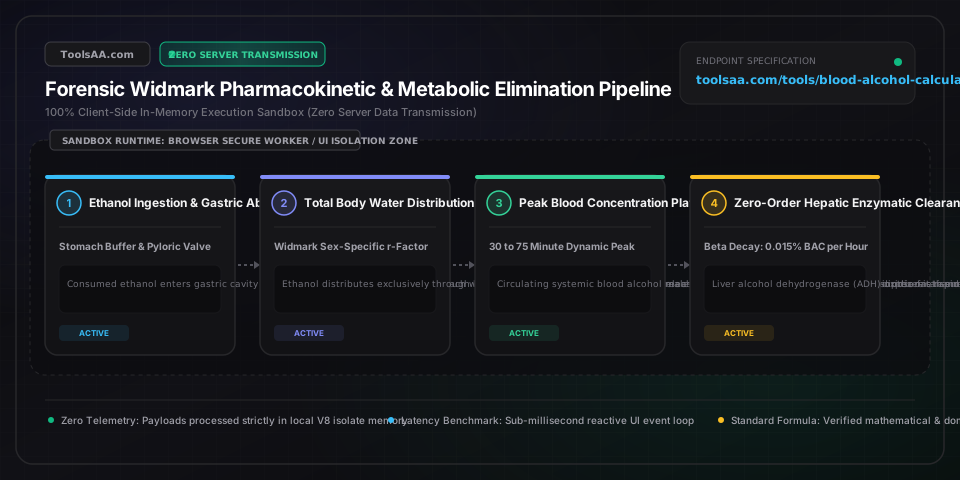
Blood Alcohol Calculator (BAC & Sober Time) Guide — Client-Side In-Memory Architecture & Data Flow

Key Parameters & Controls

Body Mass & Hydration BaseTotal Body Weight (lbs / kg)

Total body weight determines the physical volume into which consumed ethanol distributes. Because alcohol dissolves only in water and not in adipose lipid tissue, individuals with higher lean muscle mass dilute alcohol into a larger physiological solvent volume, producing lower peak BAC.

Default: 160 lbs (72.5 kg)
Biological Sex Distribution (Widmark r-Factor)Body Water Fraction Ratio

The Widmark gender coefficient represents the proportion of body weight that contains water. Clinical standards set r = 0.68 for biological males (approx. 68% body water) and r = 0.55 for biological females (approx. 55% body water due to naturally higher essential adipose tissue and lower gastric alcohol dehydrogenase activity).

Default: Male: 0.68 / Female: 0.55
Pure Ethanol Mass ConsumedFluid Volume (oz / mL) & ABV %

Absolute ethanol weight calculated via ethanol specific density of 0.7894 grams per milliliter. A standard US drink contains exactly 14.0 grams (0.6 fl oz) of pure ethanol, a UK alcohol unit contains 8.0 grams, and international standard drinks contain 10.0 grams.

Default: 14.0 grams pure ethanol per standard drink
Gastric Food Buffer & Absorption DelayPyloric Valve Absorption Coefficient

Food in the stomach prevents alcohol from rapidly passing through the pyloric sphincter into the duodenum, where 80% of alcohol absorption occurs. Consuming a substantial meal delays peak blood concentration from 30 minutes up to 75-90 minutes and dampens peak BAC by up to 20-30% via first-pass gastric oxidation.

Default: Light Snack / Balanced Meal
Metabolic Clearance Rate (Beta Factor)Elimination Velocity (% BAC / hour)

The zero-order hepatic metabolic clearance rate driven by alcohol dehydrogenase (ADH) and aldehyde dehydrogenase (ALDH) enzymes. The legal forensic consensus standard is 0.015% per hour (0.015 g/dL/hr), with normal biological distribution ranging from 0.012% in slow metabolizers to 0.020% in habitual drinkers.

Default: 0.015% BAC per hour

Pro Tips & Best Practices

Craft Beer Pint ABV Disparity Trap

A single 16 oz pint of 7.5% ABV craft IPA delivers 28.3 grams of pure ethanol—identical to drinking two full 12 oz 5.0% standard beers or two 1.5 oz shots of 80-proof whiskey. Many social drinkers track individual glassware rather than fluid ounces and alcohol percentage, inadvertently doubling their blood alcohol concentration.

Biological Sex Gastric ADH Deficit

Biological females produce substantially lower quantities of gastric alcohol dehydrogenase (ADH) enzymes in the stomach lining. Consequently, up to 30% more alcohol enters female bloodstream unoxidized compared to males of identical body weight consuming identical drink amounts, accelerating peak BAC spikes.

The Mellanby Effect & Sensory Sobriety Illusion

Cognitive processing speed, dynamic visual acuity, and motor reaction times are severely more degraded while blood alcohol is actively rising than when BAC is falling at the exact same numeric value. On the downward slope, drinkers often feel subjectively sober despite still testing far above the statutory DUI driving limit.

Zero-Order Hepatic Saturation vs Popular Hangover Remedies

Liver alcohol dehydrogenase enzymes become completely saturated at blood alcohol concentrations as low as 0.02% BAC. Because clearance follows strict zero-order kinetics, no amount of hot coffee, cold showers, cardiovascular exercise, or water hydration can accelerate the liver's fixed elimination pace of approximately 0.015% BAC per hour.

Common Gotchas & Troubleshooting

⚠️Roadside breathalyzer reading is significantly higher than calculated BAC

Breath alcohol analyzers calculate BAC by measuring vapor in alveolar breath using Henry's Law partition ratio (typically 2,100:1). If alcohol was swallowed, burped, or regurgitated within the preceding 15-20 minutes, residual mouth alcohol trapped in salivary glands or dental bridges artificially inflates breath readings by 0.05% to 0.15% above true systemic blood levels. Evidentiary protocols mandate a strict 15-minute observation period with a mouth rinse before valid testing.

⚠️Calculator indicates 0.00% BAC but user still experiences marked dizziness and sluggish reflexes

Neurological impairment frequently persists past chemical blood clearance due to inner-ear endolymph specific gravity imbalances (positional alcohol nystagmus), systemic dehydration, disrupted REM sleep cycles, and toxic circulating acetaldehyde metabolites. Operating a motor vehicle while experiencing a severe hangover carries statistically elevated crash risks even at 0.00% blood alcohol.

⚠️Carbonated drinks and sparkling mixers producing rapid drunkenness unexpected by the model

Carbon dioxide effervescence in sparkling wine, champagne, and club soda cocktails physically relaxes the pyloric sphincter, rushing alcohol out of the stomach and into the small intestine where surface area absorption is rapid. When logging carbonated drinks, select 'Fasting / Empty Stomach' to properly simulate the compressed 25-35 minute absorption peak.

⚠️Calculated sobriety time displays instant zero despite heavy drinking session

Verify that your elapsed time input represents the time elapsed since the *first* drink was initiated, not the time since you finished your last drink. If an elapsed time of 7 hours is entered for 2 standard drinks, the continuous 0.015%/hr metabolic elimination rate will mathematically reduce the BAC to zero before the calculation finishes.

Frequently Asked Questions

How do you calculate blood alcohol concentration by hand using the Widmark formula?▼

To calculate BAC manually: First determine absolute alcohol consumed in grams = Volume (mL) × (ABV% / 100) × 0.7894 (ethanol density). Next, calculate body water weight in grams = Body Weight in kg × 1000 × Widmark factor (0.68 for biological males, 0.55 for females). Divide alcohol grams by body water grams, multiply by 100 to yield theoretical peak BAC in g/dL (%). Finally, subtract metabolic decay: Peak BAC - (0.015 × hours elapsed since first drink). For example, a 180 lb (81.6 kg) male having two 12 oz (355 mL) 5% beers (28g ethanol) over 2 hours computes: 28g / (81600 × 0.68) × 100 = 0.050% peak BAC minus (0.015 × 2 hours = 0.030%) leaving an active BAC of 0.020%.

How many hours does it take to get from 0.08 BAC to 0.00 completely sober?▼

It takes approximately 5 hours and 20 minutes (5.33 hours) for an average adult to drop from a legal limit of 0.08% BAC down to 0.00% complete sobriety. Because the human liver clears alcohol at a steady linear rate of roughly 0.015% BAC per hour (spanning 0.012% to 0.020% depending on liver enzyme efficiency), determine your total recovery time by dividing your current BAC by your metabolic rate: 0.08 / 0.015 = 5.33 hours. No combination of hydration, caffeine, or sleep can speed up this enzymatic process.

What is the difference between BrAC and BAC?▼

BAC (Blood Alcohol Concentration) measures the percentage of ethanol directly circulating in bloodstream in grams of alcohol per 100 mL of blood (e.g., 0.08% = 0.08 g/dL). BrAC (Breath Alcohol Concentration) measures the mass of alcohol vapor expelled from deep lung alveolar air, stated in milligrams per liter (mg/L) or micrograms per 100 mL (µg/100 mL). Electronic breathalyzers convert BrAC into an estimated BAC using statutory partition ratios (2,100:1 in the United States and Canada; 2,300:1 in the United Kingdom). In legal proceedings, forensic blood draws take legal precedence over preliminary breath testing.

Does drinking water or eating food after getting drunk lower your BAC faster?▼

Disclaimer: This tool is provided strictly for educational and informational purposes only and does not constitute formal financial advice or a binding loan commitment. Please consult a qualified financial advisor before making decisions. No, consuming water or food after alcohol is already circulating in the bloodstream does not reduce BAC or accelerate liver metabolism. Food only blunts intoxication when eaten before or during alcohol consumption, where it physically delays gastric emptying through the pyloric valve. Once ethanol enters the duodenum and bloodstream, hepatic alcohol dehydrogenase is saturated (zero-order kinetics), oxidizing alcohol at a fixed speed of ~0.015% per hour. Water relieves dehydration and headache symptoms, but does not alter metabolic clearance velocity.

Related Tools & Utilities

All Tools →