Short title
Mode standard

Overtime Pay Calculator & Time and a Half

Calculate overtime pay, time-and-a-half, and double time. Features California daily rules, FLSA blended rates, bonus adjustments, and reverse goal solving.

100% Client-Side Privacy
Badge zero server
Badge cfa verified
Presets

FLSA 40h standard, CA § 510 daily 8h/12h rules

Client-Side ProcessingUS ($)
$25.00Unit per hr
40 Unit hours
48 Unit hours
$0.00
22%
5%
3.2%
Lbl gross pay$1,300.0048.0 Col total hours
Lbl ot premium pay$300.00+8.0 Unit ot hours
Lbl effective rate$27.08Lbl vs base $25.00 Lbl base
Lbl estimated net pay$963.30Lbl after deductions 22% Lbl deductions
Title compensation breakdownLbl hours summary: $1,300.00
74%Lbl chart net
$963.30 Lbl net paycheck upper
Lbl gross payLbl chart net$1,300.00 @ 48.0Unit hours short
40Unit hours short Thresh0h48Unit hours short64Unit hours short
Lbl chart regular:77%
Lbl chart overtime15:23%
Lbl chart double time20:0%
Lbl chart bonus:0%
Lbl straight pay:$1,000.00
Lbl ot hours:+$300.00
Lbl gross pay:$1,300.00
Lbl pre tax shelter (5%):-$65.00
Lbl estimated tax rate (22.0%):-$271.70
Lbl estimated net pay:$963.30
Lbl real purchasing power (3.2%):$933.43
Disclaimer title

Disclaimer text

Lbl reg hours
40.0 Unit hours
Lbl ot hours
8.0 Unit hours
Lbl effective rate
$27.08Unit per hr
Client-Side Processing

High-performance calculation executed entirely in browser memory.

Zero Server Upload Privacy

All payloads remain strictly local with zero external server communication.

Production Ready Export

Clean, optimized output formats ready for immediate deployment.

Technical Reference & Architecture Guide

Overtime Pay Calculator & Time and a Half Guide

Calculate overtime pay, time-and-a-half, and double time. Features California daily rules, FLSA blended rates, bonus adjustments, and reverse goal solving.

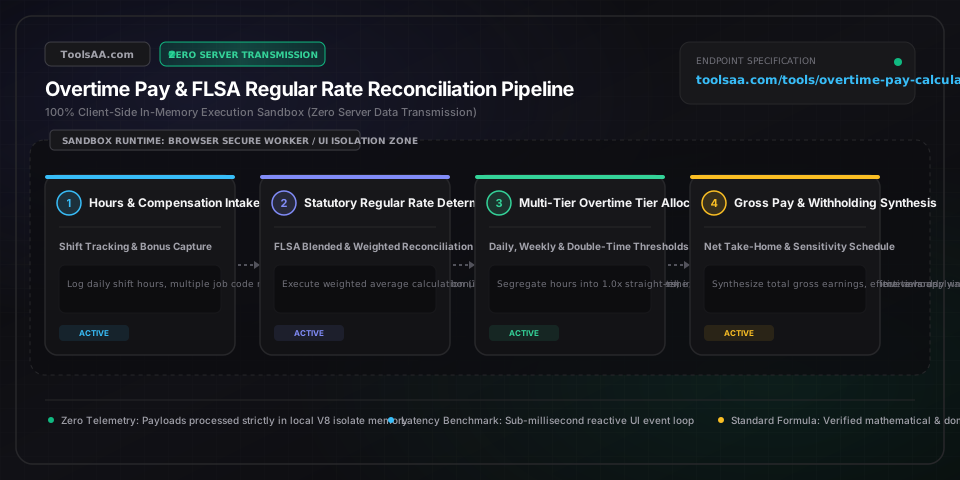
Overtime Pay Calculator & Time and a Half Guide — Client-Side In-Memory Architecture & Data Flow

Key Parameters & Controls

Regular Hourly Rate (Straight Time)Monetary Rate ($/hr, £/hr, €/hr, ¥/hr)

The contractual base wage paid per hour for standard non-overtime work. Under FLSA 29 U.S.C. § 206 rules, this rate cannot fall below the federal statutory floor of $7.25/hr, state minimum wage benchmarks (e.g. $16.00/hr in California, $16.28/hr in Washington), or municipal prevailing wage determinations.

Default: $25.00/hr
Standard Weekly Hours ThresholdDuration (Hours / Workweek)

The statutory number of hours an employee must work within a designated 7-consecutive-day workweek before overtime rates apply (40.0 hours under US FLSA, 38.0 hours in Australia, 35.0 hours in France). Statutory averaging across biweekly pay periods is strictly prohibited under 29 CFR § 778.104.

Default: 40.0 hrs
Time-and-a-Half Overtime Multiplier (1.5x)Multiplication Factor (Scalar Ratio)

The statutory minimum overtime multiplier under FLSA 29 U.S.C. § 207(a)(1) requiring employers to compensate non-exempt personnel at no less than 150% (1.5x) of the employee's established regular rate of pay for all hours worked in excess of the weekly or daily standard threshold.

Default: 1.5x
Double Time Multiplier (2.0x)Multiplication Factor (Scalar Ratio)

Premium rate equal to 200% (2.0x) of the regular hourly rate, legally mandated under California Labor Code § 510 for work beyond 12.0 hours in a single workday or beyond 8.0 hours on the 7th consecutive workday of a workweek, as well as union collective bargaining agreements (CBA) governing holidays and weekend shifts.

Default: 2.0x
Non-Discretionary Bonuses & CommissionsMonetary Allocation ($ / Pay Period)

Incentive payments tied to productivity, attendance, safety, retention, or gross sales commissions. Under FLSA 29 CFR § 778.208, non-discretionary payments must be apportioned back across all hours worked during the performance period to compute the statutory regular rate for overtime true-ups.

Default: $0.00
FLSA Blended Regular Rate (Weighted Average)Computed Monetary Rate ($/hr)

The statutory regular rate computed under 29 CFR § 778.115 when an employee performs two or more job roles at differing hourly rates during the same workweek: Total Straight-Time Compensation divided by Total Hours Worked across all job codes.

Default: $31.33/hr
Daily Overtime Thresholds (California § 510)Daily Statutory Duration Criteria

Jurisdictional daily thresholds mandating 1.5x overtime pay for daily hours exceeding 8.0 up to 12.0, 2.0x double time for all daily hours exceeding 12.0, and progressive premium tiers for all hours worked on the 7th consecutive day of the workweek.

Default: 8h (1.5x) / 12h (2.0x)
Effective Withholding & Deductions RateComposite Percentage (%)

Combined marginal payroll tax rate encompassing FICA (Social Security 6.2% up to the statutory wage ceiling and Medicare 1.45% plus 0.9% Additional Medicare Tax above $200,000 threshold), federal income tax withholding tables, and state/local payroll taxes used for net take-home pay projection.

Default: 22.0%
Pro Tips & Best Practices

Always Include Non-Discretionary Bonuses in the FLSA Regular Rate

Under FLSA 29 CFR § 778.208, non-discretionary bonuses (including attendance awards, safety incentives, production bonuses, and commissions) must be apportioned back across all hours worked in the earn-out period to recalculate the employee's regular rate of pay. Compensating overtime solely on base contract wages while omitting non-discretionary bonuses constitutes a widespread wage and hour violation exposing employers to back-pay claims and liquidated damages.

Apply Weighted Average Overtime for Employees Working Multiple Pay Rates

When an employee works in two distinct job roles at different pay scales during the same workweek (e.g. $20.00/hr warehouse fulfillment and $28.00/hr commercial driving), federal law (29 CFR § 778.115) requires calculating a blended weighted regular rate of pay: Total Straight-Time Earnings divided by Total Hours. Overtime hours are compensated with an additional half-time (0.5x) premium on that blended regular rate.

Distinguish California Daily Overtime from Federal Weekly Thresholds

Federal overtime applies strictly to weekly hours exceeding 40.0. In contrast, California Labor Code § 510 mandates overtime after 8.0 hours in a single workday, double time after 12.0 hours in a single workday, and 1.5x/2.0x on the 7th consecutive workday. Crucially, under statutory anti-pyramiding rules, daily overtime hours already compensated at 1.5x or 2.0x cannot be counted toward the weekly 40.0-hour threshold to trigger double premiums.

Account for Supplemental Withholding on Large Overtime Paychecks

Employees frequently observe a disproportionately higher tax withholding on paychecks containing significant overtime. Payroll withholding algorithms (IRS Publication 15-T) annualize each individual paycheck to determine tax brackets, which artificially pushes that single pay period into higher marginal withholding tiers. However, actual annual tax liability is reconciled on IRS Form 1040, meaning excess withheld amounts are refunded.

The Mandatory 7-Consecutive-Day Workweek Quarantine Rule

Employers are legally prohibited from averaging hours across two weeks of a biweekly payroll period to avoid overtime liability. Under 29 CFR § 778.105, each designated 168-hour workweek stands strictly alone. An employee logging 50 hours in Week 1 and 30 hours in Week 2 must be paid 10 hours of overtime in Week 1, even though total biweekly hours equal standard straight-time volume (80 hours).

Common Gotchas & Troubleshooting

⚠️Paycheck Discrepancy from Excluding Shift Differentials in the Regular Rate

If your employer pays a night-shift, weekend, or hazard differential (e.g. +$2.50/hr), that differential must be factored into your regular hourly rate before calculating the 1.5x overtime multiplier under 29 CFR § 778.207(b). If your base wage is $20.00/hr and you earn a $2.00/hr night differential, your overtime rate is ($20.00 + $2.00) * 1.5 = $33.00/hr, not ($20.00 * 1.5) + $2.00 = $32.00/hr. Reconcile pay stub line items to ensure differentials are applied prior to multiplication.

⚠️Overcounting Overtime When Daily and Weekly Overtime Overlap (Anti-Pyramiding)

If you work four 10-hour workdays in California (40 total hours), your gross pay consists of 32 straight-time hours and 8 daily overtime hours (2 hours at 1.5x per day). Even though total hours equal 40, statutory anti-pyramiding laws (California Labor Code § 510 and FLSA 29 CFR § 778.401) prohibit counting daily overtime hours toward the 40-hour weekly threshold. The remaining 32 straight-time hours do not trigger weekly overtime.

⚠️Salaried Non-Exempt Overtime Miscalculation under the Fluctuating Workweek

Under the Fluctuating Workweek (FWW) method (29 CFR § 778.114), a fixed weekly salary covers all straight-time hours worked regardless of schedule volume. Therefore, the overtime premium for hours beyond 40 is paid at half-time (0.5x) of the fluctuating regular rate (Weekly Salary / Total Hours Worked), rather than 1.5x, because straight-time (1.0x) compensation has already been satisfied by the base salary.

⚠️Employer Offset of Comp Time in Lieu of Cash Overtime in Private Sector

Offering compensatory time off ('comp time') instead of 1.5x cash overtime is unlawful for private-sector employers under the Fair Labor Standards Act, even if mutually agreed upon in writing. Comp time arrangements are exclusively authorized for public-sector government entities under 29 U.S.C. § 207(o). Non-exempt private employees must receive cash overtime in the corresponding pay period.

Frequently Asked Questions

How do you calculate time and a half overtime pay?▼

Time and a half overtime pay is calculated by multiplying your FLSA regular hourly rate by 1.5, and then multiplying that premium rate by the number of overtime hours worked beyond 40.0 in a standard workweek. Formula: Overtime Pay = Overtime Hours * (Regular Hourly Rate * 1.5). For example, if your base wage is $24.00/hr and you work 46.0 hours: Straight Time Pay = 40.0 hrs * $24.00 = $960.00; Overtime Rate = $24.00 * 1.5 = $36.00/hr; Overtime Pay = 6.0 hrs * $36.00 = $216.00; Total Gross Earnings = $960.00 + $216.00 = $1,176.00.

How do non-discretionary bonuses and commissions change the regular rate of pay?▼

Under the Fair Labor Standards Act (FLSA 29 CFR § 778.208), non-discretionary bonuses (such as productivity bonuses, retention incentives, and commissions) must be factored into your regular rate of pay. Formula: Regular Rate of Pay = (Total Base Straight-Time Earnings + Non-Discretionary Bonuses) / Total Hours Worked. Because the employee has already received straight-time payment for all hours worked, the employer must pay an additional true-up premium equal to 0.5 times the revised regular rate for all overtime hours worked during that bonus period.

How does California daily overtime differ from federal FLSA overtime rules?▼

Under federal FLSA rules, overtime is only required when an employee works more than 40.0 hours in a designated 7-day workweek. Under California Labor Code § 510, daily overtime applies after 8.0 hours up to 12.0 hours in a single workday (paid at 1.5x), and double time (2.0x) applies for all hours worked exceeding 12.0 in a workday. Furthermore, California mandates 1.5x for the first 8.0 hours worked on the 7th consecutive workday in a workweek, and 2.0x double time for all hours beyond 8.0 on that 7th consecutive day.

How do you calculate overtime when an employee has two different pay rates?▼

Under federal law (FLSA 29 CFR § 778.115), employers must calculate overtime using the weighted average blended method. Step 1: Calculate total straight-time earnings: (Job A Hours * Job A Rate) + (Job B Hours * Job B Rate). Step 2: Calculate the blended regular rate: Total Straight-Time Earnings / Total Hours Worked. Step 3: Compute the overtime premium by multiplying 0.5 times the blended regular rate by the number of overtime hours over 40.0. Adding this premium to total straight-time earnings yields total statutory gross pay.

Is overtime pay taxed at a higher rate than regular hourly wages?▼

No, overtime pay is not subject to a higher statutory tax rate. Overtime earnings are classified as ordinary income and are taxed under the exact same federal, state, and local income tax brackets as regular straight-time wages. However, payroll software calculates tax withholding on a per-period basis by annualizing that single check's gross earnings. A large overtime check can temporarily push that specific paycheck into a higher marginal withholding bracket, but any over-withheld tax is reconciled and refunded when filing your annual IRS Form 1040.

How does overtime pay work for salaried non-exempt employees under the fluctuating workweek?▼

Disclaimer: This guide is provided strictly for educational purposes and does not constitute formal legal or tax counsel. Salaried non-exempt employees are legally entitled to overtime pay. Under the Fluctuating Workweek (FWW) method (29 CFR § 778.114), an employee receives a fixed salary intended to cover all straight-time hours worked, regardless of how few or many. The regular rate is determined anew each week: Weekly Salary / Total Hours Worked in that specific week. Overtime hours exceeding 40.0 are then compensated with an additional half-time (0.5x) premium on that fluctuating regular rate.

Related Tools & Utilities

All Tools →