Card title input
Hint headspace
Hint drainage
Card title results
Ymyl notice
Calculate potting soil volume for pots, planters, and raised beds. Convert quarts, cubic feet, and liters to exact bag counts with compaction and cost estimates.
Hint headspace
Hint drainage
Ymyl notice
Calculate potting soil volume for pots, planters, and raised beds. Convert quarts, cubic feet, and liters to exact bag counts with compaction and cost estimates.
Interior rim diameter versus bottom base diameter. In tapered round containers, the base is typically 20% to 35% narrower than the rim, requiring conical frustum geometric modeling rather than cylindrical approximations. Standard patio planters range from 8 inches (20 cm) for window herbs to 24 inches (61 cm) for patio dwarf fruit trees.
Vertical space left unfilled between the soil line and container rim. Horticultural standards mandate 0.75"–1.0" on 6"–12" pots and 2.0" on raised beds to permit ponding irrigation without washing soil over edges.
Percentage loss in loose bagged volume following first deep saturation. Peat moss, perlite, and pine bark potting mixes compress 12% to 18% as microscopic air voids collapse and organic particles settle.
Certified trade packaging size. US potting media is packaged in Dry Quarts (67.2 cu in) or Cubic Feet (25.7 dry qt), while European and Asian substrates are labeled in metric Liters (EN 12580 loose volume standard).
Vertical depth of coarse aggregate (expanded clay pebbles, perlite, or pumice) placed at container bottoms. Horticultural soil physics demonstrates gravel layers actually create perched water tables that raise saturated zones closer to plant roots; maintaining uniform porosity throughout the entire container depth is strongly recommended.
The physical volume occupied by an existing nursery root ball when transplanting established plants into larger containers. Stepping a plant up from a 4-inch nursery pot to an 8-inch pot leaves approximately 0.5 dry quarts (0.55 L) of root mass, reducing the fresh potting mix required by 20% to 30%.
Commercial nursery containers labeled '#1 Gallon' or '#5 Gallon' do NOT hold true liquid or dry gallons. An industry '#1 Trade Container' holds only ~0.71 liquid gallons (2.8 dry quarts / 3.0 liters), and a '#5 Trade Pot' holds ~3.9 gallons. Never purchase soil based on trade pot numbers without measuring interior dimensions, or you will over-purchase or under-fill by up to 28%.
Calculating soil for tapered flower pots using standard cylinder formulas (Top Diameter × Depth) produces an 18% to 28% volumetric overestimate. Because potting containers taper sharply toward the drainage holes to facilitate greenhouse root extraction, always measure both top rim and base diameters to calculate true conical frustum volume.
Store-bought bagged potting mixes are fluffed during factory bagging and transit. The first thorough drenching causes peat and coco fibres to consolidate, reducing dry bench volume by 12% to 18%. Always add a 15% settling multiplier to your geometric calculation, or pots will settle to an unsightly half-empty level after the second watering.
United States horticultural substrates are legally measured in US Dry Quarts (1 dry qt = 67.2 cu in = 1.101 liters), whereas liquid quarts measure only 57.75 cu in (0.946 liters). Applying liquid kitchen measuring jugs to soil bags causes an immediate 14% mathematical deficit. Always use cubic inch or cubic foot conversions for soil calculations.
Adding a bottom layer of gravel, stones, or broken shards to pots does NOT improve drainage. Physical soil capillary action creates a 'perched water table' at the boundary where fine potting mix meets coarse rock. Water cannot cross into the gravel until the soil above is 100% waterlogged, elevating soggy root zones and inducing root rot. Fill containers with uniform, aerated potting mix throughout.
Calculated geometric volume represents solid density, whereas bagged potting mix contains high porosity that compacts 15% under initial watering and root ball firming. Enable the +15% Settling Compaction slider and verify that the 1-inch top watering headspace was deducted before calculating.
European substrate volume is certified under EN 12580 (loose bulk density under light compression), whereas US cubic foot bags are filled by weight-calibrated compaction. One standard 50-liter bag equals 1.766 cubic feet (45.4 US dry quarts). Use the Metric/Imperial regime toggle to prevent conversion skew.
Small 16-quart bags cost between $0.45 and $0.65 per dry quart, whereas 2.0 cu ft contractor bales cost ~$0.25/qt and bulk cubic yard deliveries from local landscape yards cost $0.05 to $0.09/qt. For any project exceeding 15 cubic feet, switch to bulk yard delivery or 2.0 cu ft bales to save over 60% on soil costs.
Raised bed blends high in coarse compost and un-aged forest products settle by 20% to 25% over their first 60 days of outdoor exposure. Top off beds in spring with a 2-inch dressing of finished worm castings or rich compost, and pre-fill new beds 1 inch above your target level during initial installation to absorb natural microbial consolidation.
A standard 12-inch tapered round pot (12" top rim, 9" base, 10" depth) holds approximately 0.53 cubic feet or 13.6 US dry quarts (15.0 liters). Accounting for a 1-inch watering headspace and a 15% watering compaction factor, you need exactly one standard 16-quart bag or approximately half of a 1.0-cubic-foot bag per pot.
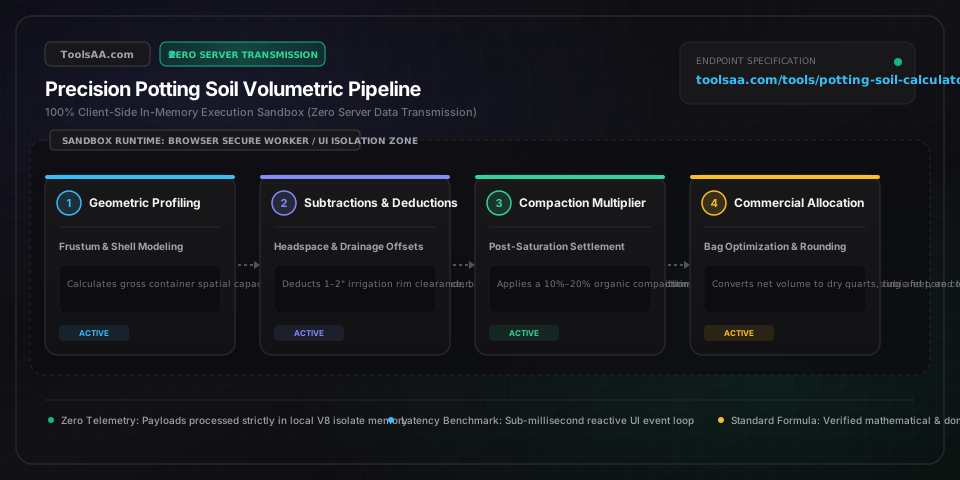
Use the conical frustum volume formula: V = (π × h / 3) × (R1² + R1×R2 + R2²), where h is the inside soil depth (total depth minus 1-inch headspace), R1 is the top radius, and R2 is the bottom base radius. Using a simple cylinder formula (π × R1² × h) overestimates required potting mix by 20% to 25%.
There are exactly 25.714 US Dry Quarts in one cubic foot of potting soil (1,728 cubic inches ÷ 67.2006 cubic inches per dry quart). Therefore, a standard 1.5 cubic foot bag contains 38.57 dry quarts, and a 2.0 cubic foot contractor bag contains 51.43 dry quarts (56.63 liters).
A standard 4ft × 8ft raised bed with 12-inch walls has a total volume of 32 cubic feet (1.19 cubic yards or 906 liters). Filling the bed to a practical 10-inch soil depth (leaving 2 inches of wood rim headspace) requires 26.67 cubic feet, which equals fourteen 2.0-cubic-foot bags or exactly 1.0 bulk cubic yard.
No. Ordinary topsoil contains heavy silt and clay minerals that collapse under container watering, eliminating air pore spaces and suffocating root systems within weeks. Container plants require a specialized soilless potting mix made of sphagnum peat moss or coconut coir, perlite or vermiculite, and composted pine bark, providing 20%–25% air-filled porosity.
One standard 50-liter bag contains 1.766 cubic feet (0.0654 cubic yards or 45.4 US dry quarts) of potting mix. To fill a standard 4ft × 4ft raised bed to a 10-inch depth (13.33 cubic feet or 377.5 liters), you need exactly eight 50-liter bags, or fifteen 50-liter bags for a 4ft × 8ft raised bed.
Calculate roofing shingles, squares, and bundles with pitch multipliers, waste factor, ridge caps, starter shingles, nails, and material cost takeoff.
Free rental property ROI calculator to analyze real estate cash flow, cap rate, cash-on-cash return, and IRR. Project 30-year appreciation and rental yields.
Calculate Roth IRA growth and compound interest with annual IRS limits, catch-up age rules, inflation drag, and tax-free retirement withdrawal forecasts.
Calculate single and multiple event probabilities, odds ratios, conditional Bayes outcomes, and independent or mutually exclusive event series with steps.
Solve proportion and ratio equations (A/B = C/D) instantly. Find unknown X values, simplify ratios, scale recipes, and calculate direct or inverse proportions.
Calculate daily protein intake by body weight, activity level, and fitness goals. Find your optimal grams per day for muscle building, fat loss, and maintenance.