Steps to Miles & Calories Calculator

Steps to Miles & Calories Calculator

Badge tier

Convert pedometer steps into miles, kilometers, and calories burned. Features personalized stride length from height, walking pace MET rates, and reverse goal solving.

Lbl quick presets

Title control deck

10,000 Unit steps
90 Unit spm • 3.5 Unit met
1x
165 Unit lbs
+0 Unit lbs
Lbl computed stride28.1 Unit inches short / 71.4 Unit cm short
0% (+0.0 Unit met)
Lbl local computedLbl decimal active

Title results cockpit

Lbl tile distance
4.43Unit miles
7.14 Unit km
Lbl tile calories
485Unit kcal
3.5 Lbl met rate
Lbl tile duration
1Unit hours short 51Unit minutes short
90 Unit spm
Lbl tile laps
17.9Unit laps
7,140 Unit meters
Title track simulation
Lbl lap progress title90%
Hud cadence label90 Unit spm17.9 Hud laps completed
Lbl daily goal bar100% (10,000 / 10,000)

Bio title

Lbl anatomical stride28.1 Unit inches (71.4 Unit cm short)

Hint stride ratio 41.3% Hint stride ratio end

Lbl pace velocity25.1 Unit min per mile

Hint cadence frequency 90 Unit spm

Lbl gross vs netLbl gross total 610 Unit kcal

Hint gross bmr

Lbl heart zone titleBadge endurance

Cardio desc

Compendium refSystem imperial desc
Stat1 valueStat1 label
Stat2 valueStat2 label
Stat3 valueStat3 label

Client-Side Processing

High-performance calculation executed entirely in browser memory.

Zero Server Upload Privacy

All payloads remain strictly local with zero external server communication.

Production Ready Export

Clean, optimized output formats ready for immediate deployment.

Disclaimer title

Disclaimer text
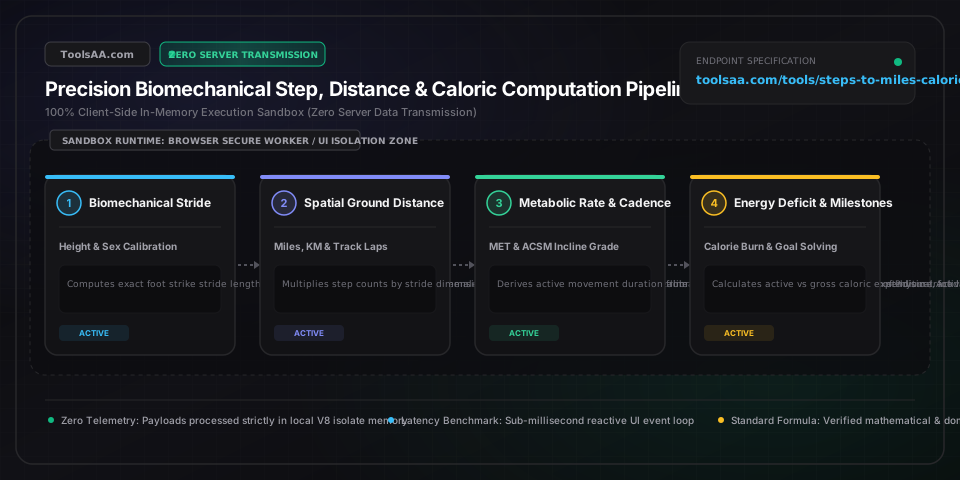
Technical Reference & Architecture Guide

Steps to Miles & Calories Calculator Guide

Convert pedometer steps into miles, kilometers, and calories burned. Features personalized stride length from height, walking pace MET rates, and reverse goal solving.

Steps to Miles & Calories Calculator Guide — Client-Side In-Memory Architecture & Data Flow

Key Parameters & Controls

Pedometer Step CountTotal Steps (Footfalls)

Cumulative daily ambulatory footsteps recorded by smartwatches, fitness bands, or smartphone sensors. While 10,000 steps per day serves as a popular global milestone, clinical studies published in JAMA Internal Medicine indicate that mortality and cardiovascular risk reductions level off between 7,500 and 8,000 steps per day for most adults.

Default: 10,000 steps
Personal Stride LengthInches / Centimeters (Distance per Pace)

Linear forward distance traveled between the initial heel strike of one foot and the heel strike of the opposite foot. Validated anatomical research correlates step length with standing height: approximately 41.3% of height for adult women and 41.5% for adult men under comfortable walking cadences.

Default: 28.5 inches (72.4 cm)
Body WeightPounds (lbs) / Kilograms (kg)

Total physical body mass propelled forward across the ground. Caloric energy expenditure scales directly with gravitational load; a 200-lb individual expends roughly 33% more energy than a 150-lb individual moving across identical terrain and step counts.

Default: 165 lbs (75 kg)
Activity Pace & CadenceSteps per Minute / MET Intensity

Stepping frequency and metabolic intensity categorized according to the Compendium of Physical Activities. Casual walking under 75 steps/min burns roughly 2.5 METs, moderate brisk walking at 90 to 105 steps/min achieves 3.5 to 4.3 METs, and sustained jogging or running exceeds 7.0 to 11.5 METs.

Default: Moderate Walk (90 steps/min, 3.5 MET)
Surface Incline GradeIncline Percentage (%) / Slope

Vertical uphill angle on a motorized treadmill or outdoor path. Biomechanical energy expenditure evaluations establish that each 1% increase in upward slope increases metabolic demand by roughly 0.1 to 0.12 METs, enabling substantial caloric burn without high-impact stress on knees or hips.

Default: 0% (flat terrain)

Pro Tips & Best Practices

The 2,000 to 2,500 Steps Per Mile Rule of Thumb

On average, an adult takes between 2,000 and 2,500 walking steps to cover one statutory mile (5,280 feet) and roughly 1,250 to 1,550 steps per kilometer. Shorter walkers under 5 ft 4 in (163 cm) average 2,300 to 2,550 steps per mile, while taller walkers over 6 ft 0 in (183 cm) average 1,900 to 2,100 steps. In running gait, the increased flight phase stretches stride length, reducing the count to 1,400 to 1,700 steps per mile.

Biomechanical Stride vs. Pace (Single Step) Calibration

In track and clinical biomechanics, a true 'stride' spans two full steps (same heel to same heel), whereas commercial pedometers and smartwatches count single paces (heel-to-opposite-heel strikes). To measure your exact personalized step length, walk 10 normal continuous steps along a hallway or sidewalk, measure the total linear distance with a tape measure, divide by 10, and enter that precise figure into custom settings.

Gross Calories vs. Net Calories in Step Tracking

Fitness wearables frequently display Gross Calories, combining your Basal Metabolic Rate (the baseline energy your body burns staying alive during that time) with active locomotion calories. Net Calories isolate the mechanical energy burned strictly by moving. Across a typical 10,000-step walk spanning 80 to 100 minutes, gross burn will read 70 to 120 kcal higher than your actual net exercise output.

The Incline and Cadence Calorie Multiplier

Adding a 4% to 6% incline to your walk increases energy expenditure by 35% to 50% without requiring running or subjecting joints to ballistic impact. Concurrently, elevating cadence past 100 steps per minute—the clinical threshold for moderate-intensity aerobic exercise defined by the American College of Sports Medicine (ACSM)—optimizes fat oxidation and doubles your caloric turnover per minute compared to casual strolling.

Common Gotchas & Troubleshooting

⚠️Step distance differs significantly between smartphone pocket pedometers and GPS smartwatches

Phones in pockets or bags rely on triaxial accelerometers that often miss gentle steps, register vehicle vibrations, and rely on fixed static height estimations. Advanced GPS smartwatches continuously self-calibrate stride length by dividing verified satellite distance by actual foot strikes. For maximum accuracy across either device, measure your real 10-step distance with a tape measure and input your exact custom stride length.

⚠️Calculated caloric burn does not match commercial gym treadmill readouts

Gym treadmills rely on generic default weights (often hardcoded at 150 lbs or 175 lbs) and estimate energy output purely from motor roller speed, ignoring your true body mass, cadence, and biological age. Caloric burn scales directly with individual mass; entering your accurate morning body weight and specific cadence alongside validated Compendium of Physical Activities MET rates provides a reliable, personalized expenditure figure.

Frequently Asked Questions

How many miles is 10000 steps for an average person?▼

For an average adult with a step length between 2.2 and 2.5 feet (26 to 30 inches), 10,000 steps equals approximately 4.2 to 5.0 miles (6.8 to 8.0 kilometers). Shorter individuals under 5 ft 4 in cover approximately 4.0 to 4.3 miles, whereas taller adults over 6 ft 0 in cover roughly 4.8 to 5.1 miles due to longer natural leg extension.

How many calories do you burn walking 10000 steps?▼

Walking 10,000 steps burns approximately 350 to 500 calories (kcal) for an average adult weighing between 140 and 200 pounds (64 to 91 kg) at a moderate 3.0 mph pace. A 140-lb individual expends around 350 calories, a 165-lb individual burns roughly 420 calories, and a 200-lb individual burns approximately 500 calories, with burn scaling directly with body mass.

How do you calculate stride length from height for steps to miles?▼

You calculate step length from standing height using established anatomical ratios: multiply standing height by 0.413 for women (for example, 65 inches × 0.413 = 26.8 inches) and by 0.415 for men (for example, 70 inches × 0.415 = 29.05 inches). For running cadences, multiply standing height by 0.450 to account for the extended airborne stride.

Do you burn more calories running 5000 steps than walking 5000 steps?▼

Yes, running 5,000 steps burns roughly 50% to 75% more calories than walking 5,000 steps and covers significantly greater ground distance. Running introduces an airborne flight phase requiring intense vertical muscular propulsion against gravity, elevating oxygen uptake from 3.5 METs (moderate walk) up to 9.8 to 11.5 METs (vigorous run).

How many steps does it take to walk a full mile or kilometer?▼

Disclaimer: This tool is provided strictly for educational and informational purposes only and does not constitute formal financial advice or a binding loan commitment. Please consult a qualified financial advisor before making decisions. It takes approximately 2,000 to 2,500 walking steps to complete one statutory mile (5,280 feet), and roughly 1,250 to 1,550 walking steps to complete one kilometer (1,000 meters). Running decreases these figures to approximately 1,400 to 1,700 steps per mile and 900 to 1,100 steps per kilometer because each running stride covers roughly 35% more ground.

Related Tools & Utilities

All Tools →