/
Short title

Body Recomposition Calculator & Macros

Katch-McArdle LBM Formula

Calculate body recomposition calories and macro targets to lose fat and build muscle simultaneously. Get custom TDEE, protein intake, and deficit projections.

Lbl presets
Lbl body dimensions
26
86
178 cm
Elevated
26%
5% (Stage)15% (Fitness)25% (Average)35%+
Lbl calorie cycling toggle
Lbl target calories
2,380kcal
-324 kcal/day
Lbl tdee
2,704kcal
BMR: 1,745 kcal
Lbl lean mass
63.6kg
Fat: 22.4 kg
Lbl protein target
140g
2.2 g/kg LBM
2,380Lbl calories / day
24%
50%
26%
Macro protein2.2 g/kg LBM • Muscle Protein Synthesis
140 Lbl grams
560 kcal (24%)
Macro carbsGlycogen stores & glycolytic training power
300 Lbl grams
1199 kcal (50%)
Macro fatsHormonal balance & testosterone/estrogen health
69 Lbl grams
621 kcal (26%)
Lbl action plan
Tip protein title

Tip protein desc

Tip training title

Tip training desc

Tip sleep title

Tip sleep desc

Tip patience title

Tip patience desc

Lbl basal metabolic share64.5Lbl pct of total daily burn
Lbl total body protein density1.6 Lbl protein density unit
Lbl weekly net energy flux-2,268 Lbl kcal per week
Technical Reference & Architecture Guide

Body Recomposition Calculator & Macros Guide

Calculate body recomposition calories and macro targets to lose fat and build muscle simultaneously. Get custom TDEE, protein intake, and deficit projections.

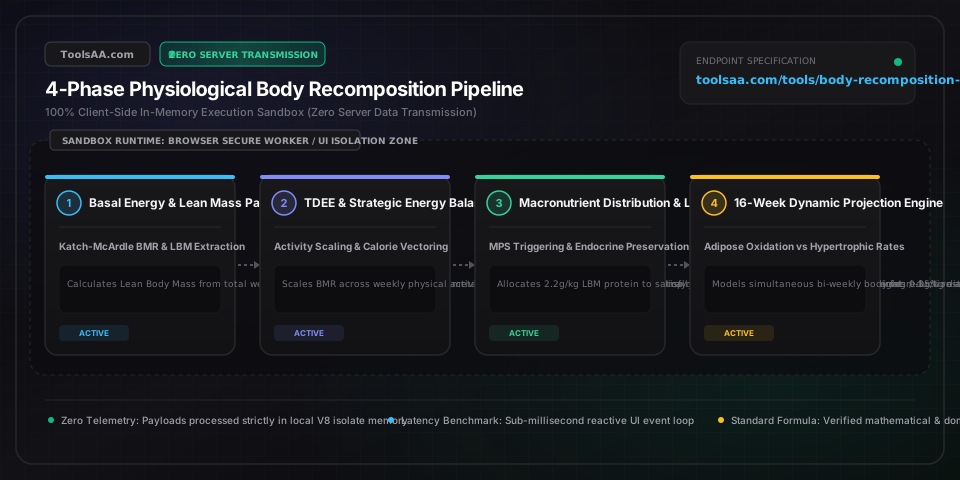
Body Recomposition Calculator & Macros Guide — Client-Side In-Memory Architecture & Data Flow

Key Parameters & Controls

Lean Body Mass (LBM) & Body Fat PercentageBody Composition Diagnostic

The exact proportion of non-adipose functional tissue (skeletal muscle, bone, internal organs, intracellular water) calculated as Total Weight × (1 − Body Fat % / 100). Clinically superior to total scale weight for determining basal metabolic expenditure via the Katch-McArdle formula, which scales directly to active metabolic tissue.

Default: 16% Body Fat (65.5 kg LBM on 78 kg total mass)
Physical Activity Level (PAL) MultiplierEnergy Expenditure Coefficient

Validated physiological scalar applied to BMR: Sedentary (1.20, desk job with minimal movement), Lightly Active (1.375, 1-3 training sessions/week), Moderately Active (1.55, 3-5 structured resistance and aerobic sessions/week), Very Active (1.725, 6-7 intense sessions/week), and Extremely Active (1.90, competitive endurance training or strenuous manual labor).

Default: 1.55 (Moderate: 3-5 training sessions weekly)
Resistance Training Experience TierHypertrophic Ceiling Stratification

Categorizes individual potential for monthly skeletal muscle accretion based on the Aragon-McDonald physiological model: Novices (<1 yr lifting) can accrete 1.0% to 1.5% of total body weight per month in lean mass; Intermediates (1-3 yrs) achieve 0.5% to 1.0%; Advanced lifters (>3 yrs) are limited to 0.25% to 0.5% per month due to myonuclear saturation.

Default: Intermediate (0.5% - 1.0% monthly lean mass gain rate)
Protein Partitioning Ratio (g/kg LBM)Dietary Macronutrient Target

Target daily amino acid intake expressed per unit of active lean mass. The clinical consensus for concurrent training and caloric restriction establishes 2.0 to 2.6 g/kg of LBM (or 1.8 to 2.2 g/kg total weight) to maximize muscle protein synthesis, satisfy the per-meal ~3g leucine trigger, and offset elevated muscular proteolysis.

Default: 2.2 g/kg of Lean Body Mass
Caloric Strategy VectorEnergy Balance Modality

Controls the directional energy deficit or surplus: Isocaloric Maintenance (0% net change, ideal for lean intermediates), Slight Deficit (-10% to -15%, optimal for individuals seeking fat loss while retaining muscle), or Calorie Cycling (+10% on training days, -15% on rest days for advanced nutrient timing).

Default: Calorie & Carb Cycling (+10% Training / -15% Rest)
Pro Tips & Best Practices

Trigger the Leucine Threshold Every 3 to 5 Hours

Muscle Protein Synthesis (MPS) is an all-or-nothing cellular signaling event mediated by the mTORC1 pathway. Consuming small, continuous protein amounts fails to trigger MPS effectively; you need at least 2.5g to 3.5g of pure L-leucine per feeding (equivalent to 25g to 40g of intact whey, egg, or animal protein) distributed across 3 to 4 distinct meals to maximize daily muscle accretion while in a caloric deficit.

Use Calorie and Carbohydrate Cycling Around Training Windows

During body recomposition, carbohydrate timing dictates glycogen replenishment and intramuscular cell swelling. Concentrating 65% to 75% of your daily carbohydrate allotment within the 4-hour peri-workout window (pre- and post-resistance training) provides peak glycolytic energy for mechanical tension while leaving rest days carb-restricted to maximize systemic insulin sensitivity and resting fat oxidation.

Rely on Waist-to-Hip Ratio and Calipers Over Bathroom Scale Weight

Skeletal muscle tissue has a physical density of 1.06 g/mL, whereas adipose tissue has a density of 0.92 g/mL. Because 1 pound of newly accreted muscle occupies roughly 15% less volume than 1 pound of lost fat, your scale weight may remain flat for 6 to 8 weeks even as your waist circumference shrinks by several centimeters and your physique visibly hardens.

Guard Sleep Duration to Prevent Cortisol-Driven Muscle Catabolism

Restricting sleep to fewer than 6 hours per night while in a caloric deficit shifts the proportion of lost mass dramatically: a landmark study by Nedeltcheva et al. demonstrated that sleep-deprived subjects lost 55% less adipose fat and 60% more lean muscle mass compared to well-rested subjects consuming the exact same caloric deficit.

Common Gotchas & Troubleshooting

⚠️Scale weight and waist circumference have stalled for over 3 weeks

Audit your non-exercise physical activity level (NEAT) and verify condiment, oil, and liquid calorie tracking. As your body loses mass, spontaneous subconscious movement (fidgeting, pacing) declines due to adaptive thermogenesis. Recalibrate your daily caloric intake downward by 100 to 150 kcal or increase daily baseline step count by 2,000 steps rather than drastically slashing dietary protein.

⚠️Gym lifting strength and repetitions are declining across consecutive sessions

Your caloric deficit is too aggressive, or workout carbohydrate availability is depleted. A true recomposition requires maintaining or progressively overloading mechanical tension. Increase your training-day carbohydrate intake by 40g to 60g specifically 60 to 90 minutes before your workout, ensure hydration includes 400mg to 600mg of sodium, and switch from an aggressive -20% deficit to a mild -8% to -10% deficit.

⚠️Sudden weight gain after initiating resistance training and higher protein

This is transient extracellular and intramuscular water retention, not body fat accretion. Resistance micro-trauma causes temporary muscular inflammation that holds water, while elevated creatine and glycogen storage draw 3 to 4 grams of intracellular water per gram of glycogen stored. Evaluate changes after 14 to 21 days once intramuscular osmotic equilibrium stabilizes.

Frequently Asked Questions

Can you actually build muscle and lose fat at the same time?▼

Yes, scientific literature (including systematic reviews by Barakat et al., 2020) confirms that body recomposition occurs robustly in resistance-trained individuals, novices, and those with elevated body fat. Adipose tissue serves as an endogenous energy reserve capable of yielding approximately 3,500 kcal per pound of oxidized fat, which the body mobilizes to fuel the energetically expensive process of Muscle Protein Synthesis (MPS) even in a net dietary caloric deficit, provided adequate protein (2.0 to 2.4 g/kg LBM) and progressive mechanical tension are present.

How do you calculate calories and macros for body recomposition?▼

To calculate body recomposition macros, determine your Basal Metabolic Rate using the Katch-McArdle formula [BMR = 370 + (21.6 × LBM in kg)], multiply by your physical activity factor (1.375–1.55) to find your TDEE, and apply a 10% to 15% deficit. Allocate 2.0 to 2.6 g of protein per kilogram of Lean Body Mass, reserve 20% to 25% of total daily calories for essential dietary fats to maintain hormone production, and designate the remaining caloric balance to carbohydrates clustered around training windows.

What calorie deficit is best for body recomposition?▼

A conservative deficit of 10% to 15% below your maintenance TDEE (roughly 250 to 350 kcal/day) is the clinical gold standard for body recomposition. Deficits exceeding 20% to 25% downregulate the mTOR anabolic pathway, diminish testosterone-to-cortisol ratios, and accelerate muscular proteolysis, while isocaloric maintenance or a subtle calorie cycling protocol (+10% on training days, -15% on rest days) allows intermediate lifters to optimize glycogen stores for hard workouts without accumulating surplus fat.

How much protein do I need for body recomposition?▼

Target 2.0 to 2.6 grams of protein per kilogram of Lean Body Mass (approximately 0.9 to 1.2 grams per pound of total body weight for individuals with moderate body fat). Morton et al.'s landmark 2018 meta-analysis showed that while 1.62 g/kg total weight is sufficient for muscle retention at caloric maintenance, energy-restricted states require higher thresholds (2.2+ g/kg LBM) to stimulate MPS, counteract hypercortisolemia, maximize satiety via peptide YY release, and leverage the higher thermic effect of food (20% to 30% of protein calories burned during digestion).

Why is my weight not changing during body recomposition?▼

Your scale weight remains flat because muscle tissue is denser and more compact than adipose tissue. One pound of skeletal muscle has a density of approximately 1.06 g/mL, whereas one pound of fat tissue is less dense at roughly 0.92 g/mL. Gaining 3 pounds of contractile muscle tissue while simultaneously losing 3 pounds of body fat yields zero net change on a conventional scale, yet reduces waist circumference by 1 to 2 inches and significantly drops your systemic body fat percentage.

Body recomposition vs cutting: which should I choose?▼

Choose body recomposition if your body fat is in the intermediate range (15% to 25% for men, 23% to 32% for women) and you want to build strength while reducing body fat; choose a traditional cut if your body fat exceeds 25% and you need rapid metabolic health improvements, or if you are under 10% preparing for a bodybuilding stage. Recomposition avoids the lethargy, muscle catabolism, and hormonal suppression associated with severe deficits by using mild 10% to 15% deficits or workout-day calorie cycling.

How long does body recomposition take to see noticeable results?▼

Disclaimer: This tool is provided strictly for educational and informational purposes only and does not constitute formal financial advice or a binding loan commitment. Please consult a qualified financial advisor before making decisions. Measurable physiological changes typically require 8 to 12 weeks of consistent resistance training and nutritional adherence. Novices can realistically gain 1.0 to 1.5 pounds of lean muscle mass per month while losing 2 to 3 pounds of adipose fat; intermediate lifters should expect 0.5 to 1.0 pound of monthly muscle accretion. Noticeable visual improvements in abdominal definition, shoulder-to-waist taper, and muscular hardness manifest around weeks 6 to 8.

Related Tools & Utilities

All Tools →