Hint closing day
Hint points
Estimate total home closing costs and buyer cash to close accurately. Calculate loan origination fees, title insurance, appraisal, escrow prepaid taxes, and fees.
Hint closing day
Hint points
Estimate total home closing costs and buyer cash to close accurately. Calculate loan origination fees, title insurance, appraisal, escrow prepaid taxes, and fees.
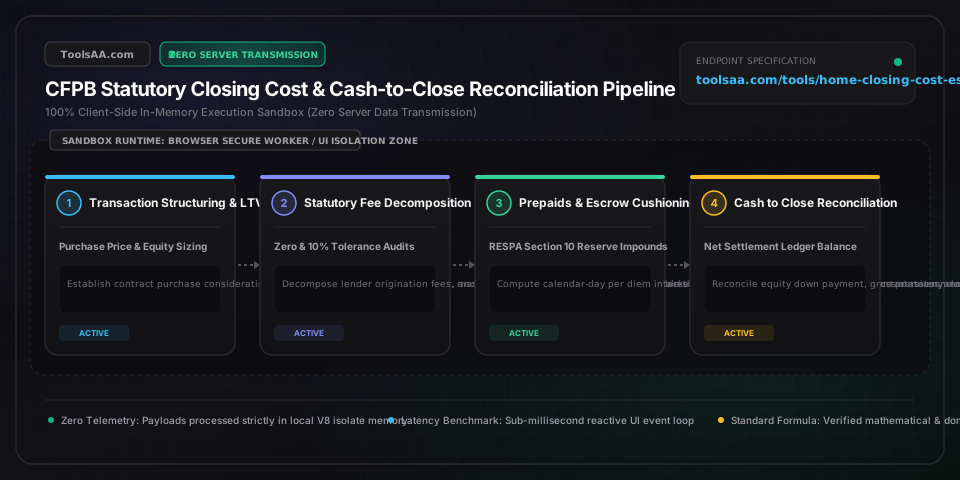
Total agreed acquisition consideration defining statutory transfer tax thresholds, maximum financing limits, title insurance policy premium schedules, and broker commissions.
Buyer upfront equity capital. Dictates statutory private mortgage insurance (PMI) requirement (<20% down payment), FHA upfront mortgage insurance premium (1.75%), and seller concession ceilings.
Lender institutional charges including underwriting ($800–$1,200), processing ($500–$900), and optional discount points (1.0 point = 1.00% of loan amount for ~25 bps rate reduction). Subject to strict 0% legal tolerance.
Mandated settlement services borrower cannot shop for (Appraisal $450–$750, Credit Report $50–$90, Flood Cert $20) and services borrower can shop for (Lender's Title Insurance, Escrow Closing Fee, Survey $350–$600).
Government transfer stamps and recording fees charged by county and municipal recorders to register new deeds and mortgage liens. Ranges from $150 nominal recording up to 2.5%+ in high transfer jurisdictions.
Advance escrow funding: 12 months hazard insurance upfront, 1 to 30 days per diem mortgage interest to month end, plus 2 to 6 months property tax and insurance cushion compliant with RESPA Section 10 caps.
When obtaining both Lender's and Owner's title insurance policies simultaneously, always verify the settlement statement applies the statutory 'simultaneous issue rate.' While lenders charge full filed rates on the loan amount, the owner's policy should only carry an incremental charge of $100 to $300 rather than a second full retail premium, saving $800 to $1,500.
Mortgage interest is collected in arrears, meaning the buyer prepays daily per diem interest from the exact date of funding through the final calendar day of the closing month. Scheduling settlement on the 28th or 29th rather than the 2nd reduces upfront prepaids by up to 27 days of interest, lowering required cash to close by $1,200 to $2,800 without altering long-term debt.
Negotiating seller credits toward closing costs must respect strict regulatory ceilings: Fannie Mae/Freddie Mac cap seller concessions at 3% of purchase price for down payments under 10%, 6% for down payments of 10% to 25%, and 9% for down payments above 25%. FHA caps concessions at 6%, and VA at 4%. Any concession negotiated in excess of actual allowable closing costs cannot be refunded as cash and is forfeited back to the seller.
If the seller acquired or refinanced the property within the past 3 to 10 years, request an official title reissue credit from the settlement underwriter. In most states with filed title rating bureaus, underwriters are legally required to discount standard title examination and search premiums by 20% to 40% when a prior title policy is furnished.
Audit the CD against CFPB TRID tolerance rules: Section A (Origination Charges) and Section B (Services borrower cannot shop for) carry a strict 0% tolerance limit. Section C (Services borrower can shop for from lender list) has a 10% cumulative tolerance. If costs increased without a documented legal Change of Circumstance (e.g., appraisal dispute, credit score downgrade), the lender is legally required to issue an immediate tolerance cure credit on page 3.
RESPA Section 10 limits lender escrow reserves to a maximum 2-month cushion (one-sixth of annual disbursements) above anticipated disbursement requirements. If the local county property tax collection date falls within 60 days of settlement, the lender must collect the upcoming cycle plus the 2-month cushion. Verify tax proration credits on line L-01 where the seller reimburses you for their portion of unpaid accrued taxes.
Federal underwriting guidelines strictly prohibit seller closing cost credits from being used toward the statutory down payment minimum (such as the 3.5% FHA or 3% Conventional floor). To prevent forfeiting excess credits, instruct your lender to reallocate surplus concession dollars toward purchasing upfront mortgage discount points, permanent interest rate buydowns, or prepaying HOA fees and hazard insurance.
Several metropolitan jurisdictions (e.g., Chicago, Philadelphia, San Francisco, New York) enforce dual municipal and county transfer stamps that are separate from state transfer taxes. Check your local regional custom in the purchase contract: in some regions transfer taxes are split 50/50, while in others the seller customarily covers transfer taxes and the buyer covers mortgage recording tax.
Typical home buyer closing costs range between 2% and 5% of the total loan amount (or approximately 1.5% to 4.0% of the home purchase price). On a $400,000 home purchase with a 10% down payment ($360,000 loan), buyer closing costs generally average between $7,200 and $14,400. This total comprises lender origination and appraisal fees ($1,500–$2,800), title search and escrow settlement fees ($2,000–$4,000), government transfer and recording charges ($1,000–$3,500), and prepaid property taxes and insurance impounds ($2,500–$5,500).
Closing costs refer specifically to the itemized administrative, legal, lender, title, and statutory government fees required to execute the transaction and establish the mortgage loan. Cash to close is the total net liquid funding required from the buyer at the settlement table, calculated as: Down Payment + Total Closing Costs - Earnest Money Deposit - Lender Credits - Seller Concessions. For example, on a $400,000 purchase with a $40,000 down payment, $10,000 in closing costs, a $5,000 earnest money deposit, and $3,000 in seller credits, your actual cash to close is $42,000.
On primary home purchase transactions, conventional and FHA lending regulations do not permit closing costs to be financed into the mortgage balance if doing so exceeds the statutory maximum Loan-to-Value (LTV) limit. However, buyers have two compliant options to avoid out-of-pocket settlement expenses: (1) Negotiate seller concessions in the purchase agreement (typically 3% to 6% of the purchase price), or (2) Choose premium lender pricing where you accept a slightly higher mortgage interest rate (e.g., +0.25% APR) in exchange for a negative point lender credit that offsets closing costs dollar-for-dollar. On rate-and-term refinances, closing costs can be rolled directly into the principal balance.
Both the buyer and seller pay closing costs, but they pay for entirely different line items. The buyer pays loan-related charges, lender title insurance, appraisal fees, recording fees, and advance property tax and hazard insurance prepaids (totaling 2% to 5% of the loan). The seller pays real estate agent commissions (traditionally 5% to 6% of sale price), owner's title policy, municipal and state transfer taxes, recording of mortgage reconveyance, and property tax prorations through the settlement date (totaling 6% to 10% of sale price).
Disclaimer: This tool is provided strictly for educational and informational purposes only and does not constitute formal financial advice or a binding loan commitment. Please consult a qualified financial advisor before making decisions. One mortgage discount point costs exactly 1.00% of your total loan balance ($3,500 on a $350,000 loan) and is added directly to upfront cash to close under Section A of the Closing Disclosure. Each point purchased typically reduces the mortgage interest rate by 0.25% (25 basis points). For a $350,000 30-year fixed loan at 6.75%, buying 1 point ($3,500) reduces the rate to 6.50%, trimming monthly principal and interest from $2,270 to $2,212 (a $58/month savings). The break-even period is 60.3 months ($3,500 ÷ $58), meaning the buyer must retain the loan for more than 5 years to achieve net positive financial return.
Compare tire sizes side by side with instant diameter, width, sidewall, circumference, and speedometer error calculations. Inspect clearance and speed reading.
Calculate loan amortization schedules with monthly and annual breakdowns, extra payments, PMI drop-off, and payoff savings. Export to Excel or PDF.
Calculate dog pregnancy due dates, canine whelping windows, daily fetal milestones, and pre-labor temperature drops with reverse mating date planning.
P value calculator to calculate p-values for Z, t, chi-square, and F tests. Find one-tailed and two-tailed significance, critical values, and reverse test goals.
Calculate sand and gravel tonnage from dimensions or cubic yards instantly. Estimate tons, tonnes, truckloads, and material costs with custom bulk density.
Calculate wire size and ampacity instantly. Size copper and aluminum AWG conductors with NEC tables, calculate voltage drop, and apply conduit derating.