Tool header title
Badge app tierBadge inbound updateBadge fba vs fbm

Amazon FBA Fee Calculator & Profit Margin

Interactive Amazon FBA Fee Calculator & Profit Margin with real-time client-side analysis and visualization.

Lbl presets header
Title control deck
Lbl physical dimensionsLbl units imperial
Lbl actual weight0.38 lb
Lbl detected tierLarge Standard
Lbl billable weight0.38 lb
Lbl category rate badge 8.0%Consumer Electronics
Kpi net profit
$17.50
43.8% Lbl margin short
Lbl monthly$21,002
Kpi amazon fees
$7.61
19.0% Lbl of selling price
Lbl fulfillment$3.90
Kpi fba advantage
+$0.84
Msg fba higher
Lbl fbm margin41.7%
Kpi break even
$20.80
1,466% Lbl annual roi
Lbl turns8.7x / yr
Lbl chart revenue stackLbl selling price base ($39.99)
100%66%33%0%FBA Model$17.50FBM Model$16.66
Leg cogs
Leg referral
Leg fulfillment
Leg inbound storage
Leg ads returns
Leg net profit
Lbl break even footnote $20.80Lbl annual velocity footnote 1,466% APR
Stat fee efficiency title229.9%

Stat fee efficiency desc

Stat dim weight title1.00x

Stat dim weight desc

Stat inventory turn title8.7 Unit turns per year

Stat inventory turn desc

Client-Side Processing

High-performance calculation executed entirely in browser memory.

Zero Server Upload Privacy

All payloads remain strictly local with zero external server communication.

Production Ready Export

Clean, optimized output formats ready for immediate deployment.

Lbl cfa disclosure header Disclaimer text
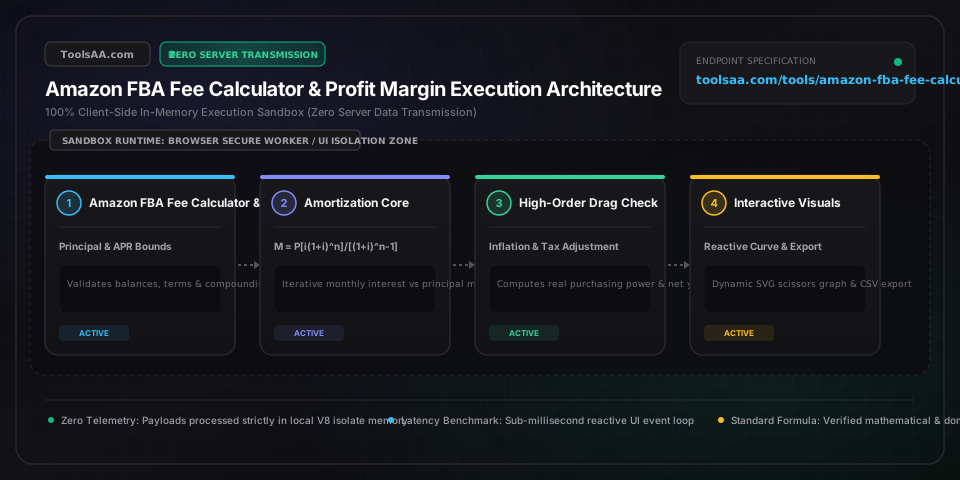
Technical Reference & Architecture Guide

Amazon FBA Fee Calculator & Profit Margin Guide

Interactive Amazon FBA Fee Calculator & Profit Margin with real-time client-side analysis and visualization.

Amazon FBA Fee Calculator & Profit Margin Guide — Client-Side In-Memory Architecture & Data Flow

Key Parameters & Controls

Gross Selling Price (Buy Box / Listing MSRP)Monetary Currency (USD)

Gross retail price billed to the customer at checkout prior to sales tax. Serves as the top-line revenue base for category referral commissions (typically 8% to 15% with a statutory $0.30 minimum floor) and dictates eligibility for Amazon's Low-Price FBA fee rate for units listed strictly below $10.00.

Default: $29.99
Landed Cost of Goods Sold (Unit COGS)Capital Outlay per Unit (USD)

Fully absorbed unit manufacturing cost including raw materials, assembly, packaging, customs duties (HTS tariffs), harbor maintenance fees, and freight-forwarder carriage to domestic prep facilities. Critical metric for calculating cash-on-cash Return on Investment (ROI) and inventory working capital carrying costs.

Default: $6.50
Packaged Dimensions (Length × Width × Height)US Imperial Linear Dimensions (Inches)

External dimensions of the fully packaged, bubble-wrapped, or boxed product. Packaging exceeding 15" × 12" × 0.75" immediately exceeds Small Standard tier constraints, pushing the unit into Large Standard (up to 18" × 14" × 8") or Large Bulky tiers, which sharply escalates baseline pick-and-pack fee schedules.

Default: 10.0 × 6.0 × 1.5 in
Unit Gross Weight & Dimensional Shipping WeightMass & Volumetric Mass (lb / oz)

Physical gross weight compared against dimensional weight computed via (Length × Width × Height) / 139. For all Large Standard items exceeding 1 lb and all Oversize classifications, Amazon assesses fulfillment fees on the greater of actual gross weight versus dimensional weight, rounding upward to the nearest billable ounce or pound interval.

Default: 1.25 lb
Inbound Placement Service & Inventory Health ConfigurationLogistical Protocol Classification

Inbound placement selection (Minimal Shipment Split at ~$0.34/unit vs. Partial/Distributed Splits at $0.00) cross-referenced with historical days of inventory supply. Ratios collapsing below 28 days of historical supply trigger statutory Low-Inventory-Level surcharges ranging from $0.32 to $0.89 per shipped unit.

Default: Single FC Placement ($0.34/unit) + Optimal Inventory (>28 Days)
Target Net Operating Margin Hurdle RateFinancial Ratio Boundary (%)

Targeted net operating margin hurdle rate calculated after all COGS, logistics, marketing PPC, and Amazon fee deductions. Institutional e-commerce private label portfolios benchmark sustainable operations between 20.0% and 30.0% net margin to absorb ad cost-per-click volatility, seasonal storage surcharges, and customer return write-downs.

Default: 25.0%

Pro Tips & Best Practices

Exploit the 0.75-Inch Thickness Cliff to Halve Base Fulfillment Fees

Amazon enforces a strict 0.75-inch thickness limit on Small Standard Size packages (maximum 15" × 12" × 0.75" and 16 oz). A package measuring 0.76 inches is automatically reclassified as Large Standard, shifting baseline pick-and-pack fees from ~$3.22 to over $3.86+ per unit—an immediate $0.64 margin penalty. Vacuum-packing textiles, compressing blister packaging, or switching from rigid cartons to flat mailers can preserve the sub-0.75" tier and save thousands of dollars across inventory production runs.

Neutralize Q4 Holiday Storage Surges with Upstream AWD Buffering

Standard monthly cubic storage rates jump 276% from $0.87 per cubic foot (January–September) to $2.40 per cubic foot during Q4 peak season (October–December). Staging palletized bulk inventory in Amazon Warehousing & Distribution (AWD) locks in bulk storage at ~$0.48/cu ft while enabling automated, just-in-time cross-dock replenishment into standard FBA fulfillment centers, simultaneously securing automatic exemption from Low-Inventory-Level surcharges.

Price at $9.99 to Capture Low-Price FBA Fee Discounts

Amazon automatically grants discounted Low-Price FBA fulfillment rates to items priced at or below $9.99 in the US, saving an average of $0.77 per unit compared to standard FBA tiers while retaining full Prime delivery badging. For price-elastic items retailing between $10.00 and $10.75, lowering the listing price to $9.99 frequently produces higher net dollar margin per unit while driving higher organic conversion and Buy Box dominance.

Amortize Restocking Fees and Outbound Freight into Return Reserves

When a buyer returns a product, Amazon refunds the customer but retains a 20% administration fee on the category referral commission (capped at $5.00), while the original outbound FBA fulfillment fee is forfeited entirely. In return-heavy categories like Apparel (15–25% return rates) or Consumer Electronics (8–12%), failing to accrue a 2% to 5% line-item return reserve directly inflates projected net profitability above true realized GAAP performance.

Common Gotchas & Troubleshooting

⚠️Cubiscan volumetric drift overcharging billable dimensional weight

Amazon automated warehouse laser scanners (Cubiscan) frequently register packaging irregularities, bulging polybags, or unflattened carton tape as rigid dimensional boundaries, artificially inflating packaging size tiers. If fee deductions exceed projections, request a physical remeasurement via Seller Central (Fulfillment > Remeasure ASIN) accompanied by high-resolution photos against a certified imperial ruler, and file retroactive fee reimbursement claims within Amazon's 90-day claims window.

⚠️Unexpected Low-Inventory-Level surcharges applied to adequately stocked ASINs

The Low-Inventory-Level Fee evaluates both 30-day and 90-day historical inventory supply ratios relative to average daily sales velocity. If a temporary stockout or stock dip occurred during a sales spike 60 days ago, your trailing 90-day ratio may register below 28 days of supply even if your current fulfillment center inventory is completely full. Mitigate this by enrolling parent ASINs in Amazon AWD auto-replenishment for automated fee waiver, or maintain a consistent 35-to-45 day inventory buffer across all peak demand cycles.

⚠️Referral fee calculation exceeding standard 15% category baseline

Audit the exact product categorization and browse node mapped to the ASIN. Certain categories mandate higher referral percentages (e.g., Apparel at 17%) or enforce multi-tier thresholds (e.g., Beauty and Health & Personal Care charging 8% on items ≤ $10 and 15% on amounts above $10). Misclassified accessories or bundling SKUs accidentally inheriting high-tariff parent categories must be updated by uploading a revised category inventory flat-file via Seller Central.

Frequently Asked Questions

How to calculate Amazon FBA fees accurately for a new product?▼

To calculate Amazon FBA fees accurately, total five core cost components: (1) Referral fee (typically 15% of gross customer checkout price, minimum $0.30); (2) Base pick-and-pack fulfillment fee, determined by packaged dimensions and the greater of actual gross weight versus dimensional weight (L × W × H / 139); (3) Inbound placement service fee (up to $0.34/unit for single-destination fulfillment center routing); (4) Monthly inventory storage fees ($0.87/cu ft Jan–Sep, increasing to $2.40/cu ft in Q4); and (5) Potential low-inventory fees ($0.32–$0.89/unit) if historical stock falls below 28 days of supply. Subtract these alongside landed COGS, inbound prep, and PPC ad spend to compute net bottom-line profit.

What is the difference between FBA and FBM fees, and which is more profitable?▼

FBA (Fulfilled by Amazon) charges bundled fulfillment, storage, and customer support fees in exchange for Prime delivery badging and higher Buy Box share, whereas FBM (Fulfilled by Merchant) eliminates Amazon fulfillment and storage charges in exchange for direct carrier shipping costs (UPS/USPS/FedEx), packaging supplies, and warehouse overhead. Lightweight products under 1 lb with high sales velocity are substantially more profitable via FBA due to Amazon volume freight discounts, whereas bulky, heavy items over 15 lbs or slow-turning niche SKUs yield higher margins through FBM warehouse operations.

How does Amazon calculate dimensional weight for FBA fulfillment?▼

In the US marketplace, Amazon calculates dimensional weight by multiplying packaged Length × Width × Height (in inches) and dividing by a volumetric divisor of 139 (or 5,000 cm³/kg in European marketplaces). For Small Standard items weighing 16 oz or less, billing is based strictly on physical unit gross weight; for Large Standard items weighing over 1 lb and all Oversize classifications, Amazon charges the greater of actual gross weight or calculated dimensional weight, rounded up to the nearest billable unit.

What is the Amazon Low-Inventory-Level Fee and how can sellers avoid it?▼

The Low-Inventory-Level Fee applies to standard-size products when both short-term (last 30 days) and long-term (last 90 days) inventory supply ratios relative to sales velocity drop below 28 consecutive days, levying surcharges from $0.32 to $0.89 per shipped unit. Sellers can avoid this penalty by: (1) Maintaining an operational buffer of 4 to 6 weeks of inventory in FBA; (2) Utilizing Amazon Warehousing & Distribution (AWD) with auto-replenishment enabled, which grants automatic regulatory fee exemption; or (3) Launching new parent ASINs enrolled in the FBA New Selection Program.

What is Amazon's Low-Price FBA fee structure for products under $10?▼

Amazon automatically applies Low-Price FBA fulfillment rates to any product listed at or below $9.99 in the US ($10.00 in the UK / €11.00 in Germany), replacing the former Small and Light program. Enrolled products maintain standard Prime delivery speeds while saving roughly $0.77 per unit compared to standard FBA fulfillment rates, requiring no minimum sales velocity qualifications or manual application paperwork.

What is a good net profit margin benchmark for Amazon FBA sellers?▼

Disclaimer: This tool is provided strictly for educational and informational purposes only and does not constitute formal financial advice or a binding loan commitment. Please consult a qualified financial advisor before making decisions. A sustainable Amazon FBA private label business should target a Net Profit Margin between 20% and 30% after fully deducting landed COGS, platform fees, storage, and PPC advertising spend. This corresponds to an annualized cash-on-cash Return on Investment (ROI) of 100% or greater ($1.00 profit returned per $1.00 invested in inventory stock). Net margins below 10% leave inadequate buffer against seasonal advertising bid inflation, customer return write-offs, or Q4 holiday storage surcharges.

Related Tools & Utilities

All Tools →