Carpet Calculator & Square Yard Estimator
Badge craft grade

Carpet Calculator & Square Yard Estimator

Calculate carpet square footage, square yards, and roll cuts with roll waste, padding, and installation costs. Instant room estimates with seam layout guide.

Lbl load sample

Sec room dimensions

Unit sq yd
15' 0" (15 Unit ft)
Unit ft
Unit in
12' 0" (12 Unit ft)
Unit ft
Unit in

Sec roll and nap

12' Lbl roll width

Hint nap

Pattern none

Sec quality and labor

$ / Unit sq yd
$
Hint cri105
$
$
$
@ $22.00

Sec stairs

Kpi net area
20
180 Unit sq ft
Kpi gross roll
20.3
15.3 lin Unit ft (12')
Kpi roll waste
1.7%
0.3 Unit sq yd Lbl scrap
Kpi project cost
$1,060
~$52.98 / Unit sq yd
Lbl cost breakdown$1,059.55
Lbl carpet material$661
Lbl cushion pad$142
Lbl labor install$132
Lbl prep and hardware$125
Lbl seam summary title1 Unit cut
Lbl cut orientation:Nap lengthwise
Lbl seam count:0 (Lbl seamless)
Lbl total linear run:15.3 Unit ft
Lbl seam length:0 Unit ft
Lbl remnant inventory0.3 Unit sq yd
Lbl remnant dim:0' x 15.3'
Lbl remnant value:$10.83
Lbl remnant use:Remnant doormats

Lbl sensitivity matrix

Desc sensitivity
Lbl dim variationLbl gross yardageLbl waste rateLbl cliff status
14.5' x 11.5'19.7 Unit sq yd (1 Lbl cuts)6.1%Status optimal
14.5' x 12'19.7 Unit sq yd (1 Lbl cuts)1.7%Status optimal
14.5' x 12.5'39.3 Unit sq yd (2 Lbl cuts)95.3%Status cliff
15' x 11.5'20.3 Unit sq yd (1 Lbl cuts)6.1%Status optimal
15' x 12'(Lbl current base)20.3 Unit sq yd (1 Lbl cuts)1.7%Status optimal
Technical Reference & Architecture Guide

Carpet Calculator & Square Yard Estimator Guide

Calculate carpet square footage, square yards, and roll cuts with roll waste, padding, and installation costs. Instant room estimates with seam layout guide.

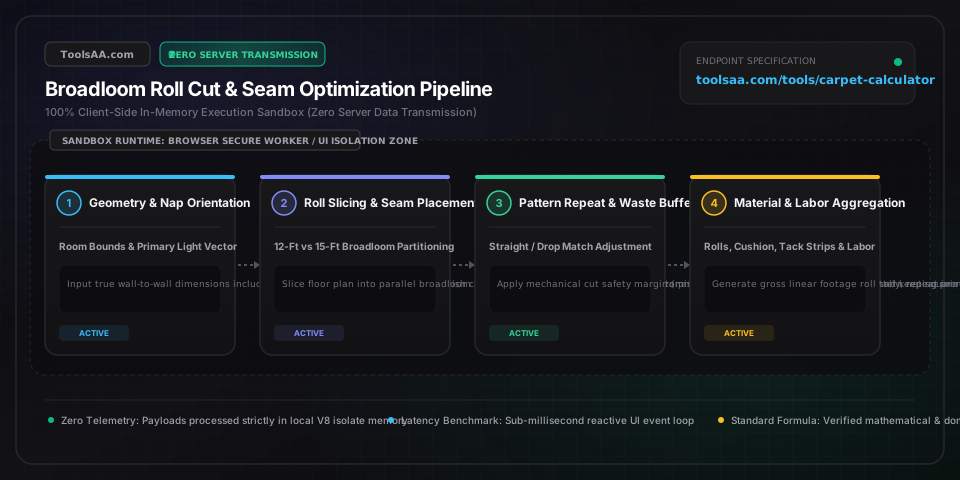
Carpet Calculator & Square Yard Estimator Guide — Client-Side In-Memory Architecture & Data Flow

Key Parameters & Controls

Broadloom Roll WidthStandard Mill Dimension (12 ft / 15 ft or 4m / 5m)

Manufactured width of carpet rolls from carpet mills. In North America, 12-foot broadloom accounts for 80% of residential inventory, while 15-foot rolls prevent mid-room seams in spaces wider than 12 feet. Europe predominantly utilizes 4-metre and 5-metre rolls.

Default: 12 ft (3.66 m)
Pile Nap DirectionOptical Fiber Alignment Vector (Degrees)

The natural angled slant of yarn fibers created during machine tufting. Joining carpet cuts with opposing nap directions creates severe optical shading (differential light reflection) that appears as a glaring color mismatch even when cut from the identical dye lot.

Default: Lengthwise (Toward Primary Natural Light Window)
Pattern Repeat Match IntervalPattern Dimension Interval (Inches / Centimetres)

The vertical and horizontal distance between repeating decorative motifs in patterned or woven broadloom. Extra linear yardage equal to the pattern repeat dimension must be added to each secondary cut to ensure seamless pattern alignment at join lines.

Default: 0" (Solid / Textured / Heather)
Cushion Density & ThicknessPhysical Underlayment Grade (Pounds per Cubic Foot / Millimetres)

Carpet cushion firmness and cushioning rating. The Carpet and Rug Institute (CRI) mandates maximum 7/16" (11 mm) thickness with 8 lb/cu ft density for residential cut piles. Berber or loop pile carpets require firmer, thinner cushion (max 3/8" thickness, 8 lb density) to prevent backing delamination under foot traffic.

Default: 7/16" Thickness, 8 lb/cu ft Density Rebond
Tackless Architectural StripPerimeter Fastener Matrix (Linear Feet / Metres)

Plywood strips embedded with angled precision steel pins fastened 1/4" away from perimeter walls to mechanically hold power-stretched carpet under continuous tension.

Default: Room Perimeter less Doorway Openings

Pro Tips & Best Practices

The 12-Foot Room Pitfall: Why 12'0" Rooms Require a 15' Roll or Seam Cut

If your room measures exactly 12 feet 0 inches wide, a standard 12-foot broadloom roll will come up short. Walls are rarely plumb or square, and broadloom edges lose up to 1 inch during factory trimming and seam truing. Always allow a minimum 3-inch margin (12'3" minimum roll width required). For a 12'0" room, order a 15-foot roll or prepare for a 6-inch side filler strip.

Orient Nap Toward the Main Light Source to Hide Cross-Seams

Direct carpet pile nap pointing directly away from primary exterior windows or room entrances. When light rakes across a perpendicular seam, it casts micro-shadows into the seam channel, making the seam visible. Aligning seams parallel to incident light makes joins virtually invisible.

Never Skimp on Cushion Density to Save on Carpet Costs

Over 70% of premature carpet wear, matting, and fiber crushing is caused by sub-par 6-lb underlayment collapsing under foot traffic. Upgrading from a 6-lb rebond to an 8-lb high-density cushion adds only $0.50 to $1.00 per square yard but doubles the lifespan of tufted nylon and triexta fibers.

Calculate Stairs by Linear Run Rather Than Flat Area

A standard flight of 13 stairs requires approximately 24 to 26 linear feet of carpet runner (each step consumes 10-11" tread + 7-8" riser + 2" nose tuck = ~20" per step). For a 36-inch wide staircase, three stair widths can be slit from one 12-foot roll width, yielding 3 steps per linear cut length.

Common Gotchas & Troubleshooting

⚠️Visible Seam Peaking Along the Floor Seam Line

Seam peaking occurs when carpet is power-stretched across a seam taped with standard thermoplastic tape, forcing backing edges upward. Remedy this by specifying premium 4-inch wide low-melt architectural seam tape and ensuring the installer uses a professional seam weight or seaming iron cooled under weight, stretching carpet lengthwise along the seam rather than perpendicular to it.

⚠️Severe Color Shading Between Adjacent Carpet Strips

This is almost always caused by opposing nap directions during cut placement, or occasionally by mixing two different roll dye lots. Verify that the directional arrows printed on the carpet backing face the exact same direction on all strips. Never turn an off-cut 90 degrees to fill a closet or alcove.

⚠️Pattern Mismatch and Bowing at Seams

Mills allow a commercial pattern bow and skew tolerance of up to 1.5 inches across a 12-foot width. Professional installers must use mechanical knee kickers and mini-stretchers to tension patterned goods into alignment before heat-bonding the seam tape. Order an additional pattern repeat length for every 10 feet of seam.

⚠️Rippling and Wrinkling 6 Months After Installation

Carpet rippling is caused by inadequate power stretching during initial installation (relying solely on knee kickers instead of pole-type mechanical power stretchers) or installing in unconditioned environments below 65°F (18°C). Restretch carpet using a commercial power stretcher over securely fastened architectural tack strips.

Frequently Asked Questions

How do you convert square feet to square yards for carpet?▼

Divide total square footage by 9 (Square Yards = Square Feet ÷ 9). For example, a 180 sq ft room equals exactly 20 square yards. However, because carpet is sold in fixed continuous 12-foot or 15-foot wide rolls, actual ordering yardage must account for roll cut waste, typically adding 10% to 15% to net square yards.

How much extra carpet should you order for waste and cuts?▼

Order 10% extra for standard square or rectangular rooms using 12-foot broadloom. For complex layouts with alcoves, diagonal walls, multiple closets, or hallways, budget 15% to 20% waste. If your carpet features a repeating pattern (e.g., 18-inch floral or geometric repeat), add 15% to 25% to accommodate cut matching.

What is the difference between 6 lb and 8 lb carpet padding?▼

The weight rating indicates density in pounds per cubic foot. An 8-lb pad is significantly denser and firmer than a 6-lb pad, providing superior structural support that prevents carpet backing from flexing, delaminating, and wrinkling. CRI guidelines recommend 8-lb density for standard residential spaces; 6-lb pad is suitable only for short-term rental turnovers or low-traffic guest bedrooms.

How much does professional carpet installation cost per square yard?▼

Basic residential carpet installation ranges between $4.50 and $8.50 per square yard ($0.50 to $0.95 per sq ft). Additional charges include old carpet removal and disposal ($1.50 to $2.50/sq yd), concrete tack strip fastening ($0.75 to $1.25/lin ft), and staircase installation ($8.00 to $15.00 per step).

Why does carpet roll width matter more than room square footage?▼

Because broadloom carpet cannot be seamlessly spliced together like hardwood or tile. A 13x13 foot room has an area of 169 sq ft (18.8 SY), but using a standard 12-foot roll requires two cuts: one 12' × 13' primary cut and one 12' × 13' secondary cut just to extract a 1' × 13' filler strip. This results in purchasing 312 sq ft (34.7 SY) with 46% waste unless a 15-foot roll is selected.

Related Tools & Utilities

All Tools →