Card controls title
14,000 RPM
45 mm
85 mm
≤ 20,000 ×g
η = 1×
Card visuals title
Calculate centrifuge RCF to RPM or convert g-force to RPM using rotor radius. Includes r_min/r_max gradient profiling, k-factor pelleting time scaling & nomogram.
This calculator is designed for biological protocol design, laboratory teaching, and centrifuge calibration. Always verify tube pressure tolerance ratings (RCFmax) and rotor imbalance limits before operating high-speed centrifuges. ToolsAA calculations assume uniform fluid density and balanced rotor setups.
Calculate centrifuge RCF to RPM or convert g-force to RPM using rotor radius. Includes r_min/r_max gradient profiling, k-factor pelleting time scaling & nomogram.
Multiplication factor of Earth standard acceleration of gravity (1 g = 9.80665 m/s²). Benchmarks: 300–500 ×g for live mammalian cells, 1,500–2,000 ×g for platelet-poor blood plasma, 12,000–16,000 ×g for nucleic acid precipitations, and >100,000 ×g for viral or exosome ultracentrifugation.
Total complete revolutions executed by the rotor drive spindle per minute. Rotational velocity alone cannot specify separation protocols; identical RPM across differing rotor bowl geometries creates up to a 300% variance in actual force delivered to biological specimens.
Perpendicular distance from the rotational center to the tube contents. r_max measures the tube cavity tip (gold standard for published protocols), r_min tracks the fluid meniscus, and r_av marks the liquid column midpoint. Rubber cushions and tube adapters reduce nominal radius by 10 mm to 25 mm.
Standardized sedimentation time rating across water or sucrose gradients at maximum rotor speed. Lower k-values denote faster pelleting throughput: high-efficiency ultracentrifuges operate at k = 20–150, while clinical benchtop swing rotors range from k = 250 to 1,500.
Because RCF is proportional to RPM squared (RCF ∝ RPM²), a modest 10% increase in speed boosts centrifugal force by 21%, while doubling the RPM quadruples the force (400%). Never eyeball centrifuge speed adjustments—always calculate exact target g-force to avoid tube fracturing or cellular lysis.
Fixed-angle microcentrifuge rotors have an r_min/r_max ratio around 0.50–0.55, meaning the liquid meniscus experiences barely half the g-force felt at the tube bottom. If a protocol mandates 'pellet at 10,000 ×g', setting 10,000 ×g at r_max leaves proteins or DNA near the meniscus at only 5,200 ×g. Use r_av or lengthen spin time by 1.3× to ensure total clearing.
Using 15 mL conical tube rubber cushions or 1.5 mL tube adaptors inside larger rotor cavities elevates the tube bottom closer to the spindle, shaving 10 mm to 25 mm off the manufacturer nominal r_max. A 15 mm radius drop on an 85 mm rotor slashes delivered g-force by 17.6% at the same RPM setting.
Never replicate spin time directly when changing rotor models. Use the relation t2 = t1 × (k2 / k1). If a protocol requires 30 minutes in a benchtop rotor (k = 360) and you migrate to an ultracentrifuge rotor (k = 90), the exact equivalent sedimentation time is only 7.5 minutes.
The protocol was authored on a small benchtop centrifuge (e.g., r = 70 mm, yielding 300 ×g at 1,960 RPM), whereas your lab rotor has a larger swing radius (e.g., r = 165 mm, delivering 706 ×g at 1,960 RPM—more than double the force). Recalculate speed using the destination rotor radius to match exactly 300 ×g (1,275 RPM).
Caused by using a fixed-angle rotor (where particles hit the outer glass/plastic wall first and slide downward) rather than a swinging-bucket rotor, or by using excessive brake deceleration. Disable electric dynamic braking (set brake to Coast or 0) for delicate gradients and low-density pellets to eliminate fluid turbulence during stop.
Standard polypropylene (PP) microcentrifuge tubes are typically rated for 16,000–21,000 ×g, while polystyrene (PS) tubes fail at just 1,400–2,000 ×g. Ultra-thin glass tubes crack beyond 1,000 ×g. Check your calculated RCF_max against the certified tube mechanical tolerance and verify that bucket cushions support conical tips.
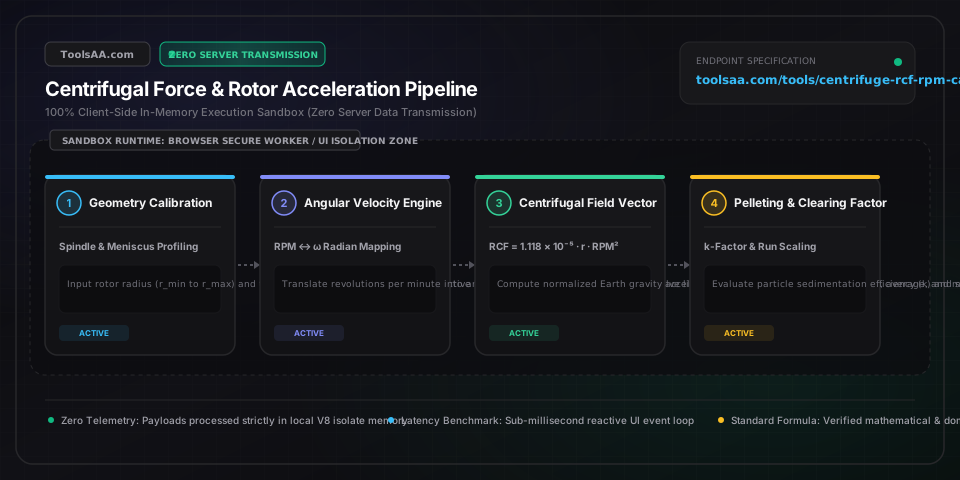
RCF (in ×g) is calculated as RCF = 1.118034 × 10⁻⁵ × r_cm × (RPM)², where r_cm is the rotor radius in centimeters from the drive spindle axis to the tube tip. If measuring radius in millimeters, use RCF = 1.118034 × 10⁻⁶ × r_mm × (RPM)². For example, an 85 mm rotor spun at 14,000 RPM generates exactly 18,627 ×g.
RPM measures spindle rotational speed (revolutions per minute), whereas RCF measures the actual gravitational acceleration multiple (×g) exerted on biological samples. Because centrifugal force depends on radius, two rotors turning at an identical 4,000 RPM deliver drastically different pelleting forces: a 60 mm compact rotor generates only 1,073 ×g, while a 180 mm floor rotor delivers 3,220 ×g.
Gold-standard clinical and research protocols recommend 300–500 ×g (5–10 minutes) for soft-pelleting live mammalian cells without membrane rupture, 1,500–2,000 ×g (10–15 minutes) for platelet-poor plasma separation, and 12,000–16,000 ×g (10–30 minutes) for compact genomic DNA, plasmid, or ethanol protein precipitates. Ultracentrifugation (>100,000 ×g) is reserved for viral capsids, ribosomes, and extracellular vesicles.
Rotor clearing factor is calculated as k = [253303 × ln(r_max / r_min)] / (RPM / 1000)². To migrate run time between two different rotors without under- or over-sedimenting particles, apply t2 = t1 × (k2 / k1). For example, if a legacy protocol requires 20 minutes in a rotor with k = 240, an efficient modern rotor with k = 120 achieves identical sample clearing in exactly 10 minutes.
Standard polypropylene (PP) microtubes and conical centrifuge tubes withstand 16,000 to 21,000 ×g. Polystyrene (PS) clear optical tubes are brittle and deform or shatter beyond 1,400 to 2,000 ×g. Untreated laboratory glass tubes crack above 1,000 to 1,200 ×g, whereas thick-walled Corex glass can endure up to 13,000 ×g with rubber adapters. Ultracentrifuge polyallomer tubes are rated for 500,000+ ×g.
Interactive Breastfeeding Calorie Calculator & Milk Supply TDEE with real-time client-side analysis and visualization.
Visual barbell plate math calculator and progressive warmup loader. Solve exact per-side plate loading for Olympic barbells, trap bars, and custom gym plate inventories in kg and lbs.
Interactive Amazon FBA Fee Calculator & Profit Margin with real-time client-side analysis and visualization.
Convert lease money factors to equivalent APR, audit dealer worksheets for hidden rate markups, and calculate Multiple Security Deposit (MSD) savings with precision rent charge analytics.
Convert polar coordinates (r, θ) to Cartesian rectangular (x, y) with real-time 2D vector canvas, radical exact forms, 3D spherical modes, and instant reverse solving.
Professional first flush rainwater diverter calculator and PVC pipe sizer conforming to ARCSA/ASCE 63-13, Texas TWDB, and AS/NZS HB 230 standards. Accurately sizes diversion volume, vertical pipe cut length, Torricelli drain reset timing, and annual clean water yield.