Electricity Cost & Power Bill Calculator
Short title

Electricity Cost & Power Bill Calculator

Calculate electricity cost and power bill usage by device or appliance. Estimate kWh consumption, compare running costs, and forecast monthly utility bills.

Regime label:
Presets label

Sec appliance config

Unit watts
8 Unit hours per day
7 Unit days per week
55%

Hint duty cycle

8 Unit watts

Hint standby power

Sec utility rates
$0.17 / Unit kwh
Lbl fixed monthly fee$15.00
Lbl tax rate5%
Lbl per hour$0.33Lbl active draw
Lbl per day$3.2115.53 Unit kwh per day
Lbl per month$97.63472.6 Unit kwh per month
Lbl per year$1,171.615,672 Unit kwh per year

Title duty cycle visualizer

Desc duty cycle visualizer

Lbl effective watts1925 Unit watts
Lbl active draw (55%)
Lbl idle rest (45%)
Lbl active energy: 15.40 Unit kwh per dayLbl standby energy: 0.13 Unit kwh per dayLbl carbon footprint: 182.0 Unit kg co2

Title load curve

Desc load curve

Legend peak zone
Legend off peak zone
Lbl hour of day: Lbl interactive scrubLegend hourly draw: 1925 Unit wattsLbl cumulative day cost: $3.21
Disclaimer titleDisclaimer text
Lbl total kwh month472.6 Unit kwh per month
Lbl effective rate$0.17 / Unit kwh
Lbl estimated monthly bill$97.63
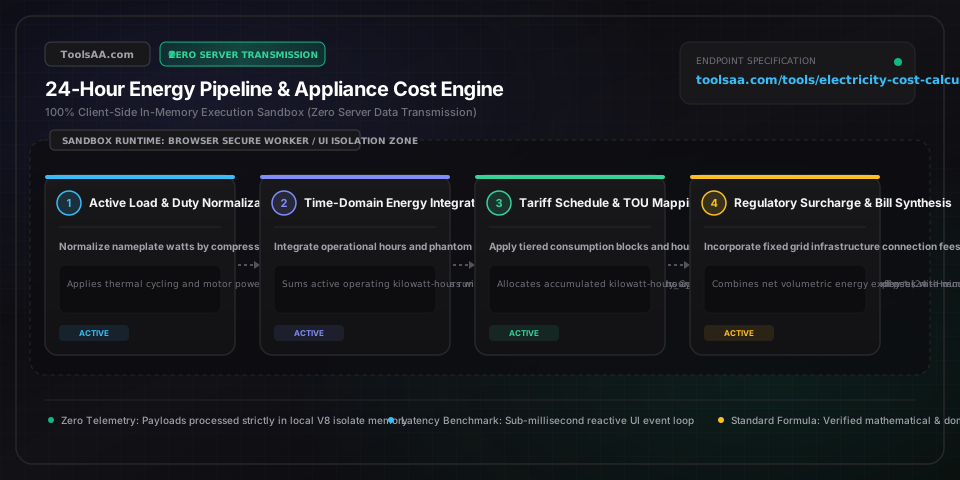
Technical Reference & Architecture Guide

Electricity Cost & Power Bill Calculator Guide

Calculate electricity cost and power bill usage by device or appliance. Estimate kWh consumption, compare running costs, and forecast monthly utility bills.

Electricity Cost & Power Bill Calculator Guide — Client-Side In-Memory Architecture & Data Flow

Key Parameters & Controls

Active Power Rating (Watts / kW)Watts (W) or Kilowatts (kW)

Nominal operating electrical load drawn by the device during continuous operation. Typical household benchmarks range from 9W for an LED lamp to 1,500W for a portable ceramic heater and up to 7,200W for a Level 2 EV charging station.

Default: 1500 W
Operational Duty Cycle (%)Percentage (10% to 100%)

Proportion of active time that the appliance internal compressor or heating element actually pulls full current. Thermostatically controlled devices like refrigerators average 30% to 40% duty, whereas space heaters and computers run at 100% load during use.

Default: 100%
Utility Electricity Rate ($/kWh)Currency per Kilowatt-hour ($/kWh, £/kWh, €/kWh, ¥/kWh)

All-inclusive retail volumetric electricity price charged by the utility provider, encompassing energy generation, transmission, and local distribution. Official benchmarks: US national average is $0.165/kWh, UK price cap is £0.245/kWh, and EU average is €0.28/kWh.

Default: $0.165 / kWh
Vampire Standby Load (Watts)Idle Watts (W)

Parasitic electrical power consumed by electronic displays, transformers, Wi-Fi antennas, and clocks while the appliance is switched off or on standby. US Department of Energy benchmarks indicate phantom load accounts for 5% to 10% of total residential consumption (typically 2W to 15W per device).

Default: 0 W
Fixed Monthly Grid Infrastructure FeeMonthly Currency ($ / £ / € / ¥)

Recurring monthly service connection or daily standing charge billed by the electric utility regardless of the volume of electricity consumed. Offsets meter reading, line maintenance, and grid reliability costs, typically ranging from $10 to $25 per month.

Default: $0.00

Pro Tips & Best Practices

Nameplate Wattage vs Real Power Factor for Motorized Appliances

Electric motors found in pool pumps, vacuum cleaners, and AC compressors draw apparent power measured in Volt-Amperes (VA), which exceeds real power (Watts) due to an inductive power factor (PF typically 0.70 to 0.85). While residential meters bill on real active power (kWh = Volts * Amps * PF * hours / 1000), using nominal nameplate Amps * Volts without factoring in PF will overestimate your calculated bill by 15% to 30%.

Thermostat Temperature Dials Do Not Alter Instant Power Draw

Turning an air conditioner or space heater to maximum does not make the motor draw more instant wattage; single-stage compressors and heating elements operate strictly as binary on/off systems drawing 100% rated power when engaged. Adjusting the thermostat merely lengthens or shortens the thermal duty cycle percentage per hour, directly impacting the cumulative daily runtime.

Inverted Block Tariffs Create Hidden Tier Jump Cliffs

Many municipal utilities utilize tiered incline block rate structures (e.g., California baseline allowance). While your initial 300 to 500 kWh monthly usage may be billed at an affordable Tier 1 rate ($0.18/kWh), any incremental kilowatt-hour consumed past that baseline threshold pushes into Tier 2 or Tier 3 at $0.35 to $0.50/kWh, causing seasonal AC or space heater usage to cost twice as much as expected.

Vampire Standby Draw Aggregates to Substantial Annual Waste

Home theater receivers, game consoles with instant-on background updates, and microwave digital clocks continuously siphon 3W to 15W 24 hours a day, 365 days a year. A persistent 10W phantom load draws 87.6 kWh annually, costing roughly $15 to $25 per device. Utilizing smart power strips that sever auxiliary circuit current eliminates this non-productive utility expenditure.

Common Gotchas & Troubleshooting

⚠️The electrical appliance rating sticker displays Volts (V) and Amps (A) but does not state Wattage (W).

Multiply the Volts by Amperes to calculate apparent power: Watts = Volts * Amps * Power Factor. For standard North American 120V household devices with resistive heating elements (toasters, irons, incandescent lights), Power Factor is 1.0, so a 10A rating equals 1,200W (120V * 10A). For motorized appliances (fans, refrigerators), apply a standard 0.85 power factor: 120V * 5A * 0.85 = 510W.

⚠️Calculated monthly appliance expense is substantially lower than the actual residential utility statement.

Utility invoices bundle non-commodity charges alongside generation supply rates. Inspect your utility statement for separate line items including transmission riders, distribution delivery rates, municipal excise taxes, and fixed monthly meter connection fees (typically $10-$25/month). Ensure your entered $/kWh rate represents the all-inclusive delivered rate (Total Invoice Amount minus Fixed Fees divided by Total kWh Billed).

⚠️A digital plug-in watt meter displays fluctuating wattage that varies from minute to minute.

Variable wattage is normal for inverter-driven appliances, modern variable-speed heat pumps, and washing machines that adjust motor torque dynamically based on thermal or mechanical load. For fluctuating devices, leave the plug-in energy meter connected for a full 24-hour cycle and record the accumulated kWh figure, then enter that directly as daily consumption rather than guessing average instantaneous watts.

Frequently Asked Questions

How do I calculate electricity cost from watts and hours?▼

To calculate electricity cost, multiply the appliance wattage by operating hours per day, divide by 1,000 to convert to kilowatt-hours (kWh), and multiply by your utility rate per kWh: Cost = (Watts * Hours / 1000) * Utility Rate ($/kWh). For example, running a 1,500-watt space heater for 4 hours daily at an average utility rate of $0.165/kWh yields: (1,500 * 4 / 1000) = 6 kWh per day, which equals $0.99 per day or $29.70 per 30-day month.

How much electricity does an air conditioner use per month?▼

A standard 3-ton (36,000 BTU) central air conditioner consumes approximately 3,000 to 3,500 watts while active. With an average summer thermal duty cycle of 50% across 8 operating hours daily (4 net compressor run hours), it consumes 14 kWh per day or roughly 420 kWh per month. At the US national average utility rate of $0.165/kWh, this amounts to approximately $69.30 per month in cooling costs, while a smaller 1,000-watt window unit running 8 hours at 60% duty consumes 144 kWh ($23.76 per month).

What is the difference between Watts and Kilowatt-hours (kWh) on an electric bill?▼

Watts (W) and Kilowatts (1 kW = 1,000 W) measure the instantaneous rate of electrical power demand at any specific second, analogous to a car's speedometer reading in miles per hour. In contrast, kilowatt-hours (kWh) measure total energy consumption accumulated over elapsed time, analogous to total odometer miles driven. Electric utility companies meter and invoice residential consumers based on accumulated kilowatt-hours (kWh) rather than instantaneous wattage demand.

Why is my electric bill higher than my calculated appliance wattage?▼

Calculated appliance costs frequently underestimate the total utility invoice because retail bills incorporate tiered rate escalations, time-of-use peak surcharges, transmission delivery charges, and mandatory fixed meter fees ($10 to $25 monthly). Furthermore, unmetered phantom standby power from interconnected household electronics (drawing 200 to 400 kWh annually per home) and uninsulated duct heat loss can add 20% to 40% in unaccounted energy consumption.

Related Tools & Utilities

All Tools →