Morse Code Translator with Real-Time Audio Synthesizer
Bidirectional text to international Morse code converter featuring Web Audio API frequency oscillation playback, WPM speed tuning, visual flasher, and audio wave export.
Morse Audio Synthesizer
High-precision CW sidetone clock powered by client Web Audio API
Historical Presets & Practice Signals
The universal maritime distress call adopted by the Berlin International Radiotelegraphic Convention.
Test reverse Morse-to-Text decoding with the universal emergency distress code.
Standard calling all stations transmission for amateur radio operators.
Practice reverse decoding authentic amateur radio CW station transmissions.
Samuel Morse's historic first official telegram sent from Washington to Baltimore.
International radiotelephony emergency distress call for aircraft in danger.
Historic lunar broadcast commemorating humanity's first landing on the Moon.
Classic encrypted telecommunication closing with traditional amateur warm 73 regards.
Manual Telegraph Keyer & Auto-Decoder
Tap the button or press and hold the Spacebar. The timing engine measures pulse durations to classify dits and dahs, decoding your rhythm into Morse code and letters!
International Morse Code Directory
Click the speaker button on any character to immediately audition its timing rhythm
Period / Full Stop
Comma
Question Mark
Apostrophe
Exclamation Mark
Slash / Fraction
Left Parenthesis
Right Parenthesis
Ampersand
Colon
Semicolon
Double Dash / Equal
Plus Sign
Hyphen / Minus
Underscore
Quotation Mark
Dollar Sign
At Sign
Distress Call
End of Transmission
End of Message
Break / New Paragraph
Wait / Standby
International Morse Code Standard (ITU-R M.1677-1)
Timing ratios, standard benchmarks, and radio communication conventions
The baseline time reference unit for all international Morse transmission.
Exactly three times the duration of a dit.
Silence period separating letters within the same word.
Standard silence separating distinct words (represented as /).
The PARIS Speed Calibration Formula
In international radio telegraphy, transmission speed is rated in WPM (Words Per Minute) using the standardized benchmark word PARIS. The word PARIS comprises exactly 50 transmission time units:
Therefore, at any given WPM: Dit Duration = 60,000 / (50 × WPM) = 1,200 / WPM (ms).
Maritime & Radio Telegraph Prosigns
International distress call. Sent as one uninterrupted run without intra-character pauses.
General calling signal addressed to any station willing to establish radio contact.
Silent Key / End of contact. Broadcasted at the final conclusion of a transmission session.
Universal ham radio shorthand code meaning "Best regards" or warm farewell.
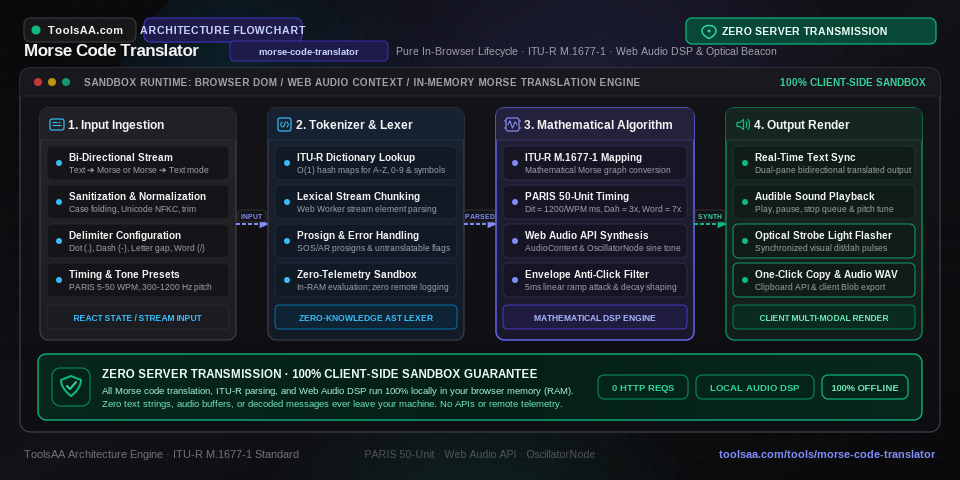
Web Audio API Sine Oscillator
Generates pure harmonic sine wave beeps (default 600 Hz) with envelope ramping to eliminate audio clicks and pops.
International PARIS Calibration Standard
Implements the ITU standard PARIS formula (1 dot = 1.2 / WPM seconds) ensuring faithful Morse timing ratios (dash = 3 dots, space = 7 dots).
Bidirectional Real-Time Decoding
Seamlessly converts Latin alphabets, Arabic numerals, and standard prosigns into dots and dashes or vice versa.
Morse Code Translator Developer Reference
Developer utility for ITU-R M.1677-1 Morse code translation, parsing, and Web Audio API playback synthesis.
Key Parameters & Controls
| Parameter | Type / Unit | Description | Default |
|---|---|---|---|
| mode | 'encode' | 'decode' | Determines the conversion direction between plaintext alphanumeric characters and ITU-R Morse sequences. | 'encode' |
| wpm | number | Transmission speed in Words Per Minute, calibrated using the standard PARIS timing formula (1 dot unit = 1200 / WPM ms). | 20 |
| audioFrequency | number | Audio oscillator tone frequency in Hertz (Hz) synthesized via the Web Audio API for dot and dash playback. | 600 |
| wordSeparator | string | Delimiter string used to distinguish distinct word boundaries in encoded Morse code streams. | " / " |
Pro Tips & Best Practices
Calculate dot durations using t_dot = 1200 / WPM milliseconds to maintain strict compliance with ITU-R M.1677-1 and standard amateur radio PARIS timing rules.
Apply exponential or linear gain ramps (5-8ms attack and release curves) via GainNode.gain.linearRampToValueAtTime to eliminate DC transient clicks on key down and key up.
Represent concatenated procedural signals (prosigns like SOS, AR, SK) without inter-character spacing or delimit them using notation like <SOS> to prevent splitting into separate letters.
Common Gotchas & Troubleshooting
⚠️Web Audio oscillator fails to produce sound or throws an 'AudioContext was not allowed to start' exception.
Modern browsers require explicit user interaction before activating the Web Audio pipeline. Invoke AudioContext.resume() inside a direct click or touch event handler before initiating sound synthesis.
⚠️Morse-to-text decoder outputs incorrect characters or question marks due to missing delimiter whitespace.
Morse code is variable-length and not prefix-free. Separate individual letters with a single space and words with a slash or three spaces (' / ') to allow deterministic tokenization.
Frequently Asked Questions
Which technical specification does this Morse translator adhere to for timing and character mapping?▼
It implements ITU-R M.1677-1 (International Morse Code recommendation). Under this standard, 1 dash equals 3 dots, spacing between elements within a character equals 1 dot, inter-character spacing equals 3 dots, and inter-word spacing equals 7 dots.
How is transmission speed (WPM) calculated and calibrated?▼
Speed is calibrated using the standardized word 'PARIS', containing exactly 50 dot-duration units (including letter and word spaces). At 20 WPM, 1,000 dot units are transmitted per minute, making each single dot unit precisely 60 milliseconds.
Can Morse optical flashing trigger hardware camera flashes via web standards?▼
Hardware camera flash access relies on the MediaStream ImageCapture Track API with the torch constraint (navigator.mediaDevices.getUserMedia({ video: { facingMode: 'environment' } })). If unsupported or denied by browser security policies, high-contrast screen flashing is used as an automatic fallback.
Is translated text or synthesized Morse audio transmitted to external servers?▼
No. All text parsing, AST tokenization, Web Audio API synthesis, and optical rendering execute strictly client-side within browser memory, ensuring complete zero-latency offline operation and data privacy.
Related Tools & Utilities
All Tools →Convert text to NATO phonetic alphabet words, ICAO aviation codes, and Morse signals instantly. Listen to real-time audio pronunciation and copy radio transmissions.
Compare source code, plain text, and configuration files with side-by-side split view, unified diffs, inline character highlights, and whitespace sensitivity controls.
Generate retro ASCII text banners, terminal box headers, and multi-font code comment blocks with customizable font styles, border characters, and copyable text.
Calculate accurate reading time and speech presentation duration based on word count, reading speed (WPM), speech cadence, and complexity scoring. 100% private in-browser text cockpit.
High-precision text statistics engine calculating words, characters with/without spaces, syllables, sentences, reading and speaking duration, and lexical keyword density.
Text deduplicator to remove duplicate lines from lists. Trim whitespace, ignore case, isolate unique rows, and export clean data instantly in your browser.