NATO Phonetic Alphabet Translator & Audio
Convert text to NATO phonetic alphabet words, ICAO aviation codes, and Morse signals instantly. Listen to real-time audio pronunciation and copy radio transmissions.
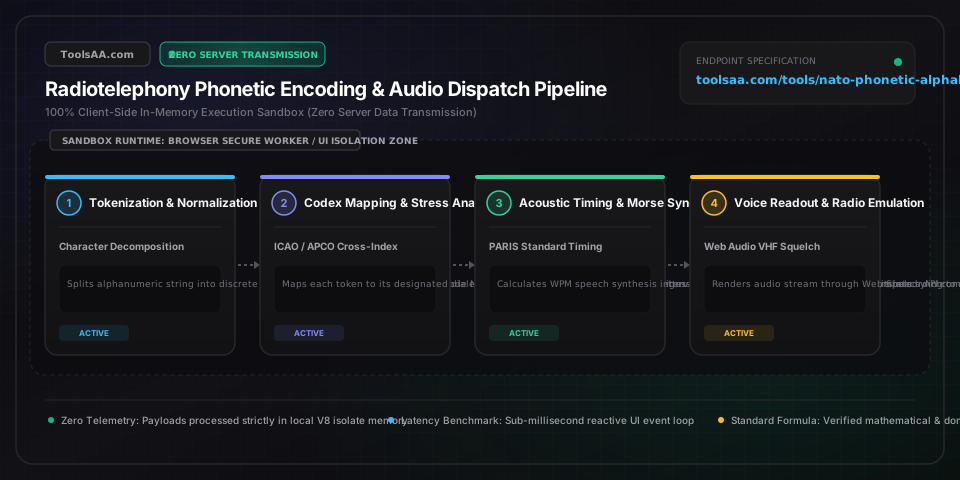
Official codex defining the phoneme-to-word mapping. NATO/ICAO STANAG 1059 is the global aviation and military standard; APCO Project 16 is standard across North American public safety dispatchers; ITU governs maritime VHF radiotelephony.
Standardized syllabic emphasis defined by ICAO Annex 10 to ensure clarity across non-native English speakers. Accented syllables are printed in capital letters (e.g., AL-FAH, BRAH-VOH, GOLF, VIC-TAH).
ICAO acoustic clarity rules modifying digits to prevent confusion over noisy analog VHF frequencies: 3 is pronounced 'TREE' (avoiding 'th' sound), 5 is 'FIFE' (preventing confusion with 'fire'), and 9 is 'NIN-ER' (avoiding the German 'nein').
Prefix injection convention for communicating cryptographic keys, flight route codes, or case-sensitive credentials over voice telephony. Injects 'Capital' before uppercase letters and 'Small' or 'Lowercase' before lowercase characters.
Voice transmission speed measured in words per minute. Standard international radiotelephony transmission regulations mandate an even rate not exceeding 100 to 120 words per minute to facilitate clear manual transcription by receiving operators.
ICAO intentionally spells 'Alfa' with an 'f' instead of 'ph' and 'Juliett' with a double 't' instead of 'Juliet'. In native Spanish and Romance languages, 'ph' is frequently mispronounced as 'p' or unfamiliar, while in French, a single terminal 't' is silent ('Joo-lee-ay'). The double 'tt' forces French-speaking air traffic controllers to pronounce the final hard dental consonant.
Under analog AM aircraft frequencies (118-137 MHz), background static, engine noise, and carrier squeal erode high-frequency consonants. The word 'Nine' is easily misheard as 'Five' or the German negative 'Nein'; appending the hard rhotic syllable makes 'NIN-ER' unmistakable. Similarly, 'Three' becomes 'TREE' because non-native speakers routinely vocalize 'th' as 's' or 'f'.
In formal radiotelephony and telegraphy, punctuation marks must never be spoken colloquially. A period is verbalized as 'STOP' or 'DECIMAL' (for numbers, never 'point'), a forward slash is 'OBLIQUE' or 'SLASH', a hyphen is 'DASH', and a space between discrete serial chunks is separated by the procedure word 'SPACE'.
Do not mix police (APCO) and military/aviation (NATO) alphabets during joint emergency operations. For example, in APCO, 'A' is 'Adam', 'B' is 'Boy', 'D' is 'David', and 'K' is 'King'. Using 'Bravo' or 'Delta' on legacy police dispatch channels or 'Boy' on aviation tower frequencies causes readback halts and hazardous delays.
Web Speech API engines frequently ignore raw punctuation marks. Set the tool's 'Punctuation Mode' to 'Procedural Words', which converts symbols into spoken tokens (e.g., '-' becomes 'DASH', '/' becomes 'OBLIQUE', '@' becomes 'AT SIGN') before routing text to the speech synthesis buffer.
When pasting phonetic dispatches from external sources that use historical or colloquial spellings (e.g., 'Alpha' instead of 'Alfa', 'Juliet' instead of 'Juliett', 'Zero' instead of 'Ze-Ro'), the tool's fuzzy alias engine automatically maps synonyms to the correct plain-text characters.
Modern web browsers block synthetic Web Audio API and Web Speech API audio execution until an explicit user gesture occurs. Always click the initial 'Listen' or 'Play Sequence' button rather than expecting immediate automated playback on page load.
In emergency maritime and ground search operations, never use standard cardinal 'Five' when signal-to-noise ratio is degraded. Always switch the 'Number Convention' selector to 'ICAO Aeronautical' so 'FIFE' is pronounced with sharp labiodental plosives that cut through atmospheric white noise.
Under ICAO Annex 10 standards, 'Nine' is pronounced 'NIN-ER' to avoid acoustic confusion with the word 'Five' and the German word 'Nein' (meaning no), which would cause catastrophic misunderstandings in air traffic control. Similarly, 'Five' is pronounced 'FIFE' with two sharp 'F' sounds to distinguish it from the distress call 'Fire' or numbers like 'Nine' over weak VHF amplitude-modulated radio signals.
The NATO phonetic alphabet is identical to the International Civil Aviation Organization (ICAO) and ITU phonetic alphabet, adopted globally in 1956 for military, maritime, and civil aviation. In contrast, North American police and emergency services often use the APCO Project 16 alphabet (A = Adam, B = Boy, C = Charles, D = David), developed specifically for domestic law enforcement radio channels before international harmonization.
Pilots and air traffic controllers pronounce decimal points exclusively as 'DECIMAL' (or phonetically 'DAY-SEE-MAL'), never as 'point'. For example, an aviation radio frequency of 118.5 MHz is transmitted as 'WUN WUN AIT DECIMAL FIFE', and aircraft altitudes like 9,500 feet are read as 'NIN-ER THOUSAND FIFE HUNDRED' with every digit articulated individually.
To spell case-sensitive data over telephone support lines, prefix uppercase characters with 'Capital' (e.g., 'Capital Bravo, small alfa, figures tree, special character dollar sign'). For passwords, technical support agents state the character case first, pause slightly, and follow with the standard NATO codeword to avoid ambiguity between B, P, D, and E.
Count word frequency, analyze keyword density, and inspect 1-gram to 3-gram phrases instantly. Filter stop words, detect overused terms, and export CSV reports.
Estimate silent reading time and spoken presentation duration across custom WPM speeds with word count, character analysis, and Flesch Reading Ease scoring.
Compare source code, plain text, and configuration files with side-by-side split view, unified diffs, inline character highlights, and whitespace sensitivity controls.
Convert text and code variables between camelCase, PascalCase, snake_case, kebab-case, CONSTANT_CASE, and 15 naming conventions instantly.
High-precision text statistics engine calculating words, characters with/without spaces, syllables, sentences, reading and speaking duration, and lexical keyword density.
Convert titles, unicode strings, and multilingual text into clean, URL-safe SEO slugs with customizable delimiters, lowercase filters, and transliteration rules.