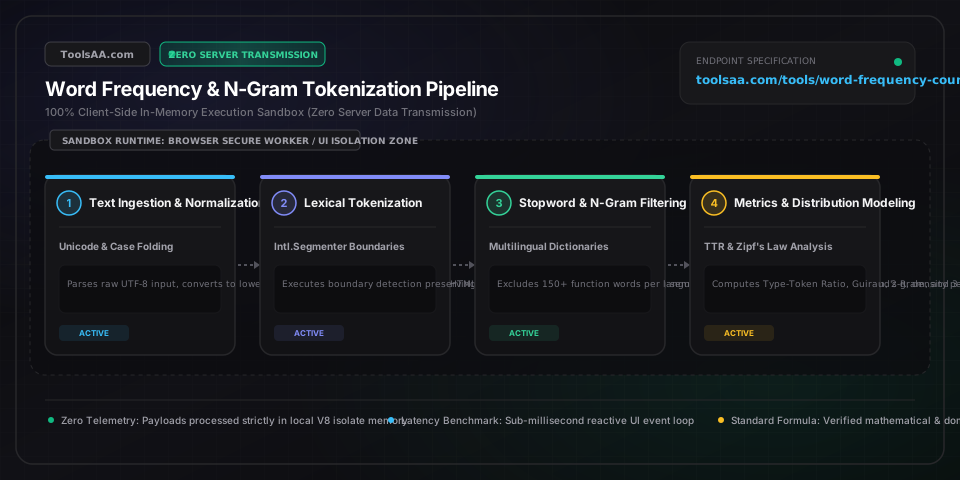
Count word frequency, analyze keyword density, and inspect 1-gram to 3-gram phrases instantly. Filter stop words, detect overused terms, and export CSV reports.
Excludes high-frequency functional glue words (articles, prepositions, conjunctions, auxiliary verbs) to isolate genuine semantic vocabulary. Standard conversational stopword lists eliminate 150 to 200 grammatical filler terms, which typically account for 40% to 50% of everyday writing volume.
Analyzes continuous multi-word sequences to uncover repeated phrases. A 1-gram tracks individual vocabulary words, a 2-gram highlights two-word pairings like descriptive modifiers, and a 3-gram captures recurrent idioms and common boilerplate expressions across your draft.
Measures vocabulary variety by dividing unique vocabulary terms by total running word count. Balanced, engaging non-fiction and student essays maintain a ratio between 0.40 and 0.65; scores below 0.35 reveal repetitive phrasing, while scores above 0.75 reflect compact, specialized prose.
Calculates the exact percentage share a primary focus phrase occupies relative to total text length. The recommended editorial standard spans 1.0% to 2.5%; exceeding 3.0% risks making writing feel robotic and triggers algorithmic penalties for unnatural repetition.
Human speech naturally follows Zipf's Law, where the second most common word occurs roughly half as often as the first, and the third occurs one-third as often. If a meaningful topic word breaks this natural decay curve and crowds into your top three spots alongside common glue words, your article will feel stiff and repetitive to readers.
Vocabulary diversity scores naturally drop as an article gets longer because everyday connecting words repeat while new concepts level off. When evaluating comprehensive essays over 1,000 words, compare diversity across consistent 400-word sections or use root-adjusted formulas to avoid penalizing in-depth, thorough chapters.
Never remove helper words before analyzing two-word or three-word phrases, or you will create artificial fragments like 'training marathon pace' instead of 'training for a marathon'. Instead, collect phrase patterns from unaltered text first, then filter out combinations that consist entirely of grammatical filler.
Search crawlers automatically group word variations such as 'healthy snack', 'healthy snacking', and 'healthy snacks' into a single topical entity. Distribute your natural synonyms across the piece rather than repeating the identical phrase, ensuring cumulative topic presence stays comfortably within the 1.5% to 2.5% range.
Contractions like 'can't' and compound descriptions like 'plant-based' can be split apart by overly aggressive punctuation strippers. Standard linguistic boundary detection keeps these compounds joined as unified conversational terms so your phrase counts remain true to reader perception.
If everyday pronouns (such as 'they', 'our', 'it') dominate your top frequency list, verify that Stopword Filtering is switched on. For recurring conversational filler unique to your project (like 'section', 'click', or 'chapter'), enter them into the custom exclusion list.
Brief snippets lack enough sample volume for statistical word variety calculations, regularly producing deceptive diversity scores above 0.85. Expand your text sample to at least 250 words to obtain a reliable reflection of your actual writing richness.
Keyword density is calculated by dividing the total count of a target word by the total word count of the entire document and multiplying by 100: Density = (Target Word Count / Total Words) * 100%. For example, an article containing 800 words where a focus phrase appears 16 times has an exact keyword density of (16 / 800) * 100 = 2.0%.
A healthy keyword density for primary search topics ranges between 1.0% and 2.5%. Keeping density within this window signals strong topical relevance without triggering search quality filters, whereas densities surpassing 3.0% to 3.5% risk penalties under Google Search Essentials guidelines for artificial keyword stuffing.
Word frequency tracks isolated single words regardless of surrounding context, whereas n-gram frequency measures contiguous multi-word sequences. A 1-gram records individual terms, a 2-gram tracks two-word combinations like 'running shoes', and a 3-gram tracks three-word expressions like 'cardiovascular heart rate', pinpointing overused catchphrases and core themes.
Type-Token Ratio (TTR) measures lexical variety by dividing the number of unique words by the total word count: TTR = Unique Words / Total Words. For general publications, essays, and educational articles between 400 and 1,000 words, a healthy TTR score falls between 0.45 and 0.65; scores below 0.40 indicate redundant phrasing, while scores above 0.70 demonstrate expressive, diverse vocabulary.
Zipf's Law is a universal linguistic rule establishing that word frequency is inversely proportional to its rank in frequency order (frequency is proportional to 1 / rank). In standard English compositions, the most frequent term ('the') represents roughly 7% of all words, the second most frequent ('of') accounts for ~3.5%, and the third ('and') ~2.8%, providing an objective baseline to detect robotic or forced keyword insertion.
Estimate silent reading time and spoken presentation duration across custom WPM speeds with word count, character analysis, and Flesch Reading Ease scoring.
Compare source code, plain text, and configuration files with side-by-side split view, unified diffs, inline character highlights, and whitespace sensitivity controls.
Convert text and code variables between camelCase, PascalCase, snake_case, kebab-case, CONSTANT_CASE, and 15 naming conventions instantly.
High-precision text statistics engine calculating words, characters with/without spaces, syllables, sentences, reading and speaking duration, and lexical keyword density.
Convert titles, unicode strings, and multilingual text into clean, URL-safe SEO slugs with customizable delimiters, lowercase filters, and transliteration rules.
Generate retro ASCII text banners, terminal box headers, and multi-font code comment blocks with customizable font styles, border characters, and copyable text.