Rainwater Harvesting & Cistern Calculator

Rainwater Harvesting & Cistern Calculator

Size rainwater cisterns and calculate annual runoff harvest yield, first-flush diversion, 12-month mass balance, and dry-spell autonomy across US & Metric units.

Lbl scenarios
Title input pane
Lbl line ending | |

Sec catchment roof

2,400 Lbl sq ft unit
90%

Sec first flush

36.0 Lbl gal unit / Lbl storm
Lbl required pipe length54.5 Lbl feet unit

Sec water demand

28,703 Lbl gal unit / Lbl year

Sec cistern tank

3,000 Lbl gal unit

Verdict undersized

Lbl current autonomy 26.8 Lbl days autonomy text 40 Lbl days target text (58% Lbl coverage text).

Kpi annual harvest yield39,488Lbl gal unit
Kpi dry spell autonomy26.8Lbl days unit
Kpi recommended tank5,151Lbl gal unit
Kpi annual savings$215.27

Title mass balance summary

Lbl gross runoff45,476 Lbl gal unit
Lbl first flush loss-1,440 Lbl gal unit
Lbl filter yield39,488 Lbl gal unit
Lbl total demand28,703 Lbl gal unit
Lbl annual supplied28,703 Lbl gal unit
Lbl simple payback41.2 Lbl years unit
Stat annual yield39,488 Lbl gal unit
Stat dry spell autonomy26.8 Lbl days unit
Stat tank adequacy58%
Stat capture efficiency86.8%
Stat annual savings$215.27
Stat local privacyVal local private
Technical Reference & Architecture Guide

Rainwater Harvesting & Cistern Calculator Guide

Size rainwater cisterns and calculate annual runoff harvest yield, first-flush diversion, 12-month mass balance, and dry-spell autonomy across US & Metric units.

Rainwater Harvesting & Cistern Calculator Guide — Client-Side In-Memory Architecture & Data Flow

Key Parameters & Controls

Catchment Footprint Area (Horizontal Plan Projected Roof Surface)Projected Plan Area: Square Feet (sq ft) / Square Meters (m²)

Effective horizontal surface footprint receiving vertical rainfall vectors (Length × Width), excluding roof pitch slope rakes. ARCSA/ASPE 63-2020 hydraulics establish that raked hypotenuse dimensions overestimate actual rainfall capture by a factor of sec(θ) − 1 (up to 20% to 44% error on 8:12 to 14:12 steep slopes).

Default: 2,500 sq ft (232.26 m²)
Precipitation Depth (Historical Mean / 10-Year Drought Rainfall)Precipitation Depth: Inches (in) / Millimeters (mm)

Historical regional rainfall depth recorded across monthly or annual billing periods, sourced from local meteorological agencies or NOAA Atlas 14 precipitation frequency grids. Sizing storage against historical decadal drought minimums rather than arithmetic means prevents 35% to 50% supply deficits during extended summer dry spells.

Default: 36.0 in (914.4 mm)
Roof Catchment Runoff Efficiency Coefficient (C)Hydraulic Runoff Factor (0.00 to 1.00)

Dimensionless coefficient accounting for surface retention, texture absorption, and initial evaporative losses. High-density standing seam metal achieves C = 0.90–0.95 (5–10% loss), glazed ceramic tile achieves C = 0.85–0.92, porous asphalt composition shingles yield C = 0.75–0.80 (20–25% loss due to mineral granule porous retention), and extensive green sedum roofs retain C = 0.35–0.50.

Default: 0.90 (Standing Seam Metal / Glazed Tile)
Pre-Storage Filtration Efficiency & First-Flush Yield (η)Hydraulic System Capture Ratio (0.00 to 1.00)

Combined mechanical efficiency factoring in downspout vortex pre-filter bypass (typically 88% to 95%) and volumetric first-flush isolation (1.0 to 2.0 gallons per 100 sq ft of catchment / 0.5 to 1.0 mm). High-efficiency stainless vortex separators maintain η = 0.90–0.92, while neglected gutter screens drop below 0.65 during peak storm laminar sheet flow.

Default: 0.90 (90% Vortex + First-Flush Capture)
Daily Non-Potable Water Demand (Indoor & Irrigation Baseline)Volumetric Consumption Rate: Gallons/Day (GPD) / Liters/Day (LPD)

Constant non-potable or whole-home potable consumption rate. Standard indoor toilet flushing (1.28 GPF) and laundry (14 gal/load) baseline averages 15 to 20 GPD (57 to 76 LPD) per resident; landscape supplemental drip irrigation demands 25 to 45 GPD per 1,000 sq ft of vegetative canopy during peak evapotranspiration periods.

Default: 120 gal/day (454.2 L/day)
Drought Autonomy Buffer (Consecutive Rainless Days)Temporal Design Duration: Integer Days

Design criteria representing the maximum anticipated consecutive dry days without measurable precipitation. The Texas Water Development Board (TWDB) standard mandates sizing the minimum reserve volume as: V_res = Daily Demand × Consecutive Dry Days × 1.15 (incorporating a 15% unusable bottom dead-storage safety margin).

Default: 45 days (Drought Reserve Period)

Pro Tips & Best Practices

Sizing Cisterns via Rippl Mass Balance Rather Than Annual Yield Averages

Sizing storage purely on annual precipitation yields (Annual Yield = Area × Rain × 0.6233 × C × η) creates severe hydraulic failure. In climates characterized by wet winters and dry summers, annual averaging masks monthly deficits, resulting in cisterns that overflow for months and run bone-dry when irrigation demand peaks. ToolsAA executes an O(n) continuous monthly mass balance: S(t) = min(C_cap, max(0, S(t-1) + Y(t) - D(t))). The mathematically optimal cistern capacity equals the maximum cumulative deficit: C_min = max(∑ [D(t) - Y(t)]). Sizing below this threshold causes total supply exhaustion during mid-summer dry spells.

Projected Horizontal Plan Area vs Actual Sloped Rake Dimensions

Never calculate catchment volume using the physical hypotenuse slope of raked rafters. Raindrop vectors fall vertically relative to gravity. For an 8:12 pitched roof (approximately 33.7°), the physical shingle surface is 20.2% larger than its plan footprint, but it intercepts the exact same volume of vertical precipitation as a flat roof covering the same building envelope. Sizing yield with sloped measurements overestimates harvest volume by up to 15% to 30% on steep 12:12 pitches, resulting in dangerously undersized emergency reserve storage.

First-Flush Diverter Auto-Drain Orifice Failure & Dead Storage

A standard 4-inch Schedule 40 PVC first-flush pipe diverts 0.653 gallons per linear foot (Texas A&M standards require 1.5 gal per 100 sq ft, or 23 ft of pipe per 1,000 sq ft roof). However, over 80% of diverters fail within 12 months because the 1.0 mm slow-drain weep orifice silts shut with atmospheric dust and organic bio-sludge. When the weep hole blocks, the chamber stays filled with dirty water, entirely bypassing first-flush diversion during subsequent storms. Always install an accessible cleanout tee paired with a floating-ball check valve and inspect the weep aperture quarterly.

Buffering Rainwater Acidic Pitting in Non-Concrete Cisterns

Atmospheric rainwater naturally dissolves carbon dioxide (CO2), creating weak carbonic acid with an acidic pH of 5.0 to 5.6 and near-zero mineral hardness (<15 ppm TDS). When harvested into chemically inert food-grade polyethylene (HDPE) or fiberglass tanks, this unbuffered aggressive soft water corrodes internal copper plumbing and leaches metallic salts. While traditional underground concrete cisterns naturally neutralize acidity via calcium carbonate dissolution (stabilizing pH at 7.4–7.8), plastic and fiberglass installations require a sacrificial limestone/calcite immersion bed to prevent copper pinhole erosion.

Deterministic Browser-Sandboxed Mass Balance & Cryptographic Integrity

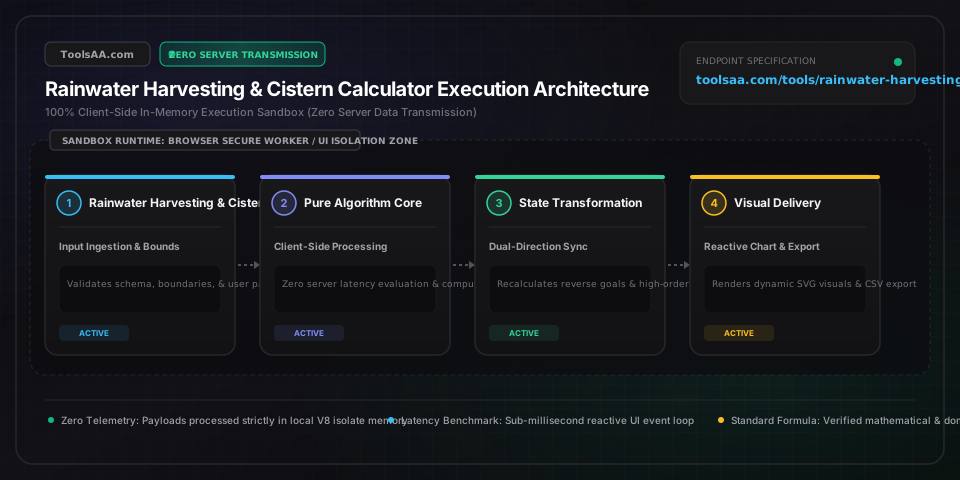
ToolsAA executes multi-year continuous daily rainfall mass balances, drought-deficit curves, and tank capacity simulations entirely client-side inside a sandboxed Web Worker thread. Bounded O(n) algorithmic complexity guarantees instant calculations across 365-day arrays without thread blocking. Enforced by Subresource Integrity (SRI) and zero-telemetry Content Security Policies (CSP), your structural roof dimensions, coordinates, and local utility resilience metrics are never transmitted across the network or logged on external servers.

Common Gotchas & Troubleshooting

⚠️Cistern Overflows Repeatedly in Spring but Empties During 30-Day Summer Dry Spells

This problem confirms a temporal supply-demand decoupling caused by sizing capacity to mean daily demand rather than the Rippl maximum cumulative storage deficit: C_min = max(∑ [D(t) - Y(t)]). To resolve this on an existing installation without replacing the main tank, connect secondary modular poly tanks using 2-inch bottom-mounted equalizing siphons, or reduce peak summer drawdown by converting overhead turf sprayers to soil-tensiometer-controlled micro-drip emitters.

⚠️Vortex Downspout Filter Hydraulic Blowout and High Wash-Off Bypass

Pre-tank downspout vortex filters rated for 90–95% capture efficiency experience hydraulic blowout (up to 70% harvest loss into overflow) during storm intensities exceeding 2.5 inches/hour (65 mm/hour). This occurs when steep vertical drops create turbulent aeration, breaking the laminar surface tension required for water to adhere across the 280-micron vertical stainless steel mesh. Install a horizontal calming pipe run (minimum 10 pipe diameters length) directly upstream of the vortex filter inlet to restore laminar flow.

⚠️Pump Cavitation, Rapid Filter Blinding, and Foul Anaerobic Odors

Rigid suction pipes positioned within 8 to 12 inches of the cistern base suck up the anaerobic benthic sludge layer, drawing settled fines and bacterial biofilm into sediment filter cartridges. Replace the fixed intake pipe with a floating suction intake suspended 4 to 6 inches below the water surface via a sealed buoy. Concurrently install a calming inlet diffuser (U-bend boot) at the bottom tank supply pipe to ensure incoming water enters upward at <0.5 m/s, preventing benthic sediment resuspension.

Frequently Asked Questions

How do I calculate rainwater harvesting cistern size?▼

To calculate cistern size accurately, you must compare two methods: (1) Demand-Side Method: Multiply your average daily non-potable consumption (e.g., 120 gallons/day) by the longest historical consecutive dry spell in your region (e.g., 45 days), adding a 15-20% safety reserve: 120 × 45 × 1.15 = 6,210 gallons. (2) Supply-Side Method (Rippl Mass Curve): Simulate 12-month cumulative monthly rainfall yields against monthly demand. The point where the cumulative deficit is greatest represents the minimum required storage. Sizing purely off annual averages causes cisterns to run dry during summer droughts or overflow constantly during wet months.

What is the formula for rainwater collection yield?▼

The universal formula for rainwater catchment yield is: Yield (Imperial Gallons) = Catchment Area (sq ft) × Rainfall Depth (inches) × 0.6233 × Runoff Coefficient (C) × Filter Efficiency (η). The constant 0.6233 converts 1 inch of rain over 1 square foot into gallons (1/12 ft³ × 7.48052 gal/ft³). In the metric system: Yield (Liters) = Catchment Area (m²) × Rainfall Depth (mm) × 1.0 × C × η (since 1 mm of rain over 1 m² equals exactly 1.0 Liter). A standing seam metal roof has C = 0.95 and high-efficiency vortex filtration has η = 0.92, capturing approximately 87.4% of total theoretical rainfall.

How much water is lost to first flush diversion?▼

Industry standards (such as Texas A&M AgriLife Extension and the Australian Rainwater Harvesting Guidelines) recommend diverting the first 1 to 2 gallons of rainfall per 100 square feet of roof (or 0.5 to 1.0 mm of rainfall depth). For a 2,000 sq ft roof, this equals 20 to 40 gallons diverted per rainfall event. Across an average climate with 45 distinct rain events per year, first-flush diversion accounts for approximately 900 to 1,800 gallons annually (about 2% to 4% of total harvest). This modest loss strips out over 90% of airborne particulates, bird droppings, mold spores, and heavy roof dirt, dramatically extending filter cartridge life.

What runoff coefficient should I use for metal vs asphalt roofs?▼

Runoff coefficients (C) measure the fraction of rain that actually leaves the roof rather than absorbing or evaporating. Standing seam metal (Galvalume, painted steel, copper) has the highest coefficient (C = 0.90 to 0.95), provides the cleanest runoff, and does not shed granules. Asphalt composition shingles have a much lower coefficient (C = 0.75 to 0.80) due to textured porous surfaces and high thermal retention that causes initial evaporation. Furthermore, asphalt shingles leach mineral grit and petroleum hydrocarbons, demanding heavier pre-filtration and making the water unsuitable for potable drinking without certified multi-barrier treatment.

How many gallons of rainwater do I need for dry spell resilience?▼

To calculate your drought resilience reserve, multiply your non-negotiable daily indoor baseline (typically 15-20 gallons per person per day for low-flow toilets and laundry) by your local maximum consecutive rainless days. For a 3-person family facing a 40-day summer drought: 3 people × 18 gal/day × 40 days = 2,160 gallons. If you also intend to sustain a 1,000 sq ft drip-irrigated garden during hot weather (approx. 300 gallons/week = 43 gal/day), your total daily consumption rises to 97 gal/day, requiring a minimum cistern capacity of 97 × 40 × 1.15 = 4,462 gallons.

Is rainwater harvesting legal and cost-effective in 2026?▼

Yes. Rainwater harvesting is legal in almost all 50 US states and globally, with states like Texas, Ohio, and Hawaii actively regulating and incentivizing whole-home potable systems through property tax exemptions and sales-tax-free equipment. In states with prior appropriation water rights (such as Colorado), residential harvesting is permitted up to 110 gallons of storage per household. Cost-effectiveness depends heavily on local municipal water and sewer tariffs: where combined rates exceed $8 to $12 per 1,000 gallons ($2.10 to $3.15/m³), well-designed residential cistern systems achieve simple paybacks within 8 to 14 years, providing complete immunity against escalating municipal water rationing and drought surcharges.

Related Tools & Utilities

All Tools →
Quarterly Estimated Tax & 1040-ES Calculatorfinance

Calculate quarterly estimated tax payments, self-employment tax (SECA), safe harbor penalty protection, Section 199A QBI deduction, and Form 2210 Schedule AI annualized income installments for freelancers, 1099 contractors, and business owners.

Open tool→
Lawn Aeration & Topdressing CalculatorUtility

Calculate lawn aeration core plugs, topdressing sand or compost volume in cubic yards, overseeding rates, and soil decompaction coverage accurately.

Open tool→
Insulation R-Value & Thickness Calculatorconstruction

Interactive Insulation R-Value Calculator & Thickness Estimator (Attic, Wall, Floor) with real-time client-side analysis and visualization.

Open tool→
Grass Seed & Lawn Overseeding CalculatorUtility

Calculate grass seed for new lawns and overseeding in lbs or kg. Get exact Pure Live Seed (PLS) rates, starter fertilizer bags, and germination watering schedules.

Open tool→
Flagstone Calculator & Patio Stone TonsUtility

Calculate flagstone tonnage, patio square footage, and base materials instantly. Estimate irregular vs dimensional stone coverage, gravel sub-base, and sand.

Open tool→
Lacto Fermentation Salt & Brine CalculatorUtility

Professional 6-in-1 lacto-fermentation salt and brine percentage calculator engineered for culinary science and food preservation. Calculates exact salt mass in grams alongside brand-calibrated volumetric spoon measures for Diamond Crystal Kosher, Morton Coarse, Fine Table Salt, and Sea Salt. Supports Total Weight wet brining (gold standard), dry salting for sauerkraut and kimchi, pre-mixed water-only brine, standard jar vessel auto-fill estimators, emergency two-way salinity dilution rescue, and real-time microbial safety and LAB kinetic phase tracking.

Open tool→