Flagstone Calculator & Patio Stone Tons

Flagstone Calculator & Patio Stone Tons

Calculate flagstone tonnage, patio square footage, and base materials instantly. Estimate irregular vs dimensional stone coverage, gravel sub-base, and sand.

Tag a s t m
Hero presets label
Card input header

Desc forward mode

rectangle
16 Unit ft
12 Unit ft
168 lb/cu ft
Unit inches
Unit inches
Unit percent
Lbl total excavation prefix 6.5 Unit inches
Unit inches
Unit inches
Unit inches
Curr usd
Kpi flagstone total
2.06Unit tons
1.2 Unit pallets (~2 Unit crates)
Kpi surface area
192.0Unit sq ft
Lbl perimeter prefix 56.0 Unit ft
Kpi base gravel
4.51Unit tons
3.2 Unit cu yds Hint compacted shrinkage
Kpi estimated budget
$2,303.48
$12.00 / Unit sq ft
Card svg header
Svg finish gradeBLUESTONE (1.5 Unit inches)Svg sand beddingSvg base gravelSvg native subgrade6.5 Unit inchesSvg total depth label
BLUESTONE Lbl yield coverage100.7 Unit yield imperial
Th material itemTh specificationTh required quantityTh packaging order
Row flagstoneBluestone (1.5 Unit inches, dimensional)2.06 Unit tons2 Unit pallets (1.2 Unit crates)
Row crushed baseSpec crushed base4.51 Unit tons3.2 Unit cu yds loose (+18% shrinkage)
Row bedding sandSpec bedding sand (1 Unit inches)0.80 Unit tons32 Unit bags (50-lb)
Row polymeric sandSpec polymeric sand5.4% joint void3 Unit bags (50-lb)
Row geotextileSpec geotextile254 Unit sq ft~1 Unit rolls
Pro tip takeoff title

Pro tip takeoff body
Stat flagstone2.06 Unit tons
Stat net area192.0 Unit sq ft
Stat crushed base4.51 Unit tons
Stat bedding sand32 Unit bags
Stat poly sand3 Unit bags
Stat budget$2,303.48
Disclaimer engineering
Technical Reference & Architecture Guide

Flagstone Calculator & Patio Stone Tons Guide

Calculate flagstone tonnage, patio square footage, and base materials instantly. Estimate irregular vs dimensional stone coverage, gravel sub-base, and sand.

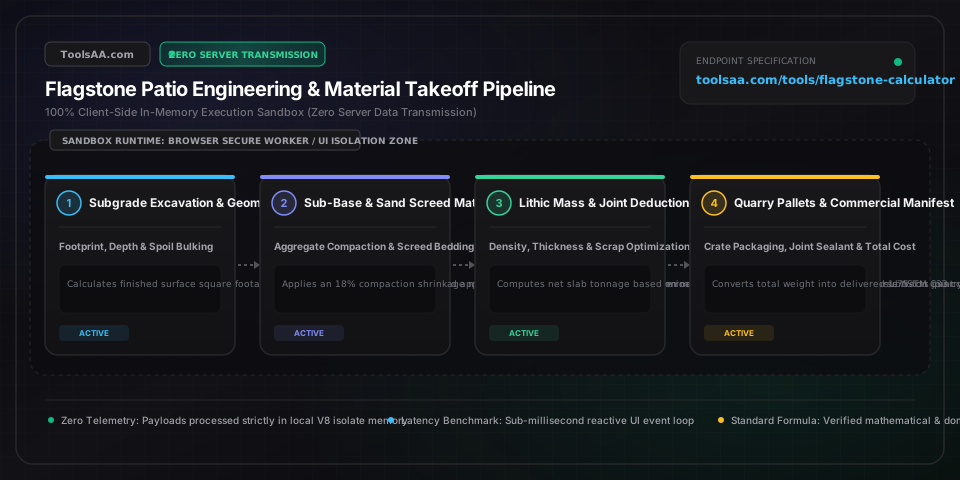
Flagstone Calculator & Patio Stone Tons Guide — Client-Side In-Memory Architecture & Data Flow

Key Parameters & Controls

Nominal Slab Caliper ThicknessDepth Dimension

Thickness profile of quarry slabs (1.0 to 2.5 inches / 25 to 65 mm). Thinner 1-inch slabs yield higher surface area per ton but require rigid concrete slab underlayment; 1.5 to 2.0-inch stones represent the industry gold standard for stable dry-laid installations.

Default: 1.5 in (38 mm)
Lithic Mineral Bulk DensitySpecific Weight Coefficient

Quarry density by mineral composition: Sandstone (140-150 lb/cu ft), Pennsylvania Bluestone (165-170 lb/cu ft), Quartzite (165-170 lb/cu ft), Slate (170-175 lb/cu ft), and Granite (170-180 lb/cu ft). Dense stone directly reduces square foot coverage per delivered ton.

Default: Bluestone: 168 lb/cu ft (2.69 g/cm³)
Cutting & Sorting Scrap FactorSafety Waste Percentage

Essential material buffer compensating for breakages, irregular edge chiseling, and unusable acute triangular fragments. Standard allowance is 5-8% for sawn dimensional pavers, 15-20% for irregular garden flagstone, and 22-25% for circular or serpentine contours.

Default: 15%
Inter-Slab Joint Gap WidthSpacing Allowance

Clear spacing between laid stone edges. Tight butt joints (0.25-0.5 in) maximize stone surface coverage. Rustic wide joints (1.0-2.5 in) decrease stone tonnage demand by 6-12% but significantly increase polymeric joint sand or mortar consumption.

Default: 0.75 in (19 mm)
Compacted Aggregate Road Base DepthSubgrade Layer Thickness

Structural foundation thickness using 3/4-inch minus dense-grade aggregate (Road Base / #21A / CR-6). ICPI guidelines prescribe 4 inches minimum for pedestrian patios in warm climates, 6 inches in heavy frost-heave clay zones, and 8-10 inches for vehicular traffic.

Default: 4.0 in (100 mm)
Base Aggregate Compaction MultiplierVolumetric Shrinkage Factor

Mechanical compaction shrinkage allowance. Vibratory plate tamping compresses loose gravel by 15% to 20%. Ordering exact excavation volume without an 18% compaction allowance causes base elevation to fall short of structural screed height.

Default: 1.18 (+18% loose volume)

Pro Tips & Best Practices

Thermal Gauged vs Natural Cleft Bluestone Thickness Trap

Sawn thermal bluestone is mechanically calibrated to a strict, uniform thickness (+/- 1/16 in), whereas natural cleft flagstone split along natural geological fault planes varies between 1.25 and 2.0 inches within the very same pallet crate. When installing natural cleft flagstone, always calculate theoretical weight using a 1.75-inch nominal average rather than 1.5 inches, and add an extra 5% sorting allowance to reject excessively thick or wedge-shaped slabs.

Compacted Base Shrinkage vs Delivery Shortages

Never order road base gravel strictly matching your trench volume. When 3/4-inch minus crushed aggregate is compacted to 95% Standard Proctor density, voids collapse, yielding a 15% to 20% volume reduction. If your patio requires 5.0 cubic yards of finished compacted base, order 5.9 cubic yards (or 8.3 tons assuming 1.4 tons/yard compacted density) to avoid emergency jobsite re-orders.

Polymeric Sand Washout Thresholds on Wide Flagstone Joints

Standard paver polymeric sand is engineered strictly for narrow uniform joints under 3/4 inch. For rustic irregular flagstone with 1.0 to 2.5-inch gaps, standard fine sand will crack, sag, and wash out within two rain cycles. Specify advanced wide-joint polymeric sand infused with cross-linking binding polymers rated for joints up to 4 inches, or bed in an open-graded permeable chips matrix (#8 or #9 stone).

Excavation Soil Bulking & Dumpster Sizing Math

In-situ undisturbed soil expands significantly upon excavation due to air entrainment. Digging 7 inches deep over a 200 sq ft patio produces 4.3 cubic yards of packed earth, which expands into approximately 5.6 loose cubic yards (a 30% bulking factor). Sizing a haul-away disposal bin based purely on hole dimensions guarantees an overflowing dumpster or excess soil left stranded on site.

Common Gotchas & Troubleshooting

⚠️Unstable, rocking flagstones ('rocker stones') immediately after bedding in sand

Natural cleft flagstone features uneven bottom contours. Lift the rocking stone, identify the high pivot point in the screeded bedding sand, hollow out that specific contact patch with a margin trowel, add sand beneath low perimeter corners, and reset. Seat the stone firmly using a 3-lb deadblow rubber mallet striking outward from center to corners.

⚠️Severe stone deficit: Running out of flagstone with 20% of the patio footprint remaining

This classic jobsite failure occurs when buying stone strictly by theoretical surface coverage without compensating for irregular puzzle-piece trimming scrap (15-25%) and quarry pallet breakage. For irregular flagstone, always multiply theoretical net tons by at least 1.18 to 1.22 before submitting purchase orders.

⚠️White powdery chalk and crust leaching across stone surfaces (Efflorescence)

Moisture is dissolving free lime inside unwashed base aggregates or wet Portland cement mortar and drawing it to the surface via capillary action. Clean with a buffered organic acid efflorescence wash and stiff nylon brush (never wire brushes on bluestone). Ensure the sub-base is graded with a mandatory 1% to 2% (1/4 in per foot) slope away from home foundations.

⚠️Weed penetration and joint erosion between irregular flagstone slabs

Occurs when standard unbonded stone dust or uncompacted masonry sand was swept into joints. Pressure-wash or vacuum joint channels to a clean depth of at least 1.25 inches, allow the stone to dry completely for 48 hours (ambient moisture ruins polymer activation), sweep in wide-gap polymeric sand, tap slabs with a mallet to settle voids, and activate with 3 progressive misting passes.

Frequently Asked Questions

How many square feet does 1 ton of flagstone cover?▼

One US ton (2,000 lbs) of flagstone covers between 65 and 140 square feet, depending directly on stone thickness and lithic density. Standard 1.5-inch thick bluestone or sandstone covers approximately 80 to 90 square feet per ton; 1-inch thin veneer stone yields 120 to 140 square feet, while heavy 2-inch thick traffic slabs yield only 60 to 70 square feet per ton.

How do I calculate how many tons of flagstone I need for a patio?▼

Calculate total square footage (Length x Width), divide by your stone thickness coverage factor (e.g., 85 sq ft/ton for 1.5-inch stone), and multiply by 1.15 to 1.20 to incorporate a 15% to 20% cutting and sorting waste buffer. For example, a 12x15 ft patio (180 sq ft) with 1.5-inch stone requires: (180 / 85) * 1.18 = 2.5 tons of flagstone.

What is the difference between irregular flagstone and dimensional bluestone coverage?▼

Dimensional bluestone is sawed into square and rectangular tiles (e.g., 12x18, 18x24, 24x36 inches) with uniform edges, requiring only 3/8-inch joints and a low 5% to 8% waste factor. Irregular flagstone consists of natural broken slabs with jagged edges that require manual chiseling and puzzle-piecing, creating 1 to 2-inch joints and generating 15% to 25% unusable scrap remnants.

How much crushed base gravel and bedding sand do I need under flagstone?▼

For every 100 square feet of patio surface, install 4 inches of compacted 3/4-inch minus road base gravel and 1 inch of coarse bedding sand. This translates to 1.5 tons (1.1 cubic yards compacted, requiring 1.3 yards delivered) of road base aggregate and 0.45 tons (approx. eight 50-lb bags or 0.35 cubic yards) of ASTM C33 concrete sand.

Can I lay flagstone directly on dirt or grass?▼

No. Laying flagstone directly on bare soil causes rapid uneven settling, slab cracking from seasonal freeze-thaw frost heave, and persistent weed intrusion. A long-lasting patio requires excavating 6 to 7 inches, compacting native subgrade soil, installing non-woven geotextile fabric, tamping 4 inches of crushed stone base, and screeding 1 inch of sand before laying stone.

Related Tools & Utilities

All Tools →
Lacto Fermentation Salt & Brine CalculatorUtility

Professional 6-in-1 lacto-fermentation salt and brine percentage calculator engineered for culinary science and food preservation. Calculates exact salt mass in grams alongside brand-calibrated volumetric spoon measures for Diamond Crystal Kosher, Morton Coarse, Fine Table Salt, and Sea Salt. Supports Total Weight wet brining (gold standard), dry salting for sauerkraut and kimchi, pre-mixed water-only brine, standard jar vessel auto-fill estimators, emergency two-way salinity dilution rescue, and real-time microbial safety and LAB kinetic phase tracking.

Open tool→
Drip Irrigation Calculator & Flow SizerUtility

Professional drip irrigation hydraulic engineering suite. Accurately calculates total zone flow (GPM/LPM), Hazen-Williams lateral friction loss with Christiansen multi-outlet reduction factors, maximum allowable lateral tubing run lengths, flow velocity safety margins, elevation head shifts, plant evapotranspiration (ETc) water demand, and pulse cycle-and-soak schedules.

Open tool→
Dough Proofing & Fermentation CalculatorUtility

Calculate dough proofing & fermentation time by temperature, yeast ratio, and hydration. Predict bulk rise or reverse-solve yeast percentage for exact bake schedules.

Open tool→
Cricket NRR Calculator (Net Run Rate)Utility

Calculate cricket NRR (Net Run Rate), tournament standings, and chase scenarios. Solve required overs or runs needed to qualify with exact ICC DLS decimal rules.

Open tool→
Carpet Calculator & Square Yard EstimatorUtility

Calculate carpet square footage, square yards, and roll cuts with roll waste, padding, and installation costs. Instant room estimates with seam layout guide.

Open tool→
Candy Temperature & Altitude CalculatorCulinary Science & Cooking

Professional high-altitude candy temperature calculator. Adjusts all 8 sugar stages (thread, soft ball, firm ball, hard ball, soft crack, hard crack, caramel) based on elevation, local barometric pressure, or boiling water calibration. Features reverse stage detection, recipe water-ratio compensation, and visual thermometer stages.

Open tool→