Drip Irrigation Calculator & Flow Sizer

Drip Irrigation Calculator & Flow SizerBadge hazen williams

Professional drip irrigation hydraulic engineering suite. Accurately calculates total zone flow (GPM/LPM), Hazen-Williams lateral friction loss with Christiansen multi-outlet reduction factors, maximum allowable lateral tubing run lengths, flow velocity safety margins, elevation head shifts, plant evapotranspiration (ETc) water demand, and pulse cycle-and-soak schedules.

Lbl quick presets

Sec emitter specs

64 Lbl total emitters
1 ft

Sec tubing hydraulics

ID: 0.600" (15.2 mm)

Sec source agronomics

Lbl soil type: Sandy Loam (Balanced Porosity)
in/day
Hint kc range
sq ft

Sec advanced hydraulics

+0.25 ft/barb
Kpi zone flow
0.53 GPM
32.0 GPH
Kpi inlet velocity
0.08 ft/s
Lbl velocity safe
Kpi pressure loss
0.65 PSI
2.6% Lbl of inlet
Kpi end pressure
24.35 PSI
Lbl christiansen f = 0.416

Chart title pressure gradient

Legend dynamic pressureLegend operating envelopeLegend elevation profile
10.020.030.040.00 ft (Lbl inlet)32.0 ft (Lbl tail)Lbl pressure (PSI)
Lbl friction model0.416Lbl elevation effect0.65 PSILbl effective length34.0 ft

Desc step profile

#Th dist ftTh flow rem gpmTh velocity ft secTh friction psiTh dynamic p psiTh emitter pct
00.00.070.080.00025.00100.0%
13.20.060.070.00024.93100.0%
26.40.050.060.00024.87100.0%
39.60.050.060.00024.80100.0%
412.80.040.050.00024.74100.0%
516.00.030.040.00024.67100.0%
619.20.030.030.00124.61100.0%
722.40.020.020.00124.54100.0%
825.60.020.020.00124.48100.0%
928.80.010.010.00124.41100.0%
1032.00.000.000.00124.3599.9%
Disclaimer hydraulic
Stat emitters active64 Lbl emitters suffix (4.0 Unit gph per row)
Stat emission uniformity94.9% Lbl uniformity score (ASAE S376)
Stat runtime schedule2 Lbl cycles per day (19 Unit min short Lbl on / 30 Unit min short Lbl off)

Client-Side Processing

High-performance calculation executed entirely in browser memory.

Zero Server Upload Privacy

All payloads remain strictly local with zero external server communication.

Production Ready Export

Clean, optimized output formats ready for immediate deployment.
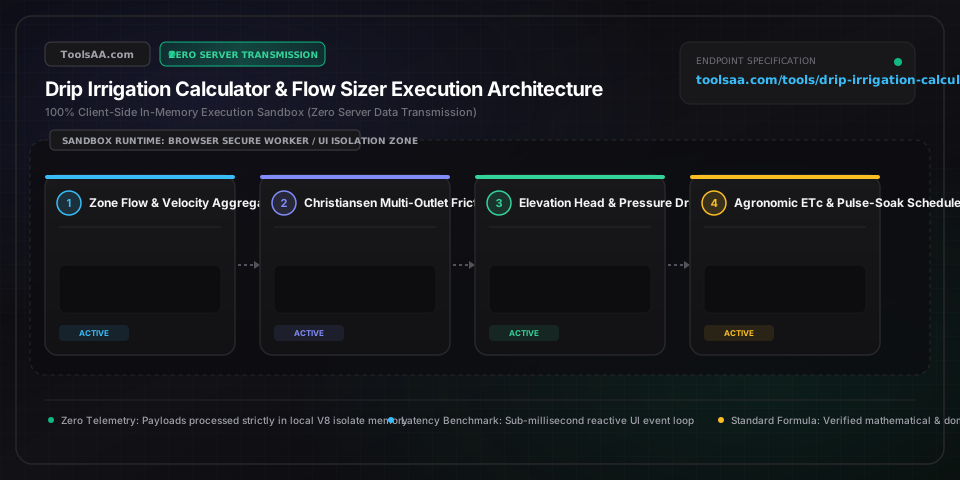
Technical Reference & Architecture Guide

Drip Irrigation Calculator & Flow Sizer Guide

Professional drip irrigation hydraulic engineering suite. Accurately calculates total zone flow (GPM/LPM), Hazen-Williams lateral friction loss with Christiansen multi-outlet reduction factors, maximum allowable lateral tubing run lengths, flow velocity safety margins, elevation head shifts, plant evapotranspiration (ETc) water demand, and pulse cycle-and-soak schedules.

Drip Irrigation Calculator & Flow Sizer Guide — Client-Side In-Memory Architecture & Data Flow

Key Parameters & Controls

Emitter Discharge Exponent (x)Hydraulic Exponent (0.0 to 1.0)

Measures how sensitive an emitter's water output is to fluctuating line pressure, governed by the power law q = k × P^x. True pressure-compensating (PC) diaphragms maintain an exponent between 0.00 and 0.10, ensuring uniform water delivery across undulating terrain. Non-compensating turbulent flow emitters stay near 0.50, while simple micro-orifices approach 0.80 to 1.00.

Default: 0.08
Christiansen Multi-Outlet Reduction Factor (F)Friction Ratio (0.35 to 1.00)

Scales down pipe wall friction loss along laterals because water volume steadily exits through consecutive drippers along the line. For lateral runs with 20 or more uniformly spaced outlets, F stabilizes between 0.36 and 0.38, preventing a 64% overestimation of friction head loss compared to an unbroken dead-end pipe.

Default: 0.38
Hazen-Williams Roughness Coefficient (C)Smoothness Rating (100 to 150)

Quantifies the internal surface smoothness of irrigation tubing. Smooth virgin polyethylene tubing is rated at 140 to 150. Inserting punch-in barbed drippers introduces physical stems into the fluid stream that generate localized turbulence, requiring a derated value of 130 to prevent unexpected tail-end pressure collapse.

Default: 140
Agronomic Crop Coefficient (Kc)Transpiration Factor (0.20 to 1.40)

Relates plant canopy water transpiration to reference baseline evapotranspiration (ET₀) across seasonal growth cycles. Typical benchmark values range from 0.20 to 0.35 for drought-hardy succulents and native perennials, 0.65 to 0.85 for established shrubs and stone fruits, and 1.00 to 1.25 for peak summer vegetable beds and high-canopy berries.

Default: 0.85

Pro Tips & Best Practices

Center-Fed Manifolds Cut Friction Loss by 75%

Feeding a lateral line from the physical center via a tee fitting splits water flow and travel distance in half for each branch. Because pipe friction loss scales directly with distance and nearly quadratically with flow volume, this simple layout configuration slashes overall line pressure loss by up to 87.5% compared to end-feeding.

Derate Roughness to C=130 for Barbed Insert Emitters

Extruded inline emitters manufactured inside the tubing maintain a smooth hydraulic boundary layer (C=140). However, punch-in barbed emitters project plastic stems directly into the core stream, causing micro-eddies and extra turbulence. Always derate your Hazen-Williams coefficient to C=130 when calculating runs with punch-in emitters to avoid starving end-of-line plants.

Match Pressure Regulators to Tubing Burst Limits

Standard thin-wall drip tape (8-mil to 15-mil) is engineered strictly for low operating pressures between 8 and 15 PSI. Connecting drip tape to common 25 PSI or 30 PSI residential landscape regulators will split seams during warm afternoon thermal spikes. Reserve 25 to 30 PSI regulators for heavy-walled 1/2-inch and 3/4-inch poly tubing.

Install Automatic Flush Valves at Lateral Terminal Ends

Suspended silt and biological slime accumulate naturally at the dead ends of laterals. Threading a spring-loaded automatic flush valve onto the terminus of each line purges 1 to 2 gallons of settled sediment every time the zone pressurizes, keeping micro-orifices clean without requiring manual line flushes.

Common Gotchas & Troubleshooting

⚠️First emitters discharge forcefully, but terminal drippers barely trickle or stop completely.

Cumulative friction head loss has exceeded the 20% operating pressure safety ceiling due to an undersized tubing diameter, excessive lateral length, or high-flow non-compensating emitters. Upsize tubing from 1/2-inch (0.600-inch ID) to 3/4-inch (0.820-inch ID), reposition the lateral supply inlet to the geographic center of the bed, or upgrade to pressure-compensating (PC) emitters rated for uniform discharge across 10 to 45 PSI.

⚠️Punch-in emitters blow off tubing or compression fittings disconnect under pressure.

Fluid velocity has breached the safe 5.0 ft/s (1.5 m/s) hydraulic ceiling causing water hammer surge spikes, or unregulated municipal water pressure (60 to 90+ PSI) is reaching thin poly tubing. Install a preset 25 PSI or 30 PSI pressure regulator downstream of your backflow preventer and filter, secure fittings with ratchet clamps, and upsize main supply lines to keep velocity under 5.0 ft/s.

⚠️Water puddles and runs off the garden surface while the root zone below 2 inches remains completely dry.

The zone precipitation rate exceeds the soil's natural intake capacity, common in compacted clay soils that absorb less than 0.20 inches per hour. Implement a Cycle-and-Soak schedule: divide your total 40-minute daily water allotment into three 13-minute pulses separated by 45 to 60 minutes of rest to allow capillary percolation without surface pooling.

Frequently Asked Questions

How do I calculate total water flow rate for a drip irrigation zone?▼

To calculate total water flow rate for an irrigation zone, multiply the total number of emitters by each emitter's rated flow rate in gallons per hour (GPH), then divide the total sum by 60 to convert into gallons per minute (GPM). For example, a planting bed with 120 emitters rated at 0.5 GPH produces 60 GPH total, which equals exactly 1.0 GPM (60 ÷ 60). If you operate mixed emitters—such as ten 2.0 GPH drippers around fruit trees and forty 0.5 GPH drippers along vegetables—sum each subtotal: (10 × 2.0) + (40 × 0.5) = 40 GPH (0.67 GPM). Always verify that this total zone demand stays within 75% of your measured outdoor spigot capacity.

What is the maximum run length for 1/2 inch drip tubing before pressure drops?▼

The maximum recommended run length for standard 1/2-inch poly tubing (0.600-inch inside diameter) operating at 25 PSI is 150 to 200 feet carrying a total flow rate under 200 GPH (3.33 GPM). For example, a 200-foot line with 0.5 GPH emitters spaced every 12 inches consumes 100 GPH, resulting in a friction loss of approximately 3.8 PSI, well within the safe 20% allowable pressure drop of 5.0 PSI. However, if using 2.0 GPH emitters on the same line, total flow reaches 400 GPH, restricting the maximum allowable run to just 75 feet before severe under-watering occurs at the tail end.

How do you calculate friction loss in drip irrigation lines using the Hazen-Williams formula?▼

Calculate friction loss along a multi-outlet drip lateral using the Hazen-Williams formula modified by Christiansen's reduction coefficient: h_f = 10.466 × (L × Q^1.852) / (C^1.852 × d^4.8655) × F, where L is line length in feet, Q is starting flow in GPM, C is pipe smoothness (140 for poly tubing), d is inside diameter in inches, and F is Christiansen's reduction factor. For laterals with 20 or more outlets, F equals approximately 0.37, mathematically accounting for flow discharging progressively at each dripper and lowering calculated friction loss by 63% compared to an unbroken pipe. Divide the resulting friction head in feet by 2.31 to convert directly into PSI.

What size drip tubing should I use: 1/2 inch, 5/8 inch, or 3/4 inch?▼

Select tubing diameter based on total zone flow volume and the critical 5.0 ft/s water velocity limit: use 1/2-inch tubing (0.600-inch ID) for residential zones carrying up to 200 GPH (3.33 GPM) with runs under 200 feet; choose 5/8-inch drip tape (0.625-inch ID) for agricultural row crops spanning 200 to 350 feet at low pressure (10 to 15 PSI); and upgrade to 3/4-inch poly tubing (0.820-inch ID) for larger zones flowing between 240 and 480 GPH (4.0 to 8.0 GPM) or continuous lateral runs up to 400 feet. For main supply manifolds delivering over 8.0 GPM (480 GPH), install 1-inch or larger pipe to prevent water hammer and extreme pressure loss.

How long should I run drip irrigation per day to avoid runoff using Cycle and Soak?▼

Calculate run time by dividing your daily plant water requirement by the zone delivery rate, then divide that duration into multiple short pulses for slow-draining soils. For example, a 100-square-foot garden requiring 30 gallons daily with a 60 GPH zone needs 30 minutes of total watering time. On dense clay soils with an infiltration rate under 0.25 inches per hour, continuous 30-minute watering produces surface pooling; running two 15-minute cycles separated by a 50-minute soak period allows water to penetrate deep into the root zone without surface waste. Rapidly draining sandy soils can receive the full 30-minute application in a single run.

How many drip emitters can I run on one outdoor garden spigot?▼

Determine how many emitters an outdoor spigot can support by performing a 5-gallon bucket test: if your spigot fills a 5-gallon bucket in 40 seconds, your raw flow capacity is (5 ÷ 40) × 60 = 7.5 GPM (450 GPH). Applying the standard 75% design safety buffer provides 5.62 GPM (337.5 GPH) of usable continuous flow. This usable budget safely powers up to 675 emitters rated at 0.5 GPH, 337 emitters rated at 1.0 GPH, or 168 emitters rated at 2.0 GPH on a single automated zone valve. If your layout requires more emitters, use an automated multi-zone hose timer to cycle separate zones sequentially.

Related Tools & Utilities

All Tools →
Dough Proofing & Fermentation CalculatorUtility

Calculate dough proofing & fermentation time by temperature, yeast ratio, and hydration. Predict bulk rise or reverse-solve yeast percentage for exact bake schedules.

Open tool→
Cricket NRR Calculator (Net Run Rate)Utility

Calculate cricket NRR (Net Run Rate), tournament standings, and chase scenarios. Solve required overs or runs needed to qualify with exact ICC DLS decimal rules.

Open tool→
Carpet Calculator & Square Yard EstimatorUtility

Calculate carpet square footage, square yards, and roll cuts with roll waste, padding, and installation costs. Instant room estimates with seam layout guide.

Open tool→
Candy Temperature & Altitude CalculatorCulinary Science & Cooking

Professional high-altitude candy temperature calculator. Adjusts all 8 sugar stages (thread, soft ball, firm ball, hard ball, soft crack, hard crack, caramel) based on elevation, local barometric pressure, or boiling water calibration. Features reverse stage detection, recipe water-ratio compensation, and visual thermometer stages.

Open tool→
Wilks Calculator & Powerlifting Scorefitness

Calculate Wilks, Wilks-2, DOTS, and IPF GL powerlifting scores with real-time bodyweight scaling, reverse target milestone solver, and competitor duel analysis.

Open tool→
Generator Wattage & Sizing CalculatorUtility

Calculate running and starting surge watts to size your whole-house or portable generator accurately. Prevent breaker trips with inductive motor surge analysis.

Open tool→