Nav back to tools
Dough Proofing & Fermentation Calculator

Dough Proofing & Fermentation Calculator

Calculate dough proofing & fermentation time by temperature, yeast ratio, and hydration. Predict bulk rise or reverse-solve yeast percentage for exact bake schedules.

Lbl presets bar
Title regime selector
Lbl yeast pct
1.00%
Hint slow rise~5.0Unit grams Hint batch inoculationHint fast rise
Title flour formula
500Unit grams
72.0%
Hint stiff bagel360Unit grams Ing waterHint wet ciabatta
Lbl salt2.0%
10.0Unit grams (Hint gluten tight)
Lbl sugar0%
0Unit grams (Hint mild feed)
Lbl fat0%
0Unit grams (Hint soft crumb)
Title thermal environment
23.0Unit celsius
Hint cool kitchenHint standard roomHint proof box
Lbl desired ddt24.5°C
Hint optimal ddt
Lbl flour temp21.0°C
Hint flour storage
Lbl enable retardHint cold retard benefit
Kpi bulk time
2Unit hours 2Unit minutes
Hint bulk target
Kpi final proof
1Unit hours 7Unit minutes
Hint poke test
Kpi total weight
875Unit grams
72% Lbl hydration short
Kpi strike water
27.5°C
Badge optimal water
Lbl total cycle: 3Unit hours 9Unit minutes
9:00 AMLbl day 1
Badge prep (30Unit minutes)

Step autolyse title

Step autolyse desc

9:30 AMLbl day 1
Badge bulk start (15Unit minutes)

Step mix title

Step mix desc

10:09 AMLbl day 1
Badge aeration (5Unit minutes)

Step fold1 title

Step fold1 desc

10:33 AMLbl day 1
Badge structure (5Unit minutes)

Step fold2 title

Step fold2 desc

11:47 AMLbl day 1
Badge peak rise (20Unit minutes)

Step bulk peak title

Step bulk peak desc

12:07 PMLbl day 1
Badge shaping (25Unit minutes)

Step shape title

Step shape desc

12:32 PMLbl day 1
Badge ready to bake (67Unit minutes)

Step proof title

Step proof desc

12:54 PMLbl day 1
Badge pre heat (45Unit minutes)

Step preheat title

Step preheat desc

1:39 PMLbl day 1
Badge oven bake (40Unit minutes)

Step bake title

Step bake desc

2:19 PMLbl day 1
Badge cooling (90Unit minutes)

Step cool title

Step cool desc

Title bakers table
Th ingredientTh bakers pctTh weight gramsTh weight oz
Ing flour100.0%500.0Unit grams17.64Unit ounces
Ing water72.0%360.0Unit grams12.70Unit ounces
Ing yeast1.00%5.0Unit grams0.18Unit ounces
Ing salt2.0%10.0Unit grams0.35Unit ounces
Ing total175.0%875.0Unit grams30.86Unit ounces
Lbl culinary notice

Desc culinary notice
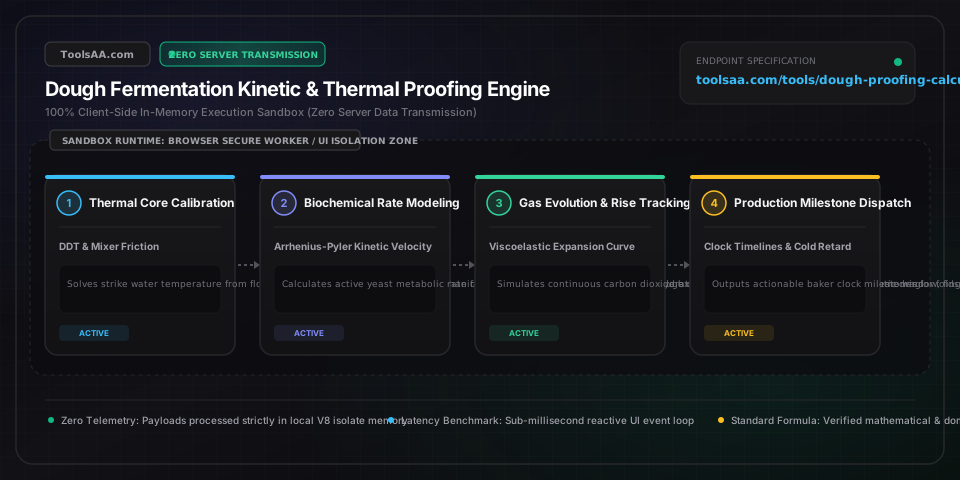
Technical Reference & Architecture Guide

Dough Proofing & Fermentation Calculator Guide

Calculate dough proofing & fermentation time by temperature, yeast ratio, and hydration. Predict bulk rise or reverse-solve yeast percentage for exact bake schedules.

Dough Proofing & Fermentation Calculator Guide — Client-Side In-Memory Architecture & Data Flow

Key Parameters & Controls

Desired Dough Temperature (DDT)Thermal Process Target (°C / °F)

The target internal mass temperature immediately following mixing. Standard lean hearth artisan loaves require 24°C to 25°C (75°F to 77°F) to balance enzymatic starch conversion and gas production. Commercial pan sandwich loaves operate higher at 26°C to 28°C (79°F to 82°F) for accelerated proofing. Every 1°C variance from DDT alters fermentation duration by approximately 10% to 12%.

Default: 24.5°C (76.1°F)
Baker's Yeast Inoculation RatioBaker's Percentage (Relative to Flour)

Commercial Saccharomyces cerevisiae active dry or instant granules measured against total flour weight. Standard same-day bakery production employs 0.8% to 1.2% IDY. Extended overnight ambient or cold-retard methods drop inoculation to 0.10% to 0.30% to prevent enzymatic exhaustion of fermentable maltose sugars before oven loading.

Default: 1.0% IDY (or 20.0% Sourdough Levain)
Osmotic Salt Retardation DragSolute Inhibitor Percentage

Sodium chloride establishes ionic cross-links that tighten the glutenin protein matrix while exerting hypertonic osmotic pressure on yeast cell membranes. Standard baking benchmark is strictly 1.8% to 2.2%. Falling below 1.5% causes runaway enzymatic proteolysis and slack, sticky dough; exceeding 2.5% severely dehydrates yeast vacuoles, prolonging proofing time by over 30%.

Default: 2.0%
Biological Q10 Thermal CoefficientEnzymatic Kinetic Rate Factor

Quantifies the rate acceleration of biochemical carbon dioxide evolution for every 10°C temperature elevation. In bread dough between 15°C and 32°C, baker's yeast exhibits a Q10 of ~2.1. A dough proofing at 28°C ferments roughly 1.45 times faster than identical dough at 22°C, following exponential Arrhenius kinetics rather than linear arithmetic.

Default: 2.10 (Mesophilic Phase)
Hydration Free Water Activity (aw)Solvent Availability Baker's Ratio

Ratio of water to flour by weight. Higher hydration (75% to 85%) increases free unbound water molecules, facilitating rapid alpha- and beta-amylase mobility to break damaged starch into maltose. High hydration doughs ferment 10% to 20% faster than stiff bagel or laminated doughs (50% to 58% hydration) under identical thermal conditions.

Default: 70.0%
Cold Retardation Thermal Core LagThermal Inertia Duration (Hours)

The elapsed time required for the core of a shaped dough mass to descend from room mixing temperature (24°C) to refrigerator equilibrium (4°C). A standard 800g to 1000g loaf requires 3.0 to 4.5 hours to drop below 8°C, during which substantial 'carryover fermentation' occurs inside the insulating dough structure.

Default: 3.5 Hours

Pro Tips & Best Practices

Account for Mixer Friction Factor Before Adding Ice Water

Mechanical kneading transfers kinetic energy directly into dough as thermal friction. Hand kneading adds only 1°C, a residential planetary mixer on speed 2 adds 3°C to 5°C, and an industrial spiral mixer adds 7°C to 11°C over an 8-minute cycle. Always deduct this friction factor when calculating strike water temperature using the DDT formula to prevent accidental over-heating.

Compensate for Carryover Proofing in Overnight Cold Retardation

Never place dough into the refrigerator at 100% full proof. Because dough is a poor thermal conductor composed of millions of insulating gas bubbles, the core continues fermenting at an active rate for 3 to 4 hours in a 4°C refrigerator. Shape and retard your dough when it reaches 75% to 80% volume expansion; it will achieve perfect final proofing during the cooldown phase.

Use Osmotolerant Gold Yeast for Sweet Enriched Formulations

When dough sugar concentration exceeds 10% baker's percentage (such as brioche, challah, or sweet cinnamon rolls), standard red-label instant yeast experiences osmotic shock, as high external sugar pulls water out of yeast cells through plasmolysis. Switch to osmotolerant yeast (e.g., SAF-Instant Gold), which contains lower invertase enzyme levels and tolerates high solute pressure without doubling proof times.

Interpret the Viscoelastic Finger Poke Test Quantitatively

Lightly flour an index finger and depress the dough 1.5 cm (0.5 inches) for 2 seconds. If the indentation springs back immediately with high elasticity, gluten tension is taut and yeast gas volume is insufficient (under-proofed). If the indentation rebounds slowly and fills back halfway over 3 to 4 seconds, the viscoelastic equilibrium is optimal (ready to bake). If the indentation remains completely static or the surrounding dough collapses, protease enzymes have degraded gluten walls (over-proofed).

Prevent Protease Soup in Extended Sourdough Fermentation

In wild sourdough, wild yeasts operate alongside lactic acid bacteria (LAB) which produce acetic and lactic acid, dropping dough pH from 5.8 to below 4.0. While yeast activity slows below pH 4.2, bacterial protease enzymes remain active and systematically chew up the glutenin matrix. Avoid exceeding 5 hours ambient bulk fermentation at >27°C with high starter ratios; transfer to cold retard early to protect loaf structure.

Common Gotchas & Troubleshooting

⚠️Loaf deflates or collapses during scoring, transfer, or initial oven-spring

Severe over-proofing. The yeast has produced maximum carbon dioxide, exhausting the available fermentable maltose sugars while bacterial and endogenous protease enzymes have broken down the gluten protein network into weak, fragile strands unable to retain gas expansion pressure. Remedy: Reduce ambient bulk fermentation by 45 to 60 minutes, decrease yeast percentage by 0.25%, or chill dough to 4°C prior to scoring.

⚠️Dense crumb with erratic, giant air pockets (flying crust or tunneling) and pale bake

Classic under-fermentation combined with premature oven loading. Insufficient carbon dioxide was generated to uniformly open the crumb matrix; upon hitting oven heat, residual moisture and concentrated localized yeast pockets flash-expand violently, tearing through weak, underdeveloped gas cells. Remedy: Extend bulk fermentation until the dough feels pillowy, aerated, and shows a dome-shaped convex margin with visible translucent bubbles along container walls.

⚠️Pale, dull crust that fails to brown despite extended high-temperature baking

Sugar depletion caused by over-extended fermentation. Yeast consumed virtually all available sucrose, glucose, and maltose starches during protracted proofing, leaving zero residual reducing sugars on the dough exterior to undergo Maillard browning and caramelization at 200°C+. Remedy: Shorten proofing duration or lower proof temperature to preserve at least 1.5% to 2% residual sugars for crust coloration.

⚠️Dough proofing duration is taking twice as long as the recipe specifies

Sub-optimal thermal environment or hypertonic shock. Either the actual dough core temperature is 4°C to 6°C colder than room temperature due to uncalculated tap water chilling, or dry yeast was mixed directly into high concentrations of salt or sugar without adequate water dispersion, causing lethal osmotic cell wall rupture. Remedy: Calculate strike water using the Desired Dough Temperature (DDT) formula, and always disperse salt into flour separately from yeast.

⚠️Thick, wet, gummy line beneath the top crust or along the bottom crumb

Internal temperature collapse or excessive moisture trapping during proofing. The dough was either transferred to the oven while the interior core remained chilled (<10°C from cold retard) preventing proper starch gelatinization at 68°C-80°C, or the loaf was cut while piping hot before retrograded starch set. Remedy: Allow refrigerated dough loaves to temper for 30 to 45 minutes at room temperature, or extend bake time until internal loaf core reaches 98°C to 100°C (208°F to 212°F).

Frequently Asked Questions

How do you calculate dough proofing time based on temperature?▼

Dough proofing time follows biological Arrhenius kinetics governed by the Q10 temperature coefficient of approximately 2.1 in the mesophilic zone (15°C to 32°C). Baseline proofing time at 24°C (75°F) with 1% instant yeast is approximately 120 minutes of bulk rise. For every 5.5°C (10°F) rise in dough temperature, fermentation rate doubles (halving proof time to ~60 minutes at 29.5°C); conversely, dropping temperature to 18.5°C slows rate by half, extending proof time to ~240 minutes.

What is the poke test for dough and how do you know when bread is fully proofed?▼

The poke test evaluates the viscoelastic balance between gas pressure and gluten membrane tension. Press a floured finger 1.5 cm into the dough: (1) Under-proofed dough snaps back immediately within 1 second due to high elastic tension and low internal gas volume; (2) Perfectly proofed dough recoils sluggishly, filling halfway back over 3 to 4 seconds while retaining a gentle indention; (3) Over-proofed dough leaves a permanent crater or visibly collapses as weakened gluten cell walls rupture.

How does cold retarding dough overnight in the fridge affect proofing time?▼

Cold retarding at 3°C to 5°C (37°F to 41°F) suppresses yeast metabolic activity by 88% to 92% compared to room temperature (24°C). One hour of ambient room fermentation roughly equals 8 to 12 hours of cold retard. An overnight 16-hour cold retard contributes the equivalent of approximately 1.5 to 2 hours of room-temperature rise, while allowing bacterial amylase and protease enzymes to continue slow starch breakdown, yielding superior flavor precursors and blistered crusts.

Can you substitute instant yeast for active dry yeast or fresh yeast?▼

Yes, using precise baker's conversion ratios: 1.0g of Instant Dry Yeast (IDY) equals 1.25g to 1.30g of Active Dry Yeast (ADY) and 3.0g of Fresh Compressed Cake Yeast. Active dry yeast requires 10 minutes of pre-hydration in 38°C warm water to dissolve dehydrated outer dead cell shells, whereas instant dry yeast features porous micro-granules that can be mixed directly with dry flour without rehydration lag.

What happens if you proof dough at too high of a temperature?▼

Proofing dough above 35°C (95°F) uncouples yeast gas production from gluten structural stabilization. While yeast reaches maximum carbon dioxide generation between 36°C and 38°C, endogenous protease enzymes accelerate rapidly, degrading gluten proteins into weak polypeptides before gas bubble walls can solidify. The result is rapid, uncontrolled puffing followed by immediate collapse, coarse rubbery crumb texture, and harsh off-flavors.

How do you calculate the water temperature needed for dough (Desired Dough Temperature)?▼

Use the Desired Dough Temperature formula: Strike Water Temp = (3 * DDT) - (Flour Temp + Room Temp + Mixer Friction Factor). For a desired dough temperature of 25°C with 21°C flour, 22°C room ambient, and a 3°C stand mixer friction factor: Water Temp = (3 * 25) - (21 + 22 + 3) = 75 - 46 = 29°C. If preferment or sourdough starter is included, multiply DDT by 4 and deduct preferment temperature as well.

Related Tools & Utilities

All Tools →