Title input deck
Desc how to pay
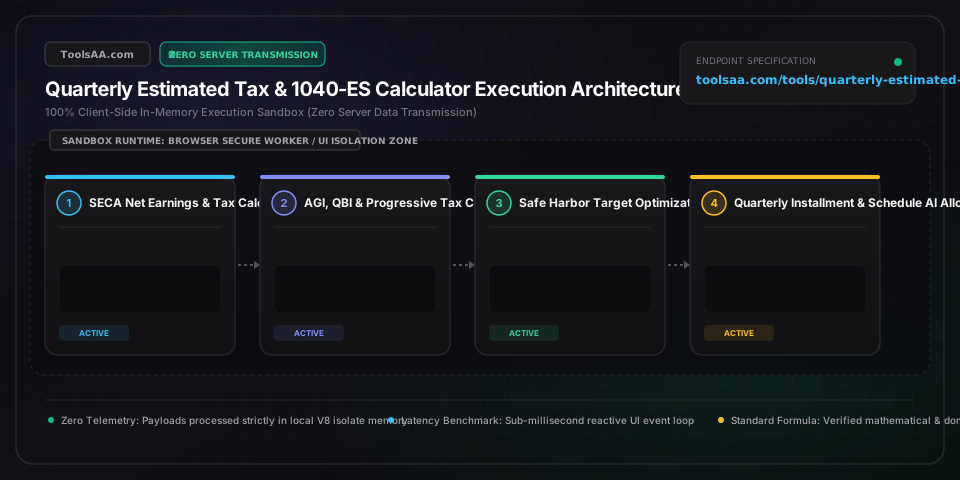
Calculate quarterly estimated tax payments, self-employment tax (SECA), safe harbor penalty protection, Section 199A QBI deduction, and Form 2210 Schedule AI annualized income installments for freelancers, 1099 contractors, and business owners.
Desc how to pay
High-performance calculation executed entirely in browser memory.
All payloads remain strictly local with zero external server communication.
Clean, optimized output formats ready for immediate deployment.
Disclaimer text
ToolsAA.com • Lbl all rights reservedCalculate quarterly estimated tax payments, self-employment tax (SECA), safe harbor penalty protection, Section 199A QBI deduction, and Form 2210 Schedule AI annualized income installments for freelancers, 1099 contractors, and business owners.
Annual net business earnings subject to 15.3% SECA taxation, calculated after applying the statutory 92.35% (0.9235) adjustment factor under IRC § 1402(a)(12) up to the statutory OASDI cap ($176,100 for 2025; $168,600 for 2024) and uncapped Medicare.
Total tax liability from the preceding tax year used to determine the statutory Section 6654 safe harbor baseline: 100% of prior-year tax for AGI ≤ $150,000, or 110% for high earners exceeding the $150,000 AGI cutoff ($75,000 if Married Filing Separately).
Annual federal income tax withheld across all wage employments, statutorily deemed under IRC § 6513(b)(2) to be paid in four equal 25% installments regardless of actual deduction dates, offsetting 1040-ES voucher obligations.
Statutory deduction of up to 20% on net qualified pass-through entity earnings under the Tax Cuts and Jobs Act, subject to statutory phase-out thresholds ($191,950 Single / $383,900 MFJ for 2024; $197,300 Single / $394,600 MFJ for 2025) and SSTB limitations.
Statutory multiplier under IRC § 6654(d)(2) applied to cumulative year-to-date profit to annualize uneven cash flow: Q1 (3 mos) × 4.0, Q2 (5 mos) × 2.4, Q3 (8 mos) × 1.5, and Q4 (12 mos) × 1.0 to establish required checkpoint installments.
IRC § 6513(b)(2) stipulates that federal income tax withheld from wages is statutorily treated as paid equally across all four tax quarters (25% per quarter), regardless of when it was deducted. If you discover in Q4 that you underpaid estimated taxes for Q1 or Q2, ask your employer to make a large one-time withholding adjustment on your December paycheck or year-end bonus. This retroactively eliminates underpayment penalties that direct 1040-ES payments cannot cure.
If your business income is doubling or tripling this tax year, base your estimated payments strictly on 110% of your prior year tax liability (Line 24 of Form 1040). Paying this fixed safe harbor target completely shields you from IRS Section 6654 penalties, allowing you to retain surplus cash in high-yield business savings or working capital until April 15.
The IRS payment periods are unequal: Q1 is 3 months, Q2 is only 2 months, Q3 is 3 months, and Q4 is 4 months. If your business earns most of its profits in Q3 and Q4, filing Form 2210 with Schedule AI proves your income was back-weighted, wiping out erroneous default penalties assessed under the standard 25% equal installment assumption.
State estimated tax rules often do not mirror federal percentages. For example, California FTB requires payments in non-equal installments (30% Q1, 40% Q2, 0% Q3, 30% Q4) and eliminates the prior-year safe harbor for taxpayers with California AGI over $1,000,000. Always check your state department of revenue rules in tandem with federal 1040-ES.
Expected W-2 withholding entered already satisfies the 90% current year or 100%/110% prior year safe harbor threshold, or your net balance due after withholding is under $1,000. Check the W-2 federal tax withheld field; if your spouse or your own W-2 job withholds enough to meet safe harbor requirements, you are legally exempt from filing quarterly 1040-ES vouchers under IRC § 6654(e).
Prior-year AGI entered exceeds $150,000 ($75,000 for married filing separately), triggering IRC § 6654(d)(1)(C) which escalates the prior-year safe harbor baseline from 100% to 110%. Verify prior-year Form 1040 Line 11 (AGI); if it is $150,001 or higher, the 110% benchmark is legally mandated to guarantee penalty protection.
Form 2210 Schedule AI establishes the cumulative minimum legal payment checkpoints (22.5%, 45%, 67.5%, and 90%), not 100% of final year-end liability. Any remaining unpaid balance between 90% and 100% of final liability is due with your annual return on April 15 without penalty.
To calculate quarterly estimated tax, first estimate your expected annual net self-employment earnings (gross receipts minus allowable deductible expenses). Next, calculate your self-employment tax by multiplying net profit by 92.35% and applying the 15.3% SECA rate (12.4% Social Security up to the wage base limit and 2.9% Medicare). Deduct 50% of the SE tax from your gross income to determine Adjusted Gross Income (AGI). Subtract your standard or itemized deductions and the Section 199A Qualified Business Income (QBI) deduction (up to 20% of net profit) to arrive at taxable income. Calculate your progressive federal income tax, add the SE tax, and subtract any expected W-2 withholding. Divide the remaining balance by 4 to determine your quarterly payment vouchers.
Under Internal Revenue Code Section 6654, you are immune from IRS underpayment penalties if your cumulative withholding and estimated tax payments meet either of two safe harbor thresholds: (1) 90% of your current year's final total tax liability, or (2) 100% of your prior year's total tax liability (found on Line 24 of your prior year Form 1040). If your prior year Adjusted Gross Income exceeded $150,000 ($75,000 if married filing separately), the prior-year safe harbor benchmark increases to 110%. Paying the prior-year safe harbor amount shields you from penalties even if your income doubles or triples in the current year.
IRS Form 1040-ES estimated payments are due four times a year: Q1 is due April 15 (covering January 1 to March 31); Q2 is due June 15 (covering April 1 to May 31); Q3 is due September 15 (covering June 1 to August 31); and Q4 is due January 15 of the following year (covering September 1 to December 31). If any due date falls on a weekend or federal holiday, the deadline rolls over to the next business day. Note that Q2 covers only 2 months of income while Q4 covers 4 months.
If your income fluctuates significantly—such as for e-commerce store owners, landscapers, or freelance designers with uneven project billings—using the standard 25% equal quarterly payment method can cause unfair penalties for early quarters. The Annualized Income Installment Method (Form 2210, Schedule AI) allows you to pay estimated taxes based on what you actually earned up through each quarter. You multiply your actual cumulative net profit for each period by IRS annualization multipliers (4.0 for Q1, 2.4 for Q2, 1.5 for Q3, and 1.0 for Q4), calculate the theoretical annualized tax, and pay the proportional cumulative installment. This eliminates penalties when revenue surges late in the year.
Yes, W-2 tax withholding has a unique advantage over estimated tax payments: the IRS treats W-2 withholding as having been paid evenly throughout all four quarters regardless of when it was actually deducted from your paycheck. If you realize in November that you underpaid your estimated taxes for Q1, Q2, or Q3, you can increase your W-2 withholding on late-year paychecks or year-end bonuses. The increased withholding retroactively credits against earlier quarters, legally erasing or reducing underpayment penalties that direct estimated payments could not.
Disclaimer: This tool is provided strictly for educational and informational purposes only and does not constitute formal financial advice or a binding loan commitment. Please consult a qualified financial advisor before making decisions. If you fail to make required quarterly estimated tax payments or pay less than your safe harbor amount by the deadline, the IRS assesses an underpayment penalty under Section 6654. The penalty is calculated as daily compounding interest on the unpaid amount from the date the installment was due until the date paid or April 15 of the filing year, whichever comes first. The IRS interest rate for underpayment is adjusted quarterly and currently sits at 8% per annum. You cannot avoid earlier quarter penalties simply by making an oversized fourth-quarter voucher payment; only W-2 withholding provides retroactive credit.
Calculate lawn aeration core plugs, topdressing sand or compost volume in cubic yards, overseeding rates, and soil decompaction coverage accurately.
Interactive Insulation R-Value Calculator & Thickness Estimator (Attic, Wall, Floor) with real-time client-side analysis and visualization.
Calculate grass seed for new lawns and overseeding in lbs or kg. Get exact Pure Live Seed (PLS) rates, starter fertilizer bags, and germination watering schedules.
Calculate flagstone tonnage, patio square footage, and base materials instantly. Estimate irregular vs dimensional stone coverage, gravel sub-base, and sand.
Professional 6-in-1 lacto-fermentation salt and brine percentage calculator engineered for culinary science and food preservation. Calculates exact salt mass in grams alongside brand-calibrated volumetric spoon measures for Diamond Crystal Kosher, Morton Coarse, Fine Table Salt, and Sea Salt. Supports Total Weight wet brining (gold standard), dry salting for sauerkraut and kimchi, pre-mixed water-only brine, standard jar vessel auto-fill estimators, emergency two-way salinity dilution rescue, and real-time microbial safety and LAB kinetic phase tracking.
Professional drip irrigation hydraulic engineering suite. Accurately calculates total zone flow (GPM/LPM), Hazen-Williams lateral friction loss with Christiansen multi-outlet reduction factors, maximum allowable lateral tubing run lengths, flow velocity safety margins, elevation head shifts, plant evapotranspiration (ETc) water demand, and pulse cycle-and-soak schedules.