Grass Seed & Lawn Overseeding Calculator

Grass Seed & Lawn Overseeding Calculator

Calculate grass seed for new lawns and overseeding in lbs or kg. Get exact Pure Live Seed (PLS) rates, starter fertilizer bags, and germination watering schedules.

Lbl load scenario
Lbl measurement system
≈ 0.11 Unit acres
-0 Unit sq ft

Hint deductions

Lbl net lawn area5,000 Unit sq ft
≈ 464.5 m²
≈ 0.115 acres
Lbl turf species
Lbl cool season
Lbl seeds per pound: 220,000 / lbLbl germination days: 7-14 Lbl days

Hint overseeding

Lbl seed quality headerPLS: 83.3%
Lbl purity pct98.0%
Lbl germination pct85.0%
Lbl waste buffer+10%

Hint waste buffer

Lbl soil temp checkLbl optimal soil temp
62°F (17°C)

Hint soil optimal

Lbl starter fert header
Lbl fert grade analysis
Lbl target p2 o5 rate0.75 Unit lbs per1k

Hint target p2 o5

Lbl summary kpi seed29.7 Unit lbs
Lbl summary kpi bags1×20lb 2×5lb
Lbl summary kpi density6.9 / sq in
Lbl summary kpi fert15.6 Unit lbs
Lbl total bulk seed
29.7Unit lbs(13.5 Unit kg)

Lbl net pure seed: 22.5 Unit lbs | Lbl waste buffer: +10%

83.3%Lbl calculated pls
Seed grade standard
Lbl canopy densityDensity sparse

Hint canopy calc ≈ 4.95M Hint viable seeds (6.9 Unit per sq inch / 1.1 Unit per sq cm).

Lbl estimated cost:
$/Unit lbs
≈ $134
Lbl retail bags planLbl bag mix optimal
Lbl bag50lb00 Unit lbs
Lbl bag20lb120 Unit lbs
Lbl bag5lb210 Unit lbs
Lbl bag3lb00 Unit lbs
Lbl leftover seed:+0.3 Unit lbs

Disclaimer agronomic
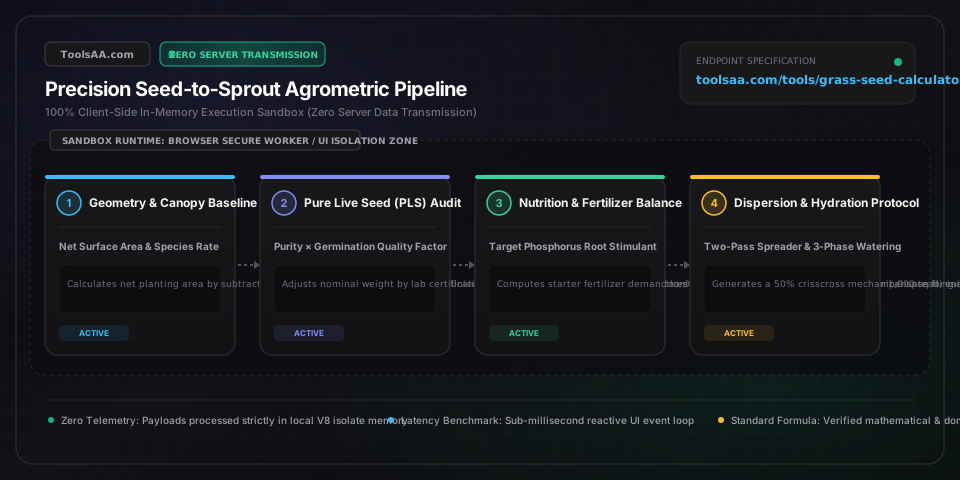
Technical Reference & Architecture Guide

Grass Seed & Lawn Overseeding Calculator Guide

Calculate grass seed for new lawns and overseeding in lbs or kg. Get exact Pure Live Seed (PLS) rates, starter fertilizer bags, and germination watering schedules.

Grass Seed & Lawn Overseeding Calculator Guide — Client-Side In-Memory Architecture & Data Flow

Key Parameters & Controls

Net Lawn Surface AreaSquare feet (sq ft) or Square metres (m²)

Effective turfgrass soil footprint excluding non-vegetated impervious surfaces such as driveways, paved stone patios, wooden decks, swimming pools, and dedicated mulched flowerbeds. Accurate exclusion prevents over-purchasing seed by 15% to 30%.

Default: 5,000 sq ft (or 500 m²)
Turfgrass Species Baseline RatePounds per 1,000 sq ft or Grams per m²

University Extension agronomic seeding density calibrated to seed count per unit weight. Fine-seeded cultivars like Kentucky Bluegrass (~1,300,000 to 2,000,000 seeds/lb) require only 2 to 3 lbs/1,000 sq ft, whereas coarse large-seeded species like Turf-Type Tall Fescue (~220,000 seeds/lb) require 8 to 10 lbs/1,000 sq ft to achieve equivalent live ground cover.

Default: Tall Fescue: 8.0 lbs/1,000 sq ft (New) / 4.0 lbs/1,000 sq ft (Overseeding)
Lawn Condition Application ModifierAgronomic Factor (0.50 to 1.00)

Adjustment coefficient accounting for existing turf competition: 1.00 (100% rate) for freshly tilled or graded bare ground, 0.50 (50% rate) for standard seasonal overseeding into existing turf stands, and 0.75 (75% rate) for degraded lawns with extensive bare patches or grub damage.

Default: 0.50 (Overseeding)
Pure Live Seed (PLS) Quality IndexPercentage (%)

Calculated agronomic metric: (Purity % × Germination %) / 100. Accounts for non-viable inert material, chaff, weed seeds, and dormant grains declared on certified seed tags. A bag with 90% purity and 80% germination possesses a 72% PLS index, necessitating 1.39 lbs of bulk bag seed for every 1.0 lb of target live seed.

Default: 83.3% (98% purity × 85% germination)
Starter Fertilizer Phosphorus (P2O5) RatioPounds P2O5 per 1,000 sq ft or g/m²

Agronomic nutrient load formulated to promote rapid juvenile root branching without foliar nitrogen burn. University soil labs recommend delivering 0.5 to 1.0 lb of elemental phosphate (the middle 'P' number in N-P-K) per 1,000 sq ft concurrently with seeding.

Default: 0.75 lb P2O5 per 1,000 sq ft
Spreader Pass Overlap BufferPercentage (%)

Compensatory margin for rotary spreader centrifugal distribution taper, irregular lawn perimeter borders, wheel-turn dead zones, and surface seed loss to foraging birds or wind displacement.

Default: 10%

Pro Tips & Best Practices

Never Seed by Weight Without Calculating PLS (Pure Live Seed)

Bargain retail seed mixtures frequently contain up to 15% inert filler (such as moisture-absorbing seed coatings, chaff, or weed seed) and germination guarantees as low as 70%. A 50-lb discount bag with 50% coating and 75% germination delivers only 18.75 lbs of actual live seed (37.5% PLS). Always read the analysis tag and divide your required net seed weight by the PLS decimal to avoid a chronically sparse lawn.

Calibrate Spreaders for a Two-Pass Crisscross Pattern

Never apply 100% of your seed in a single direction. Set your rotary or drop spreader to half the recommended delivery rate. Walk the first pass in parallel North-to-South lines, then apply the remaining half walking East-to-West perpendicularly. This eliminates visible striping, feathering gaps, and heavy wheel-rut clumping.

Prioritize Soil Temperature Over Air Temperature

Cool-season grasses (Fescue, Bluegrass, Ryegrass) germinate optimally when soil temperature at a 2-inch depth measures between 50°F and 65°F (10°C to 18°C), typically correlating to daytime air temperatures of 60°F to 75°F. Sowing when summer air is 85°F+ induces thermal seed dormancy, while sowing below 45°F soil halts enzyme activation and promotes seed rot.

Seed-to-Soil Contact Trumps Seed Volume Every Time

Broadcasting seed directly onto thatch or hard compacted soil yields less than 20% seedling survival regardless of how heavily you spread. Core aerate with 2-to-3-inch hollow tines or scarify/dethatch the lawn prior to spreading, and roll the surface with a half-filled water roller or topdress with 1/8-inch of screened peat moss to lock in moisture.

Common Gotchas & Troubleshooting

⚠️Seeds Washed Out or Clumped in Low Drainage Swales After Heavy Rain

Lightly rake clumped areas outward before germination occurs. On sloped terrain, apply an agricultural biodegradable straw erosion blanket or wood-cellulose tackifier blanket immediately after spreading, and avoid using high-pressure spray nozzles that blast seed away from soil crevices.

⚠️Zero Germination After 14 Days Following Sowing

Verify species germination velocity first: Perennial Ryegrass sprouts in 5 to 10 days, Tall Fescue in 7 to 14 days, but Kentucky Bluegrass requires 14 to 28 days of sustained dampness. If past the species threshold, inspect for dry soil crusting: if the top 1/2 inch dries out even once after the seed swells, the emerging embryo desiccates and dies.

⚠️Seedling Thinning and Yellowing Collapse (Damping-Off Fungus)

Excessive seed density combined with saturated soil promotes Pythium and Rhizoctonia damping-off blight. Never exceed recommended seeding rates thinking 'thicker is better'—crowded seedlings choke out root oxygen. Transition from short frequent watering to deeper, less frequent morning irrigation as soon as green shoots exceed 1 inch in height.

⚠️Accidental Application of Pre-Emergent Weed Preventer During Seeding

Standard crabgrass pre-emergents (Prodiamine, Dithiopyr, Pendimethalin) form a chemical vapor barrier in the upper soil profile that inhibits all grass seed germination for 3 to 6 months. If mistakenly applied, seeding must be postponed until the chemical degrades, or the barrier must be physically disrupted via aggressive mechanical core cultivation and fresh topsoil topdressing. (Exception: Mesotrione/Tenacity is the only safe pre-emergent at seeding for most cool-season grasses).

Frequently Asked Questions

How do I calculate how much grass seed I need for my lawn?▼

Multiply your lawn's length by width in feet to determine total square footage, subtract non-grass zones (patios, driveways, beds), and divide by 1,000. Next, multiply this result by your grass species' recommended rate per 1,000 sq ft (e.g., 8 lbs for Tall Fescue new lawn, 4 lbs for overseeding). Finally, divide by your seed's Pure Live Seed percentage (Purity × Germination) and add a 10% safety margin for spreader calibration.

How many pounds of grass seed do I need per 1000 square feet?▼

The required seed weight per 1,000 sq ft depends on the grass cultivar's seed size: Kentucky Bluegrass requires 2 to 3 lbs for new lawns (1 to 1.5 lbs for overseeding); Turf-Type Tall Fescue requires 8 to 10 lbs for new lawns (4 to 5 lbs for overseeding); Perennial Ryegrass requires 6 to 8 lbs for new lawns (3 to 4 lbs for overseeding); and Bermudagrass requires 1.5 to 2.5 lbs for new lawns (0.75 to 1.25 lbs for overseeding).

What is the difference between new lawn seeding and overseeding rates?▼

New lawn seeding rates apply to bare, freshly prepared soil where grass seedlings experience zero competition for sunlight, water, and soil nutrients. Overseeding rates are calibrated 50% lower because existing mature turfgrass already occupies the soil canopy; spreading at full new-lawn rates into an established lawn causes severe seedling overcrowding, canopy smothering, fungal blight, and poor root establishment.

What happens if you put too much grass seed down?▼

Spreading grass seed too thickly causes seedlings to compete aggressively against each other for limited soil moisture, nitrogen, and oxygen. The resulting turf develops shallow, weak root systems and creates an overly dense, humid microclimate vulnerable to Pythium blight and damping-off fungal decay. The lawn may look lush for two weeks, but will die off dramatically at the onset of summer heat.

What is Pure Live Seed (PLS) and how does it affect the amount of seed I buy?▼

Pure Live Seed (PLS) measures the actual percentage of viable seed in a bag by multiplying mechanical Purity % by lab Germination % and dividing by 100. For example, a bag with 90% purity and 80% germination has a PLS of 72% (0.72). To deliver 10 pounds of actual live seed, you must buy 13.9 pounds of bulk bag seed (10 ÷ 0.72). Ignoring PLS leads to chronically thin, weed-prone turf.

Related Tools & Utilities

All Tools →
Flagstone Calculator & Patio Stone TonsUtility

Calculate flagstone tonnage, patio square footage, and base materials instantly. Estimate irregular vs dimensional stone coverage, gravel sub-base, and sand.

Open tool→
Lacto Fermentation Salt & Brine CalculatorUtility

Professional 6-in-1 lacto-fermentation salt and brine percentage calculator engineered for culinary science and food preservation. Calculates exact salt mass in grams alongside brand-calibrated volumetric spoon measures for Diamond Crystal Kosher, Morton Coarse, Fine Table Salt, and Sea Salt. Supports Total Weight wet brining (gold standard), dry salting for sauerkraut and kimchi, pre-mixed water-only brine, standard jar vessel auto-fill estimators, emergency two-way salinity dilution rescue, and real-time microbial safety and LAB kinetic phase tracking.

Open tool→
Drip Irrigation Calculator & Flow SizerUtility

Professional drip irrigation hydraulic engineering suite. Accurately calculates total zone flow (GPM/LPM), Hazen-Williams lateral friction loss with Christiansen multi-outlet reduction factors, maximum allowable lateral tubing run lengths, flow velocity safety margins, elevation head shifts, plant evapotranspiration (ETc) water demand, and pulse cycle-and-soak schedules.

Open tool→
Dough Proofing & Fermentation CalculatorUtility

Calculate dough proofing & fermentation time by temperature, yeast ratio, and hydration. Predict bulk rise or reverse-solve yeast percentage for exact bake schedules.

Open tool→
Cricket NRR Calculator (Net Run Rate)Utility

Calculate cricket NRR (Net Run Rate), tournament standings, and chase scenarios. Solve required overs or runs needed to qualify with exact ICC DLS decimal rules.

Open tool→
Carpet Calculator & Square Yard EstimatorUtility

Calculate carpet square footage, square yards, and roll cuts with roll waste, padding, and installation costs. Instant room estimates with seam layout guide.

Open tool→