Sonotube Calculator & Concrete Pier Bags

Sonotube Calculator & Concrete Pier Bags

Calculate concrete volume in cubic yards, cubic feet, and 40, 50, 60, or 80 lb bags for Sonotube cardboard forms, flared footings, and rebar cages.

Lbl presets

Card dimensions title

10 inches
42 "

Hint frost depth

6 "

Hint reveal height

4 Unit piers
4
+10%

Hint waste margin

$
Metric cubic yards0.36 Unit cu yds
Metric total bags16 × Bag short80lb
Metric total weight1,392 Unit lbs
Metric water gallons12.0 Unit gal
Metric steel weight63.2 Unit lbs
Lbl estimated cost$185.00
Lbl recommended order
0.36Unit cu yds/0.27Unit m3

4 Piers at 2.40 Cu ft each 10% Waste allowance.

Bag short80lb Bags needed16(16.0 Exact bags)
Card visualizer title
Vis ground gradeVis frost lineVis gravel subbaseØ 10"+6"-42"
All standard bagsLbl astm yield
Lbl bag80 title16 Unit bagsLbl yield80
Lbl bag60 title22 Unit bagsLbl yield60
Lbl bag50 title26 Unit bagsLbl yield50
Lbl bag40 title32 Unit bagsLbl yield40
Lbl bag25kg title22 Unit bagsLbl yield25kg
Lbl bag40kg title14 Unit bagsLbl yield40kg
Lbl physical healthLifting total of 1,280 Unit lbs.
Water to batch12.0 Unit gal (45 Unit liters)

Disclaimer title Disclaimer text

Technical Reference & Architecture Guide

Sonotube Calculator & Concrete Pier Bags Guide

Calculate concrete volume in cubic yards, cubic feet, and 40, 50, 60, or 80 lb bags for Sonotube cardboard forms, flared footings, and rebar cages.

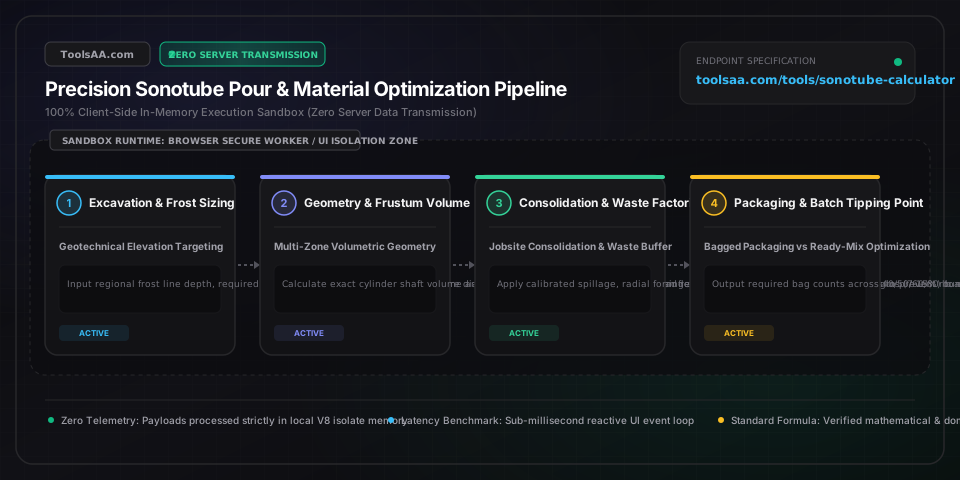
Sonotube Calculator & Concrete Pier Bags Guide — Client-Side In-Memory Architecture & Data Flow

Key Parameters & Controls

Inside Column DiameterCylindrical Inner Bore Dimension

Standard nominal inner bore of commercial spiral-wound cardboard form tubes. Crucial: concrete volume scales with the square of the radius (r^2), meaning a 12-inch tube consumes 2.25 times more concrete than an 8-inch tube for the exact same vertical depth.

Default: 10 inches (250 mm)
Frost Depth vs Above-Grade RevealVertical Elevation Partitioning

Total tube height equals excavation depth below grade plus above-grade reveal. The base must extend at least 6 to 12 inches below the municipal frost penetration line to eliminate frost heave, while the reveal holds wooden post bases 4 to 8 inches above grade away from damp soil.

Default: 42 in below grade + 6 in reveal = 48 in total
Flared Bell Base Frustum (Bigfoot)Truncated Cone Footing Geometry

Expanded conical footing installed beneath the cylindrical shaft. Disperses concentrated vertical structural loads across weak soil according to geotechnical bearing capacity (psf) and serves as an anchor flange against seasonal frost heave.

Default: 20-inch base x 12-inch height
ASTM C387 Dry Packaged YieldsVolumetric Packaging Standard

Standard wet consolidated concrete yield per dry packaged pre-mix bag: an 80 lb bag yields 0.60 cu ft (45 bags/cu yd), a 60 lb bag yields 0.45 cu ft (60 bags/cu yd), a 50 lb bag yields 0.375 cu ft (72 bags/cu yd), and a 40 lb bag yields 0.30 cu ft (90 bags/cu yd). Wet density averages 145 lbs/cu ft.

Default: 0.60 cu ft per 80 lb bag
Consolidation & Hydrostatic AllowanceVolumetric Safety Buffer

Recommended overage contingency between 7% and 15%. Accounts for cardboard form radial deflection under wet hydrostatic head, consolidation volume loss during mechanical tamping/vibrating, and wheelbarrow-to-tube transfer spillage.

Default: 10%

Pro Tips & Best Practices

Beware Hydrostatic Form Bulging on Tall Tubes

Cardboard Sonotubes taller than 48 inches undergo intense outward lateral hydrostatic pressure from wet concrete. Without backfilling around the tube exterior before pouring, 12-inch and larger tubes expand radially by 3% to 6%, swallowing half a bag more concrete per pier than geometric calculations indicate. Always backfill soil around the tube or secure external 2x4 bracing collars before pouring.

Adfreeze Frost Heave Prevention Rule

In freezing climates, frozen ground adheres to rough-poured bare soil concrete (adfreeze bond) and jackhammers the pier upward during winter freezes. Cardboard Sonotubes provide a smooth outer skin that breaks soil friction. Ensure the base extends below the local frost depth and inspect that the cardboard remains dry and intact until placement.

The 1.5 Cubic Yard Labor & Cost Tipping Point

Mixing bagged concrete in a wheelbarrow or portable drum mixer becomes economically and physically unviable past 1.5 cubic yards (~68 80-lb bags or 90 60-lb bags). An 80-lb bag requires roughly 3 quarts of clean water and 3 minutes of vigorous mixing; 68 bags demand lifting 5,440 lbs of dry mix and moving hundreds of gallons of wet mud. Order a ready-mix transit mixer truck when footing volume exceeds 1.5 cubic yards.

Rebar Concrete Displacement Offsetting

While vertical reinforcement steel rebar (e.g. four #4 bars) displaces a tiny volume of concrete (~0.05 cu ft per 4-ft pier), mechanical rodding and consolidation remove entrained air voids, causing a net volume reduction of 2% to 4%. Never deduct rebar volume from your concrete order.

Common Gotchas & Troubleshooting

⚠️Sonotube floated or lifted upward during concrete placement

When pouring concrete into a flared bell footing form (Bigfoot) or unanchored tube, buoyant forces and upward hydraulic pressure push the lightweight tube upward. Fasten the cardboard tube to the plastic footing adapter using 1-inch self-tapping screws and clamp a 2x4 wooden collar staked firmly into the ground before pouring.

⚠️Ran short of concrete with 4 to 6 inches remaining at the tube top

Never allow a partial pour to cure past 30 to 45 minutes before topping off, as this creates a dangerous structural cold joint. If bag concrete runs short, immediately insert clean L-shaped rebar dowels vertically across the joint interface, score the surface with a trowel, and mix emergency supplemental bags within 20 minutes.

⚠️Excavated pier hole filling with subsurface groundwater

Do not dump dry concrete mix into standing water hoping it will hydrate properly. Pump out standing water immediately prior to placing the Sonotube, install a plastic poly sleeve or footing boot, and pour concrete continuously from the bottom up using a tremie pipe to displace residual moisture without washing out cement paste.

⚠️Uneven cut line at the top of the Sonotube causing non-level post brackets

Wrap a wide ratchet strap or flexible drywall tape around the tube circumference at the marked transit laser elevation line and score along the edge with a reciprocating saw or sharp utility knife. This ensures a clean, perpendicular top cut providing a flush mounting surface for post base brackets.

Frequently Asked Questions

How many 80 lb bags of concrete for a 10 inch Sonotube?▼

For a standard 4-foot (48-inch) total height with a 10% waste allowance, a 10-inch Sonotube requires approximately 3.9 (rounded to 4) 80-lb bags of pre-mix concrete. If using 60-lb bags, you will need approximately 5.2 (rounded to 6) bags. At 3 feet deep, an 80-lb bag count drops to 3.0 bags per pier.

What is the formula to calculate concrete for a Sonotube pier?▼

Calculate cylinder volume with: Volume (cu ft) = PI * (Radius in feet)^2 * Height in feet. For example, a 10-inch tube has a radius of 5 inches (0.4167 ft). At 4 feet deep: 3.14159 * (0.4167)^2 * 4 = 2.18 cu ft. Divide by 27 to get 0.081 cubic yards. Multiply by 1.10 to add a 10% safety margin (2.40 cu ft), then divide by 0.60 cu ft per 80-lb bag to get 4.0 bags.

Should a Sonotube go all the way to the bottom of the footing hole?▼

If using a flared bell footing form (such as Bigfoot), the Sonotube securely slips onto the top ring of the bell adapter at the bottom of the hole. If pouring a straight cylindrical pier without a bell form, the Sonotube typically rests 4 to 6 inches above the bottom of the excavation on compacted gravel, allowing the bottom concrete to flare outward into undisturbed soil, forming a self-made anchor pad.

Is it cheaper to use bagged concrete or order a ready-mix truck?▼

Bagged concrete is significantly cheaper for pours under 1.5 cubic yards (under 68 80-lb bags), totaling $300 to $500 in materials. Ready-mix transit concrete suppliers charge a base price of $140 to $180 per cubic yard, but enforce a 4 to 5 yard minimum order or levy a short-load penalty of $120 to $200. Ready-mix becomes financially cost-effective only when total pour volume surpasses 2.0 to 2.5 cubic yards.

How high should a concrete Sonotube pier stick out of the ground?▼

Building codes (IRC Section R404.1.6) and standard deck construction guidelines recommend setting Sonotubes to project 4 to 8 inches (100 to 200 mm) above finished grade. This elevation prevents splash-back water, garden mulch, and damp soil from contacting wooden posts and rotting structural framing.

Related Tools & Utilities

All Tools →
Tap Drill Size Calculator & Thread Chartengineering

Calculate exact pre-tapping hole diameters for Metric ISO (M1–M68) and Unified Imperial (UNC, UNF, UNEF #0–2") threads across cutting taps and cold-forming roll taps, with adjustable Percent of Thread (% engagement), material recommendations, and nearest fractional/letter/number/metric drill bit snapping.

Open tool→
Steps per mm Calculator & E-StepsUtility

Calculate theoretical and measured steps per mm, steps per inch, or Klipper rotation distance for 3D printers and CNCs. Calibrate GT2 belts, T8 leadscrews, ballscrews, and geared E-steps.

Open tool→
Stair Carpet & Runner Yardage CalculatorUtility

Calculate exact stair carpet linear feet, square yards, and runner rolls for straight or landing flights. Compares Hollywood wrap vs waterfall styles with cut waste.

Open tool→
Fondant Coverage Calculator & Cake TierUtility

Calculate exact fondant weight, rolled circle diameter, and commercial pack requirements for round, square, and tiered cakes with zero cracking or waste.

Open tool→
Vegetable Garden Yield Calculator & PlannerUtility

Comprehensive vegetable garden harvest calculator for home gardeners, homesteaders, and self-sufficiency planners. Estimates total yield in pounds and kilograms across 30+ crops, family servings, required raised bed area, and nutritional calories.

Open tool→
Plant Spacing & Garden Grid CalculatorUtility

Calculate plant spacing, garden grid density, and crop capacity for raised beds, row gardens, and staggered layouts. Compare square vs triangular yield bonus.

Open tool→