Header short title

Plant Spacing & Garden Grid Calculator

Calculate plant spacing, garden grid density, and crop capacity for raised beds, row gardens, and staggered layouts. Compare square vs triangular yield bonus.

Lbl presets bar
Kpi total plants
40Lbl plants word
Lbl bed density1.25 / Unit sq ft
Kpi density gain
+25%
+8 Lbl more than square
Kpi seeds needed
48Lbl seeds word
85% Lbl germination label
Kpi soil volume
0.99Unit cu yd
~18 Lbl standard bags

Title garden dimensions

8×4 Unit ft
Lbl locked86

Lbl triangular lock note

3

Lbl buffer tip

10

Lbl depth tip

85%
Lbl total plot area32 Unit sq ft
Lbl visual bed top(40 Lbl plants word)
8 Unit ft (90in usable)4 Unit ft
Lbl stem legendLbl canopy legendLbl margin legend

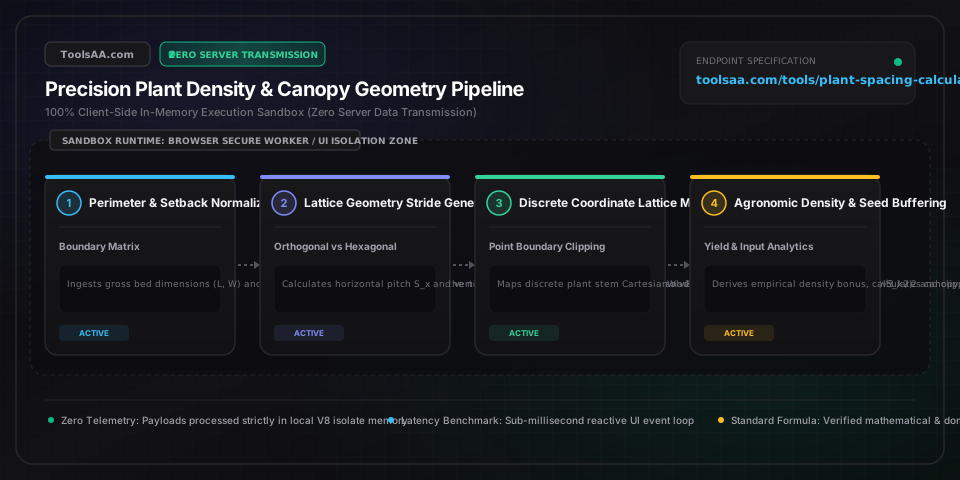
Client-Side Processing

High-performance calculation executed entirely in browser memory.

Zero Server Upload Privacy

All payloads remain strictly local with zero external server communication.

Production Ready Export

Clean, optimized output formats ready for immediate deployment.
Technical Reference & Architecture Guide

Plant Spacing & Garden Grid Calculator Guide

Calculate plant spacing, garden grid density, and crop capacity for raised beds, row gardens, and staggered layouts. Compare square vs triangular yield bonus.

Plant Spacing & Garden Grid Calculator Guide — Client-Side In-Memory Architecture & Data Flow

Key Parameters & Controls

In-Row On-Center SpacingHorticultural Dimension Interval

Linear stem-to-stem spacing along the same cultivation furrow. Commercial guidelines mandate 2 to 4 inches for radishes and baby greens, 12 inches for head lettuce and brassicas, and 18 to 24 inches for determinate nightshades to prevent powdery mildew and foliar shading.

Default: 12 in (30 cm)
Inter-Row Bed DistanceLattice Stride Dimension

Perpendicular distance between parallel planting lines. In equilateral staggered triangular geometry, inter-row spacing is mathematically governed by h = S * (sqrt(3)/2) ≈ 0.866 * S, which compresses row height while preserving uniform root radial buffers.

Default: 12 in (30 cm)
Perimeter Setback BufferPerimeter Clearance Margin

Distance between outer plant stems and the structural bed edge or walking pathway. Standard raised bed protocol requires a minimum 3 to 6 inch margin to prevent soil drying at edges and foliage damage against wooden or corrugated metal side walls.

Default: 3 in (8 cm)
Staggered Density Multiplication FactorHexagonal Packing Constant

Theoretical maximum space-filling circle packing density advantage of 2 / sqrt(3) ≈ 1.1547 (+15.47%). Actual empirical advantage on finite home beds varies between +8% and +18% depending on whether odd offset rows clip at the bed boundary.

Default: 1.1547 (15.47%)
Thinning & Germination Attrition BufferAgronomic Seed Safety Multiplier

Compensatory seed surcharge accounting for certified lot germination percentage (standard 75% to 90% per Federal Seed Act standards) and early seedling damping-off losses, calculated as Gross Seeds = Target Stems / (Germination Rate * Field Survival Factor).

Default: 85% Survival
Root Zone Medium VolumeCultivation Volumetric Measure

Total organic potting mix or native topsoil required calculated as Bed Length * Bed Width * Effective Root Depth. Standard potting blend utilizes 1/3 peat moss or coco coir, 1/3 coarse horticultural vermiculite, and 1/3 blended compost.

Default: 10 in (25 cm) Depth

Pro Tips & Best Practices

Boundary Truncation Trap in Narrow Raised Beds

On beds under 3 feet (0.9 m) wide, equilateral triangular staggered planting often fails to deliver the theoretical 15.5% density bonus because odd rows lose their terminal plant against the edge setback buffer, resulting in identical total counts to standard square grid layouts. Always preview the interactive coordinate visualizer to confirm whether your bed width accommodates an extra full offset row.

Airflow Resistance and Fungal Spore Pressure

While triangular offset planting maximizes ground cover and suppresses weed emergence by achieving 100% canopy closure 12 to 14 days earlier than square grid planting, it reduces horizontal air velocity by up to 40%. For Botrytis-susceptible crops like strawberries and tomatoes in humid maritime climates, widen in-row spacing by 15% when utilizing triangular patterns.

Ergonomic 4-Foot Maximum Center Reach Rule

Never design raised beds wider than 4 feet (1.2 meters) when accessible from both sides, or 2.5 feet (0.75 meters) when against a wall or fence. Exceeding these thresholds forces gardeners to lean onto the growing medium, causing soil compaction that destroys pore spaces and inhibits root aeration.

Square Foot Gardening (SFG) 1-4-9-16 Rule

Standardize companion bed planning using Mel Bartholomew's classic SFG density tiers per 12x12 inch square: 1 plant for extra-large feeders (tomatoes, peppers, broccoli, cabbage); 4 plants for medium crops (leaf lettuce, spinach, swiss chard); 9 plants for compact roots (beets, bush beans, turnips); and 16 plants for slender alliums and taproots (carrots, radishes, scallions).

Common Gotchas & Troubleshooting

⚠️Staggered triangular layout shows fewer plants than square grid despite equal bed area

This occurs when bed width divided by row height (S * 0.866) rounds down to the same integer row count as the square layout, but the odd-numbered staggered rows drop one end plant due to perimeter setback restrictions. Increase bed width by 2 to 4 inches or reduce edge setback by 1 inch to unlock the next full staggered tier.

⚠️Outer row plants display stunted growth and severe dry-down compared to interior rows

Perimeter setback buffer was set too low (<2 inches / 5 cm). Wooden and metal raised bed frames conduct exterior ambient heat and accelerate boundary moisture evaporation, desiccating shallow peripheral feeder roots. Maintain at least 4 inches (10 cm) of buffer space and mulch perimeter edges heavily.

⚠️Actual seedling transplant count falls short of bed capacity after starting seeds

The seed calculation omitted the dual-stage germination and transplant survival drop. Always calculate Gross Seeds by dividing net target plants by the product of lab germination rate (e.g. 0.85) and potting survival index (typically 0.90), which necessitates starting approximately 1.3 seeds per desired finished planting hole.

⚠️Drip irrigation emitters do not align with staggered plant coordinate nodes

Standard straight pre-punctured drip tape (with fixed 8, 12, or 18-inch emitter spacing) cannot track zigzagging triangular offset patterns efficiently. Switch to a serpentine laser-drilled drip layout, micro-spray misters, or install individual 0.5 GPH pressure-compensating button drippers connected via 1/4-inch distribution tubing directly at each plant coordinate.

Frequently Asked Questions

How do you calculate plant spacing and plant density per bed?▼

To calculate plant capacity in a standard square grid, subtract twice the edge margin from both bed dimensions, divide usable length by in-row spacing and usable width by inter-row spacing, add 1 to each dimension, round down to whole integers, and multiply the two counts together. For example, a 4x8 ft bed with 12-inch spacing and 3-inch edge margins yields 4 rows of 8 plants for 32 total plants.

Why does equilateral triangular staggered planting give 15% more plants?▼

Equilateral triangular planting arranges plants in a hexagonal circle-packing lattice where each plant sits at the vertex of an equilateral triangle with 60-degree angles. This reduces the vertical distance between rows from the full spacing distance S down to S * sin(60°) = S * (sqrt(3)/2) ≈ 0.866 * S, condensing row spacing by 13.4% and increasing theoretical area density by exactly 2 / sqrt(3) - 1 = 15.47%.

What is the difference between in-row spacing and between-row spacing?▼

In-row spacing is the on-center distance between individual plant stems along the same cultivation line, whereas between-row spacing is the lateral distance between adjacent parallel crop rows. In intensive raised beds and square foot gardens, both values are often identical (e.g. 12x12 inches), while in traditional tractor or push-cultivator farming, between-row spacing is broadened to 24 to 36 inches to provide walking aisles and weed tillage access.

How many bags of soil do I need for a 4x8 raised garden bed?▼

A standard 4x8 foot raised bed with a depth of 10 inches requires approximately 26.7 cubic feet (1.0 cubic yard or 755 liters) of soil mix. If purchasing commercial soil in standard 1.5 cubic foot bags, you will need 18 bags; if using 2.0 cubic foot bags, you will need 14 bags. For deep 12-inch beds, the volume increases to exactly 32 cubic feet (1.19 cubic yards or 21 bags of 1.5 cu ft).

Related Tools & Utilities

All Tools →
Hot Tub Chemical Calculator & DosingUtility

Calculate precise chemical dosages for chlorine, bromine, pH, alkalinity, calcium hardness, and shock. Includes Langelier Saturation Index (LSI) and drain interval countdown.

Open tool→
Greenhouse Heating Calculator & BTU SizerUtility

Greenhouse heating calculator to size heater BTU/hr and Watts. Calculate surface heat loss, glazing U-values, air infiltration, and winter fuel heating costs.

Open tool→
EC to PPM Converter & Hydroponic Calculatorconverter

Universal Electrical Conductivity (EC) to Parts Per Million (PPM / TDS) bidirectional converter for hydroponics, soil runoff, and water quality. Supports 500 (Hanna/USA), 700 (Truncheon/AU), and 640 (EU) international conversion scales.

Open tool→
Wine Chaptalization Calculator & Sugar ToolUtility

Calculate precise sugar additions for wine chaptalization with liquid volume displacement, Brix and SG conversion, EU and TTB compliance, and staged feeding.

Open tool→
Sugar Brix Calculator & SG ConverterUtility

Convert Sugar Brix to Specific Gravity, Plato, and Baumé. Accurately calculate refractometer temperature corrections, fermentation ABV, and sugar additions.

Open tool→
Tree Height Calculator & Clinometer ToolUtility

Professional arborist and forestry measurement tool calculating exact tree height using 5 verified field methods—tangent clinometer, two-angle sloped terrain, leaning tree sine rule, shadow ratios, and stick proportions—with real-time interactive visual canvas, slope/lean compensation, felling safety zone perimeter, and timber volume estimation.

Open tool→