Short title

Tree Height Calculator & Clinometer Tool

Professional arborist and forestry measurement tool calculating exact tree height using 5 verified field methods—tangent clinometer, two-angle sloped terrain, leaning tree sine rule, shadow ratios, and stick proportions—with real-time interactive visual canvas, slope/lean compensation, felling safety zone perimeter, and timber volume estimation.

Lbl presets label
Tab field surveyBadge verified trig
Tab field surveyUnit imperial
66 Unit feet
Unit feet

Hint distance to tree

42°
°

Hint angle top

5.6 Unit feet
Unit feet

Hint eye height

Kpi total height
65.0Unit feet
Lbl apex
Kpi height above eye
59.4Unit feet
Kpi height below eye: 5.6 Unit feet
Kpi fell safety radius
130.1Unit feet
2.0× Kpi total height
Kpi board foot yield
403Unit board feet
2.6 Lbl log count
Title visual canvasTag visual live
Lbl observerLbl apex (65.0 Unit feet)Lbl eye datum lineD = 66 Unit feet42°

Tab geometry summary

Lbl horizontal baseline

66 Unit feet

Lbl angle top

42°

Lbl calculated above

59.43 Unit feet

Lbl elevation below

5.60 Unit feet

Disclaimer text
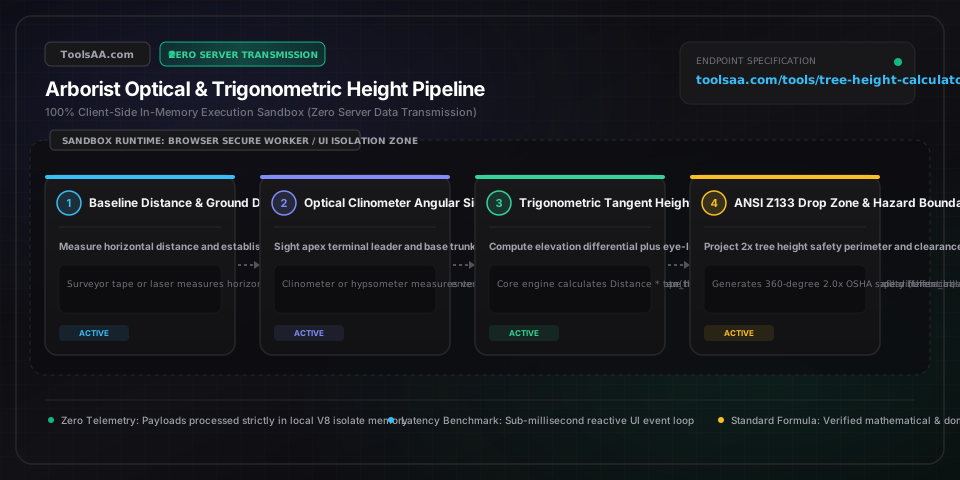
Technical Reference & Architecture Guide

Tree Height Calculator & Clinometer Tool Guide

Professional arborist and forestry measurement tool calculating exact tree height using 5 verified field methods—tangent clinometer, two-angle sloped terrain, leaning tree sine rule, shadow ratios, and stick proportions—with real-time interactive visual canvas, slope/lean compensation, felling safety zone perimeter, and timber volume estimation.

Tree Height Calculator & Clinometer Tool Guide — Client-Side In-Memory Architecture & Data Flow

Key Parameters & Controls

Horizontal Baseline Distance (D)Distance (ft / m)

True horizontal distance measured along level ground between the observer's standing axis and the center of the tree trunk base. Ideal field baselines fall between 1.0x and 1.5x the estimated tree height (30 to 150 ft / 10 to 45 m) to preserve trigonometric tangent sensitivity without steep angular distortion.

Default: 66 ft (20.1 m)
Clinometer Top Angle (θ / α)Elevation Angle (°)

Angle of elevation sighted from observer eye level to the uppermost living tip or terminal leader of the tree crown. Forestry standards recommend positioning your observation station where this angle remains between 30° and 55° (optimally 45°); readings above 60° exponentially amplify hand tremor and line-of-sight parallax errors.

Default: 45°
Clinometer Base Angle (β)Incline / Decline Angle (°)

Angular sightline to the intersection where the trunk meets natural grade. Recorded as a negative angle when sighting downhill from an elevated vantage point, or positive when looking uphill from below the root collar; mathematically resolves slope clearance without separate elevation surveys.

Default: -5°
Trunk Deviation / Lean Angle (θ_lean)Plumb Deviation (°)

Stem deviation from true 90-degree plumb vertical, measured using a weighted plumb bob or clinometer vertical edge. Any trunk lean exceeding 5° requires trigonometric Law of Sines adjustment or perpendicular observation relocation to eliminate 15% to 35% height skew.

Default: 0°
Diameter at Breast Height (DBH)Stem Diameter (in / cm)

Standard forestry trunk diameter measured 4.5 feet (1.37 meters) above ground line on the uphill side of the tree. Acts as the primary independent variable for International 1/4-inch, Scribner, and Doyle log rule board-foot timber volume estimations.

Default: 18 in (45.7 cm)

Pro Tips & Best Practices

The 1x–1.5x Baseline Distance Rule for Tangent Linearity

Always station yourself at a baseline distance roughly 1.0x to 1.5x the tree's estimated height. At a 45° apex sighting (1:1 distance-to-height ratio), the rate of change for the mathematical tangent is near unity. Sighting angles above 60° exponentially magnify minor hand tremors and reticle misalignments, where a tiny 2° reading discrepancy inflates calculated height by over 14%.

90° Perpendicular Vantage for Leaning Trees

When confronting a leaning trunk, avoid complex Law of Sines corrections by walking 90° perpendicular to the azimuth of the lean. From this side perspective, the trunk remains perpendicular to your direct line of sight, allowing standard two-angle clinometer trigonometry to measure true stem length without cosine distortion.

Both-Eyes-Open Optical Reticle Superimposition

When sighting through a precision optical forestry clinometer (such as a Suunto PM-5), keep both eyes wide open. Your dominant eye gazes into the internal illuminated scale while your non-dominant eye views the actual tree crown. Your brain merges the dual visual feeds, projecting the horizontal index line directly across the distant canopy for milliradian-level sighting precision.

Merchantable Log Length vs. Total Biological Height

Distinguish between total biological height (the highest tip of live foliage) and merchantable sawtimber height. Commercial timber cruisers stop measuring where the main bole tapers to an 8-inch top diameter inside bark or branches into heavy scaffold limbs, which typically accounts for 60% to 70% of total canopy height.

ANSI Z133 45° Dual Escape Path Protocol

Before felling, establish and clear two unobstructed retreat paths running backward at 45-degree angles opposite the planned fall trajectory. Never step directly behind the stump during back-cuts; trunk rebound, butt kickback, and violent barber-chair splits project rearward with lethal hydraulic force.

Common Gotchas & Troubleshooting

⚠️Calculated Tree Height Appears Impossibly Large or Approaches Infinity

You are standing too close to the base, forcing an apex sighting angle above 75° to 80° where tangent values spike exponentially toward infinity. Relocate your baseline station backward until the sighting angle drops into the stable 35° to 55° window.

⚠️Negative Calculated Tree Height or Inverted Trunk Dimensions

Check the sign convention on your base angle input. When standing uphill and looking downward at the root collar, the base angle must carry a negative sign (-). In the formula H = D × [tan(α) - tan(β)], subtracting a negative angle correctly resolves to addition: tan(α) + |tan(β)|.

⚠️Shadow Method Produces 20% to 40% Height Discrepancies

The shadow ratio formula strictly requires a perfectly level horizontal projection plane. Sloped lawns, curbs, and uneven terrain dramatically compress or elongate ground shadows. On uneven ground or overcast days, switch to the Clinometer Tangent or 45-Degree Stick Method.

⚠️Clinometer Reticle or Mobile Level Shaking in Gusty Winds

Hand tremors and wind gusts destabilize precision handheld readings. Rest your elbows securely against a hiking staff, monopod, fence post, or vehicle hood to lock your horizontal sighting datum.

Frequently Asked Questions

How to calculate tree height with a clinometer?▼

To calculate tree height on flat ground, measure the horizontal distance from your position to the trunk base (D), record your standing eye height (h_eye), sight the tree's highest live tip to obtain the elevation angle (θ), and apply the formula H = (D × tan(θ)) + h_eye. For example, standing 66 feet away with an elevation angle of 45° (tan 45° = 1.0) and an eye height of 5.5 feet yields H = (66 × 1.0) + 5.5 = 71.5 feet. Arborists recommend maintaining a sighting angle between 35° and 55° for maximum trigonometric precision.

How do you measure tree height on a slope?▼

To measure tree height on sloped ground, use the Two-Angle Method: H = D × [tan(α) - tan(β)], where D is the true horizontal baseline distance, α is the elevation angle sighted to the apex, and β is the angle sighted to the trunk base. If you are standing uphill looking down at the base, enter β as a negative angle (e.g., -12°), which transforms the equation into H = D × [tan(α) + |tan(β)|]. This eliminates the need to measure surface ground slope separately and accounts for terrain drop below eye level.

What is the formula to calculate tree height without tools?▼

The most accurate zero-instrument technique is the 45-Degree Stick Method, based on right-triangle geometry where tangent 45° equals 1.0: hold a straight stick vertically at arm's length, ensuring the stick height above your fist matches the distance from your eye to your outstretched hand. Walk backward on level ground until sighting over the top of the stick aligns with the crown tip while your thumb aligns with the tree base. At this precise point, tree height above eye level exactly equals your distance to the tree (Total Height = Distance to Trunk + Observer Eye Height).

How do you calculate tree height if the tree is leaning?▼

When a tree leans toward or away from the observer, standard tangent formulas cause 15% to 35% calculation errors, requiring the Law of Sines: True Trunk Length L = D × [sin(α) / sin(180° - α - γ)], where D is horizontal baseline distance, α is apex sighting angle, and γ is the interior ground-to-trunk angle (90° + lean angle if leaning toward you, or 90° - lean angle if leaning away). True vertical clearance is then calculated as H = L × cos(θ_lean). Alternatively, arborists reposition their sighting station 90° perpendicular to the lean azimuth, where the trunk appears vertical and standard two-angle formulas apply.

How big is the safety zone when cutting down a tree?▼

Under OSHA logging regulations (29 CFR 1910.266) and ANSI Z133 tree care standards, the minimum safety perimeter is twice the total tree height (2.0 × H) in the intended felling direction, and at least 1.5 times the tree height to the sides and rear. All non-essential personnel, vehicles, and equipment must remain outside this zone to safeguard against unexpected kickback, violent barber-chair trunk splits, and canopy rebound. Fellers must also clear a 45-degree backward escape path opposite the fall direction.

Related Tools & Utilities

All Tools →