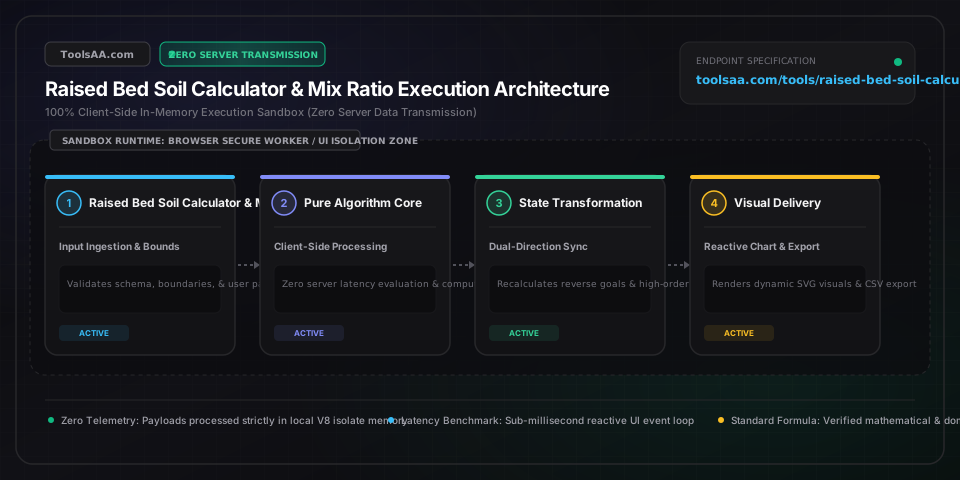
Raised Bed Soil Calculator & Mix Ratio
Dedicated raised bed soil calculator for garden construction and spring planting. Computes precise volume in cubic yards, cubic feet, liters, and standard bag counts for rectangular, square, round, and L-shaped raised beds.
Title input cockpit
Lbl physical dimensionsLbl feet inches
Lbl net soil depth10.5 Unit inches text
Lbl settling factor+10%
Lbl settle minLbl settle standardLbl settle max
Lbl price parameters
Lbl cavity status 32.00 Unit cu ftLbl settling tag +10%
Kpi net volume cu ft
30.80
+10% Lbl settling suffix
Kpi net volume cu yd
1.14
Lbl bulk dump scoop
Kpi primary bags
16 Unit bags
$144.00 Lbl est
Kpi alt bags
21 Unit bags
$157.50 Lbl est
Title bag matrixSub bag matrix
| Th bag type | Th unit volume | Th required bags | Th transport load |
|---|---|---|---|
| Bag type2_0 | 2.0 cu ft (56.6 L) | 16 | 2 Unit trips |
| Bag type1_5 | 1.5 cu ft (42.5 L) | 21 | 2 Unit trips |
| Bag type1_0 | 1.0 cu ft (28.3 L) | 31 | 2 Unit trips |
| Bag type50 l | 50 L (1.77 cu ft) | 18 | 2 Unit trips |
| Bag type40 l | 40 L (1.41 cu ft) | 22 | 2 Unit trips |
Title visualizer
Lbl target soil 30.80 Unit cu ft (1.14 Unit cu yd)16 Unit bags (2.0 cu ft)
Foot stat1 title
30.80 Unit cu ft (1.14 Unit cu yd)
872.16 Unit liters (0.87 Unit m3)
Foot stat2 title
16 Unit bags (2.0 cu ft)
Lbl bag alt1 21 Unit bags (1.5 cu ft) / 18 Unit bags (50L)
Foot stat3 title
~2,310 Unit lbs (~1.16 Unit tons u s)
~1,047 Unit kg (~1.05 Unit tonnes metric)
Client-Side Processing
High-performance calculation executed entirely in browser memory.
Zero Server Upload Privacy
All payloads remain strictly local with zero external server communication.
Production Ready Export
Clean, optimized output formats ready for immediate deployment.