Short title

Sausage Fat Ratio & Lean Meat Calculator

Calculate sausage fat ratio and lean meat percentage instantly. Balance pork shoulder, back fat, or wild game to hit target 80/20 or 70/30 ratios with exact salt.

Lbl quick presets

Section title formulation

20.0% Lbl fat
Lbl adjust cut fat20%
90.0% Lbl fat
Lbl adjust fat purity90%
5.00 Unit lbs (80.0 Unit oz)
Lbl target fat ratio22.0% (78.0% Lbl lean)

Section title bakers seasoning

Badge base block
1.80%

Hint salt

Lbl liquid6%
Lbl binder0%
Lbl sugar0.3%
Lbl pepper0.5%

Section title thermal

Temp status safe
Lbl working temp2.2°C (36.0°F)

Temp advice safe

Kpi meat block5.00 Unit lbs100% Lbl base
Kpi lean needed4.86 Unit lbs97.1% Lbl fraction
Kpi fat needed0.14 Unit lbs2.9% Lbl fraction
Kpi finished fat22.0%Lbl balanced

Chart title pearson square

Svg lean cut20.0%Svg fat source90.0%Svg target22.0%Svg lean parts68.0Svg fat parts2.078.0% Lean Muscle22.0% Adipose

Section nutrition

Lbl per link
Lbl calories246kcal
Lbl protein15.8grams
Lbl fat gram20.3grams
Lbl moisture ratio3.71H2O : Protein

Title batch sheet

US Butcher Lot
Th ingredientTh bakers pctTh weight lbTh precision
Row lean meat (20% Lbl fat)97.1%4.8677.7 Unit oz (2,203 Unit grams)
Row fat trim (90% Lbl fat)2.9%0.142.3 Unit oz (65 Unit grams)
Row kosher salt1.80%0.0901.4 Unit oz (41 Unit grams)
Row ice liquid6.0%0.3004.8 Unit oz (136 Unit grams)
Row sugar0.3%0.0150.2 Unit oz (7 Unit grams)
Row black pepper0.50%0.0250.4 Unit oz (11 Unit grams)
Row total green--5.4386.9 Unit oz (2,463 Unit grams)
Box links yield~22 Unit links5.4m / 17.7ft Lbl casing run
Box dry cured yield3.53 Unit lbsLbl post cure mass

Stat ratio title

Stat ratio desc

Stat nitrite title

Stat nitrite desc

Stat thermal title

Stat thermal desc

Client-Side Processing

High-performance calculation executed entirely in browser memory.

Zero Server Upload Privacy

All payloads remain strictly local with zero external server communication.

Production Ready Export

Clean, optimized output formats ready for immediate deployment.
Technical Reference & Architecture Guide

Sausage Fat Ratio & Lean Meat Calculator Guide

Calculate sausage fat ratio and lean meat percentage instantly. Balance pork shoulder, back fat, or wild game to hit target 80/20 or 70/30 ratios with exact salt.

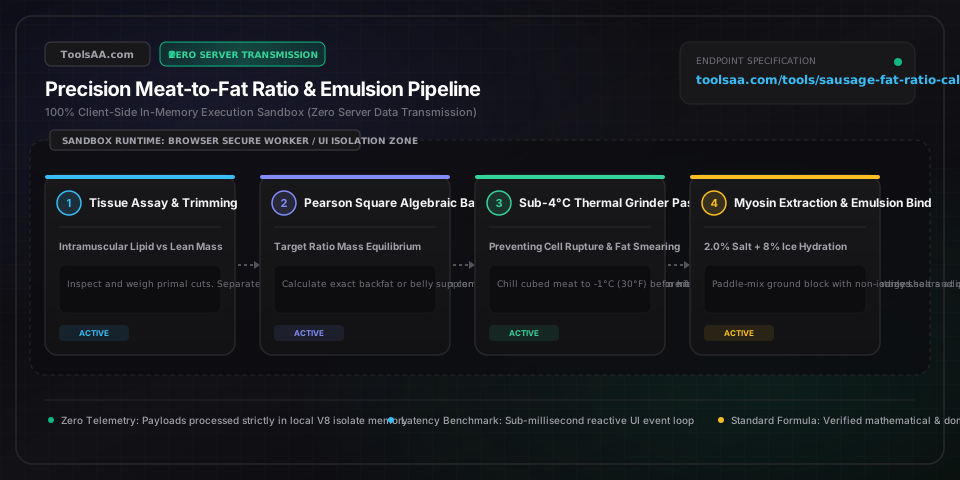
Sausage Fat Ratio & Lean Meat Calculator Guide — Client-Side In-Memory Architecture & Data Flow

Key Parameters & Controls

Target Lean to Fat RatioFinished Sausage Ratio

The targeted visual balance of muscular lean fiber to rich adipose fat in the final sausage block. An 80/20 ratio yields firm, traditional dinner links; 75/25 delivers classic juicy bite for fresh Italian or Polish sausage; 70/30 provides the luscious mouthfeel required for smoked kielbasa and emulsified bratwurst. Formulations below 18% total fat turn dry and crumbly.

Default: 75/25 (25% Total Fat)
Intrinsic Lean Cut Fat ContentMuscle Marbling Percentage

Natural intramuscular marbling inherent to your primary cut before adding supplemental fat. Standard benchmarks: Field-dressed venison or elk: 3–5%; skinless chicken or turkey thigh: 9–11%; beef round: 6–8%; pork loin: 8–10%; pork picnic shoulder: 15–18%; well-marbled pork Boston butt: 18–22%.

Default: 18.0%
Supplemental Fat Cut Lipid PurityAdipose Lipid Density

The actual pure fat density of supplemental adipose cuts. Firm subcutaneous pork backfat tests at 88–92% pure lipid bound by structural collagen; pork jowl averages 68–72% fat; pork belly contains 48–52% fat alongside meat strata; beef suet reaches 90–94% lipid purity.

Default: 90.0% (Hard Pork Backfat)
Non-Iodized Charcuterie Salt RateProtein Extraction Benchmark

Butcher-grade salt proportion calculated against aggregate batch weight. Formulating between 1.8% and 2.2% unlocks essential myosin proteins to create a sticky emulsion bind that traps juices. Dropping below 1.5% causes water and fat to purge during cooking; exceeding 2.5% overpowers natural meat flavors.

Default: 2.0% (Butcher Standard)
Prague Powder Nitrite DosageFood Safety Standard

Prague Powder #1 (6.25% sodium nitrite, 93.75% table salt) dosed at exactly 0.25% of total meat mass (2.5 grams per kilogram, or 1 level teaspoon per 5 lbs). This delivers the statutory 156 ppm sodium nitrite required to protect warm-smoked sausages against anaerobic foodborne spoilage. For fresh unsmoked links, omit curing salt entirely.

Default: 0.25% (156 ppm NaNO2 for Smoked Links)

Pro Tips & Best Practices

Sub-4°C Thermal Grinder Ceiling to Prevent Fat Smear

Chill all meat and fat cubes down to -2°C to +2°C (28°F to 35°F) before grinding. If fat warms past 4°C (40°F), grinder plates crush rather than cleanly shear adipose cells. This causes melted fat to coat lean fibers, crippling protein extraction and producing greasy, leaky links with rubbery textures when cooked.

Hard Backfat vs Soft Mesenteric Belly Fat Melting Points

Always select firm subcutaneous pork backfat over soft belly seam or flare fat for coarse-ground sausages. Backfat is rich in saturated stearic and palmitic fats with a resilient 38°C to 40°C (100°F–104°F) melting threshold, maintaining juicy fat pockets. Soft internal abdominal fat contains high unsaturated oleic acid, liquifying into oily puddles at room temperature.

Myosin Protein Emulsion Mechanics

Adding generous fat cannot fix dry sausage without an active protein bind. Vigorously knead ground meat with 2.0% salt and 8% to 10% crushed ice water for 90 to 120 seconds until paste turns intensely tacky and sticky. This extracted myosin web encapsulates microscopic fat globules, sealing in juices across pan-searing or grilling.

Dry Curing Net Weight Loss Mathematical Shift

During dry curing, salami loses 35% to 40% of its initial green weight through evaporated water while all fat remains intact. A green 70/30 salami formulation concentrates into a dense 46% to 50% finished fat ratio on dry basis. Always restrict starting green fat to 22–26% for dry-cured charcuterie to prevent greasy, oil-sweating salami logs.

Common Gotchas & Troubleshooting

⚠️Crumbly, dry, and sawdust-like texture after cooking

Under-formulated fat ratio or incomplete protein bind. Either aggregate fat fell below 20% (frequent when using pure wild venison, elk, or poultry), or meat was stuffed without developing a tacky paste. Rebalance the formula to at least 25% total fat using diced pork backfat and blend with 2.0% kosher salt and 8% ice water until sticky before casing.

⚠️Greasy puddle in casing with hollow, shriveled meat interior (Fat-out)

Fat smearing during processing or high cooking heat exceeding 74°C (165°F). Warm fat cells burst under the grinder blade, melting into a puddle rather than binding into muscle fibers. Freeze meat and grinder parts until crunchy (-1°C / 30°F), sharpen blades, and poach or smoke gently until the sausage core reaches 66°C to 68°C (152°F–155°F).

⚠️Tough, loose casing that separates from the sausage core

Under-stuffing, excess air pockets, or inadequate moisture binding. Maintain steady back-pressure on the stuffer horn to pack casings firmly without blowing them out, prick visible air pockets with a sausage pricker, and blend 8% to 10% cold liquid into the meat block to swell protein fibrils.

⚠️Harsh metallic saltiness in smoked sausages

Double-counting salt when using curing salts. Prague Powder #1 contains 93.75% table salt. When adding 0.25% curing salt, it contributes approximately 0.23% sodium chloride to your batch. Deduct this amount from your pure kosher salt (e.g., reduce pure salt from 2.0% down to 1.77%) to avoid over-salting.

Frequently Asked Questions

What is the best fat ratio for homemade sausage?▼

The gold standard for fresh homemade sausage (such as Italian links, Polish kielbasa, and bratwurst) is 75% lean to 25% fat (75/25). An 80/20 ratio yields a leaner, firmer bite favored for breakfast patties, while 70/30 produces ultra-plump bratwurst and emulsified frankfurters. Sausages formulated below 18% fat lack sufficient moisture and inevitably turn crumbly and dry.

How to calculate how much pork fat to add to venison?▼

Calculate supplemental pork fat using Pearson's Square formula: Added Fat Weight = Lean Venison Weight × ((Target Fat % - Venison Fat %) / (Pork Fat % - Target Fat %)). For example, to make a 75/25 blend from 10 lbs of wild venison (5% natural fat) using pork backfat (90% pure fat): 10 × ((25 - 5) / (90 - 25)) = 10 × (20 / 65) = 3.08 lbs of backfat, creating a 13.08 lb finished batch.

Pork back fat vs pork belly for sausage making: what is the difference?▼

Pork backfat is firm subcutaneous hard fat containing roughly 90% lipid and 10% connective tissue with a high melting threshold (38°C to 40°C), making it ideal for clean, distinct fat dice in salamis and fresh links. Pork belly contains only 50% fat alongside 50% lean meat and soft seam fat, meaning you need nearly double the weight to achieve the same fat boost, and it renders at lower cooking temperatures.

Can you make sausage with less than 20% fat without it being dry?▼

Yes, lean sausages between 12% and 15% fat (such as skinless chicken or turkey breast) stay moist if you incorporate functional water binders and control cooking temperatures. Add 2.0% non-fat dry milk powder or potato starch, increase cold gelatin-rich broth to 10–12% of total weight, and never let the internal cooking temperature exceed 68°C (155°F).

Related Tools & Utilities

All Tools →