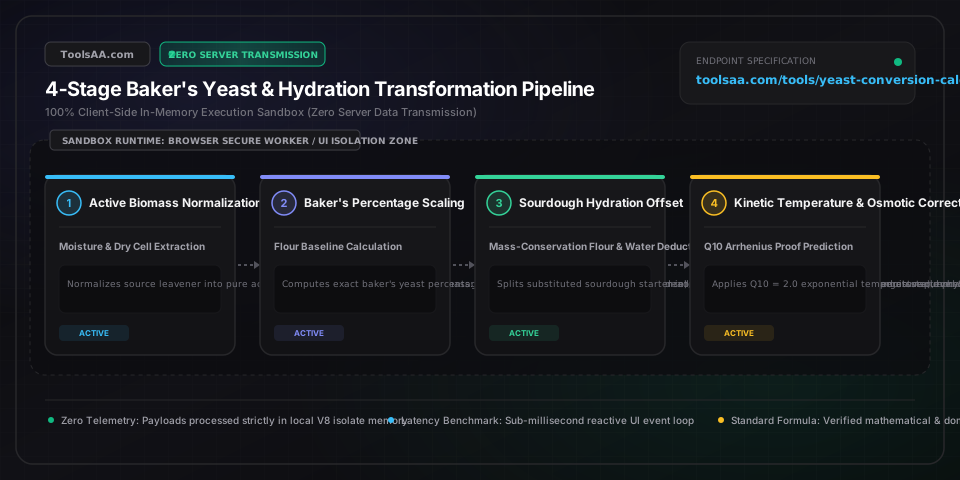
Convert instant dry yeast (IDY), active dry, fresh cake yeast, and sourdough starter with baker's percentages, flour hydration balance, and proof temp adjustments.
Lbl generated for IDY → ADY Lbl conversion
Lbl recipe base flour 500g
Lbl input yeast 7 grams (IDY)
Lbl target yeast dose 8.8g (ADY)
Lbl retail measure 1.25 packets (~8.8g)
Lbl bakers pct baseline 1.4%
Lbl flour adjustment label 0g
Lbl water adjustment label 0g
Lbl adjusted recipe flour 500g
Lbl proofing environment 24°C | Lbl est rise time 1h 17m
Convert instant dry yeast (IDY), active dry, fresh cake yeast, and sourdough starter with baker's percentages, flour hydration balance, and proof temp adjustments.
Fine-particle dehydrated Saccharomyces cerevisiae coated with sorbitan monostearate emulsifier. Can be blended directly into dry flour without water rehydration. Potency baseline = 1.00x.
Larger spherical pellets dried at lower temperatures, surrounded by a shell of dead yeast cells. Requires warm water blooming (40°C-43°C / 105°F-110°F) for 5-10 minutes. Conversion ratio = 1.25x IDY weight.
Moist, perishable blocks of living cultured yeast cells. Crumbles easily into water or milk. Conversion ratio = 3.00x IDY weight (or 2.40x ADY weight). Must be stored refrigerated at 1°C-4°C.
Active, ripe sourdough culture fed equal parts flour and water by weight (100% hydration). Standard leavening replacement benchmark = 20.00x IDY weight (15% to 25% of recipe flour weight).
The international standard for recipe formulation. Normal lean dough IDY ranges from 0.3% (slow ferment) to 1.0% (fast 2-hour bread) to 1.5% (sweet brioche).
Empirical biological rate factor where fermentation metabolic speed doubles roughly every 8°C (14.4°F) between 18°C and 32°C. Below 10°C, activity decelerates sharply towards dormancy.
Instant Dry Yeast contains fast-acting live cells with porous membrane walls. Pouring hot water (above 45°C / 113°F) directly onto unbuffered dry yeast causes thermal cell wall lysis and mass mortality. Mix IDY directly into dry flour, or ensure liquid is tepid (24°C-30°C / 75°F-86°F).
Adding 200g of 100% hydration sourdough starter introduces 100g of flour and 100g of water into your dough matrix. Failing to reduce the recipe's water by 100g and flour by 100g turns a workable 65% hydration bread dough into an unhandleable 76% sticky soup.
The dead yeast cells forming the outer shell of ADY pellets release glutathione—a natural reducing agent containing free sulfhydryl (-SH) groups that breaks disulfide gluten bonds. If dough feels noticeably slacker when using ADY, reduce bulk fermentation time by 10-15%.
When sugar baker's percentage exceeds 10%, sucrose draws water out of Saccharomyces cerevisiae cells through osmosis, dehydrating them and cutting carbon dioxide output by 30-50%. Increase yeast dosage by 25-40% or switch to osmotolerant dry yeast (Saccharomyces cerevisiae var. chevalieri).
Never place measured salt directly on top of fresh or dry yeast in the mixing bowl. A localized salt concentration exceeding 2.5% exerts extreme osmotic shock, causing irreversible cellular plasmolysis. Separate yeast and salt on opposite sides of the flour bed before water is added.
Active Dry Yeast pellets have a hard outer shell of dehydrated cells that cannot absorb moisture evenly inside stiff flour. Dissolve ADY in 4x its weight of lukewarm water (40°C / 105°F) with a pinch of sugar for 7-10 minutes until a foamy cap forms before incorporating.
You omitted the hydration offset. Calculate starter flour (Starter Weight / (1 + Hydration%)) and starter water. Deduct those exact gram values from your master recipe's flour and liquid additions to preserve original dough hydration.
Proofing temperature was too warm or yeast percentage was too high for room ambient. For warm kitchens (>28°C / 82°F), reduce yeast quantity by 30% or shorten bulk fermentation. If dough has overproofed, gently degas, reshape, and reduce final proof time by half.
High concentrations of sugar (>12%) and butter (>20%) slow down regular baker's yeast via osmotic dehydration and fat encapsulation of yeast cells. Use osmotolerant Instant Gold yeast, increase regular IDY by 35%, and ensure butter is incorporated only after full gluten development.
Fresh yeast is highly perishable and expires within 2-3 weeks at 2°C-4°C. Dark oily spots or ammonia odors indicate bacterial spoilage and cell death. Discard spoiled yeast immediately and substitute with 1/3 the weight in Instant Dry Yeast.
Multiply the active dry yeast (ADY) weight by 0.80 (or divide by 1.25) to get instant dry yeast (IDY). For example, 1 standard US packet of active dry yeast (7g or 2 1/4 tsp) equals 5.6g of instant dry yeast (approx 1 3/4 tsp). You can add instant dry yeast directly to your flour without proofing in water.
The universal baking ratio is 3:1 for Fresh Yeast to Instant Dry Yeast (IDY), and 2.4:1 for Fresh Yeast to Active Dry Yeast (ADY). Specifically: 30g Fresh Compressed Yeast = 10g Instant Dry Yeast = 12.5g Active Dry Yeast. To convert dry yeast to fresh cake yeast, multiply instant yeast by 3, or active dry yeast by 2.4.
Replace each 1g of instant dry yeast (IDY) with 20g of active, mature 100% hydration sourdough starter (or replace a 7g packet of yeast with 140g to 150g of ripe starter). Crucially, adjust the dough hydration: subtract 50% of the starter weight from your recipe's water and 50% from your recipe's flour to maintain perfect dough consistency.
For overnight cold retardation at 4°C (39°F) lasting 16 to 24 hours, reduce the baker's yeast percentage to 0.2% - 0.4% of total flour weight (about 1g to 2g IDY per 500g flour). Give the dough a 60-90 minute initial room temperature bulk fermentation to initiate gas nucleation before transferring to the refrigerator.
Sugar is hygroscopic and binds water tightly, depriving yeast cells of moisture and creating high osmotic pressure across the cell membrane. In doughs with over 10-12% sugar baker's percentage (like brioche, cinnamon rolls, or donuts), standard yeast gas production drops by up to 50%. Bakers must increase yeast by 25-40% or use osmotolerant instant yeast specially bred to thrive in low-water-activity environments.
Calculate your STOP-BANG score for sleep apnea risk with this clinical screening tool. Evaluate OSA probability, neck size cutoffs, and pre-op anesthesia risks.
Calculate sausage fat ratio and lean meat percentage instantly. Balance pork shoulder, back fat, or wild game to hit target 80/20 or 70/30 ratios with exact salt.
Calculate RSU tax withholding, sell-to-cover shares, and net vesting proceeds. Estimate federal, state, FICA, and capital gains tax on your tech equity compensation.
Dedicated raised bed soil calculator for garden construction and spring planting. Computes precise volume in cubic yards, cubic feet, liters, and standard bag counts for rectangular, square, round, and L-shaped raised beds.
Size rainwater cisterns and calculate annual runoff harvest yield, first-flush diversion, 12-month mass balance, and dry-spell autonomy across US & Metric units.
Calculate quarterly estimated tax payments, self-employment tax (SECA), safe harbor penalty protection, Section 199A QBI deduction, and Form 2210 Schedule AI annualized income installments for freelancers, 1099 contractors, and business owners.