Short title

Wine Chaptalization Calculator & Sugar Tool

Calculate precise sugar additions for wine chaptalization with liquid volume displacement, Brix and SG conversion, EU and TTB compliance, and staged feeding.

Preset label
Tab must specs

Temp correction note

Stat natural brix: 20.1°BxStat enriched target: 13.0% vol
Kpi total sugar
28.76Kpi sugar kg
(63.40 lbs)
Kpi potential alcohol
13.00%vol
Kpi alcohol boost: +0.56% vol
Kpi final volume
2,518Unit liters
+0.72% Kpi volume displaced
$35.95
$0.01 / 750ml
Lbl chart title
Tank headspace noteTank initial must2,500 LTank displaced sugar (+0.72%)+18.0 LTank total must2,518 L
Lbl schedule title
Col stageCol timingCol sugar amountCol target densityCol action notes
Stage label 1 (60%)timingOneThirdBreak17.25 kg13.4Lbl unit brix (1.054 Lbl unit sg)stage1Of2Desc
Stage label 2 (40%)timingHalfBreak11.50 kg10.0Lbl unit brix (1.040 Lbl unit sg)stage2Of2Desc
Lbl conversions titleTemp correction note
Col metricCol raw value (18.0°C)Col corrected value (20°C / 68°F)
Metric brix20.2020.09
Metric s g1.08391.0834
Metric oechsle83.983.4
Metric baume11.2211.16
Metric k m w16.5616.47
Metric sugar g l218.9 g/L217.6 g/L
Metric pot a b v12.51% vol12.44% vol
Stat natural brix20.1° Brix
Stat enriched target13.00% ABV
Stat net expansion+0.72%

Client-Side Processing

High-performance calculation executed entirely in browser memory.

Zero Server Upload Privacy

All payloads remain strictly local with zero external server communication.

Production Ready Export

Clean, optimized output formats ready for immediate deployment.
Technical Reference & Architecture Guide

Wine Chaptalization Calculator & Sugar Tool Guide

Calculate precise sugar additions for wine chaptalization with liquid volume displacement, Brix and SG conversion, EU and TTB compliance, and staged feeding.

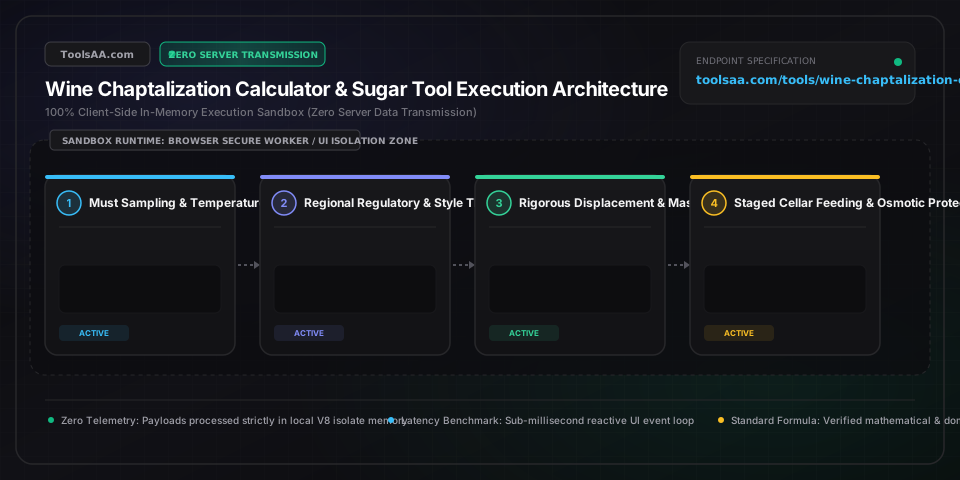
Wine Chaptalization Calculator & Sugar Tool Guide — Client-Side In-Memory Architecture & Data Flow

Key Parameters & Controls

Initial Must Sugar ConcentrationDegrees Brix (°Bx) or Specific Gravity (SG)

Baseline soluble solids in freshly pressed grape juice measured at 20°C (68°F). Standard cool-climate harvest musts measure between 16.0° and 20.0° Brix (1.065 to 1.083 SG), where juice below 17.0° Brix typically requires enrichment to achieve harmonious mouthfeel and microbial shelf stability.

Default: 18.5 °Bx
Target Finished Alcohol (% ABV)Target Alcohol by Volume (% vol)

Desired finished alcohol concentration after dry fermentation. Standard dry table wines target 11.5% to 13.5% ABV, bound by statutory regional caps such as EU Zone thresholds or the US TTB 14.0% table wine ceiling.

Default: 12.5% vol
Total Must Batch VolumeLiquid Volume (Liters or US Gallons)

Net unfermented juice volume inside the fermentation vessel before dry sugar addition, measured accurately to calculate required dissolved solids without tank overflow.

Default: 100 Liters
Sugar-to-Alcohol Conversion FactorMetabolic Efficiency Ratio (g/L per 1% ABV)

Empirical yeast metabolic conversion constant. Cool-fermented white and sparkling base wines consume approximately 16.83 g/L per 1% ABV, whereas warm red fermentations consume 17.00 to 17.50 g/L due to volatile evaporative alcohol loss.

Default: 17.0 g/L
Enrichment Sugar Type & PuritySolute Formulation

Purity specification of the sweetening agent. Pure refined dry sucrose (beet or cane) provides 100% fermentable solids, whereas dextrose monohydrate (corn sugar) contains 91.5% fermentable solids and requires a 1.093 weight correction multiplier.

Default: Refined Dry Sucrose (100% Purity)

Pro Tips & Best Practices

Split Additions at the One-Third Sugar Depletion Mark

Adding the entire sugar allotment directly into cold, unfermented must creates an osmotic spike exceeding 150 bar, stressing yeast cell membranes and elevating volatile acidity. Inoculate with 50% of the calculated enrichment at pitch, then feed the remaining 50% after one-third of the initial sugar has fermented out (approximately 1.055 to 1.060 SG), when yeast biomass is dense and vigorously metabolic.

Dissolve Dry Sugar in Drawn Juice, Never Exogenous Water

Never dissolve chaptalization sugar in tap or spring water. Adding exogenous water is strictly prohibited under commercial appellation laws worldwide ('watering back' violation) and irreversibly dilutes natural tartaric acidity, body, and phenolic balance. Draw 10% of warm must from the fermenter, whisk in the sugar until crystal-free, and gently blend it back.

Recalibrate Hydrometer Readings for Must Temperature

Hydrometers are calibrated strictly at 20°C (68°F). Testing freshly crushed red must fermenting at 30°C (86°F) underestimates gravity by up to 0.8° Brix, prompting unnecessary over-chaptalization. Apply a +0.00025 SG offset per degree Celsius above calibration before weighing out sugar.

Reserve 20% Tank Headspace for Volume Displacement

Every kilogram of dissolved granulated sucrose expands liquid volume by 0.625 liters (or 0.075 gallons per pound). Adding 40 kg of sugar to a 1,000-liter batch yields 1,025 liters of fluid, which can cause severe overflow during peak carbon dioxide foam formation if tank ullage is insufficient.

Common Gotchas & Troubleshooting

⚠️Fermentation stalls or becomes sluggish after introducing the second sugar addition.

Secondary sugar was added too late into escalating alcohol toxicity (past the 50% sugar drop) with exhausted yeast assimilable nitrogen (YAN). Ensure staged sugar additions occur strictly before the 1/3 sugar break (SG ≥ 1.055), and incorporate 15 to 20 g/hL of balanced complex yeast nutrients (organic amino acids and DAP) to support cell wall transport enzymes.

⚠️Finished dry wine delivers 0.3% to 0.5% lower ABV than calculated.

The calculation relied on an unadjusted static volume formula that ignored the +0.625 L/kg fluid expansion, or utilized dextrose monohydrate (corn sugar) without compensating for its 8.5% bound water of crystallization. Apply the rigorous displacement model and multiply dextrose additions by 1.093 to meet target gravities.

⚠️Sharp solvent or vinegar aromas (volatile acidity) emerge after must enrichment.

High initial sugar concentrations delayed the onset of active yeast fermentation, allowing wild non-Saccharomyces strains to produce excessive ethyl acetate. Maintain a protective 30 to 40 ppm sulfur dioxide (SO2) barrier at crush, ensure temperature does not exceed 28°C during enrichment, and pitch a healthy, killer-positive active dry yeast culture.

Frequently Asked Questions

How do you calculate sugar addition for wine chaptalization?▼

Calculate the required sugar mass using the displacement formula: Mass (kg) = [Must Volume (L) × (Target Sugar g/L - Initial Sugar g/L)] ÷ [Purity Factor - (0.000625 × Target Sugar g/L)]. As a trusted rule of thumb for dry table wine, dissolving 17.0 grams of pure sucrose per liter of must (or 2.27 ounces per US gallon) increases potential alcohol by exactly 1.0% ABV while expanding overall volume by 0.0106 liters per liter of must.

How much sugar does it take to increase wine alcohol by 1 percent?▼

Raising wine alcohol by 1.0% ABV requires 16.83 grams of sucrose per liter of juice for white and sparkling wines, and between 17.00 and 17.50 grams per liter for red wines due to warm fermentation ethanol evaporation. If using brewing dextrose monohydrate (corn sugar) instead of cane sugar, you must add 18.6 grams per liter to adjust for the 9.3% moisture content trapped in dextrose crystals.

Does adding sugar to wine must increase the total liquid volume?▼

Yes, dissolving granulated sugar physically expands total must volume at a rate of 0.625 liters per kilogram of sucrose (0.075 gallons per dry pound). Adding 25 kg of sugar into a 500-liter fermentation vessel produces an extra 15.6 liters of liquid, increasing the batch to 515.6 liters. Calculators that omit displacement underestimate the true sugar mass required, leading to finished wines falling 0.3% to 0.5% below target alcohol.

What is the legal limit for chaptalizing wine in the EU and United States?▼

Under EU Regulation 1308/2013, statutory limits depend on climate zones: Zone A (UK, Germany) permits up to +3.0% vol (+3.5% in catastrophic cool vintages); Zone B (Champagne, Loire, Alsace) allows +2.0% vol; Zone C I (Bordeaux, Burgundy) allows +1.5% vol; while Zone C III (Southern Italy, Spain) forbids dry sucrose entirely. In the United States, federal TTB rule 27 CFR § 24.177 permits adding sucrose or dextrose up to 25.0° Brix provided finished table wine does not exceed 14.0% ABV, though California state law prohibits cane sugar entirely in commercial grape wine, allowing only pure grape juice concentrate.

When is the best time to add sugar during fermentation to avoid yeast shock?▼

The safest time to add chaptalization sugar is in two stages: introduce 50% of the sugar during active yeast pitch, and the remaining 50% at the 'one-third sugar break' (when hydrometer gravity drops to approximately 1.055–1.060 SG). Dumping 100% of the sugar into cold must before fermentation starts creates hyper-osmotic pressure exceeding 150 bar, dehydrating yeast cells, extending the lag phase, and spiking unwanted volatile acidity.

Can you use regular table sugar or brown sugar for wine chaptalization?▼

Refined white granulated table sugar—whether derived from sugar cane or sugar beet—is 99.8%+ pure sucrose and represents the universal benchmark for clean wine chaptalization. Conversely, brown sugar, turbinado, raw sugar, honey, and molasses should never be used in fine grape winemaking because they contain residual molasses, ash, and unfermentable caramel compounds that impart off-odors, haze, and bitter notes.

Related Tools & Utilities

All Tools →
Sugar Brix Calculator & SG ConverterUtility

Convert Sugar Brix to Specific Gravity, Plato, and Baumé. Accurately calculate refractometer temperature corrections, fermentation ABV, and sugar additions.

Open tool→
Tree Height Calculator & Clinometer ToolUtility

Professional arborist and forestry measurement tool calculating exact tree height using 5 verified field methods—tangent clinometer, two-angle sloped terrain, leaning tree sine rule, shadow ratios, and stick proportions—with real-time interactive visual canvas, slope/lean compensation, felling safety zone perimeter, and timber volume estimation.

Open tool→
Garden Mulch Calculator & Bulk EstimatorUtility

Calculate exact garden mulch volume in cubic yards, cubic feet, and bags with compaction loss, bulk vs bag price break-even, multi-bed mapping, and truck payload safety.

Open tool→
Yeast Conversion Calculator & SourdoughUtility

Convert instant dry yeast (IDY), active dry, fresh cake yeast, and sourdough starter with baker's percentages, flour hydration balance, and proof temp adjustments.

Open tool→
STOP-BANG Calculator & Sleep Apnea Riskhealth

Calculate your STOP-BANG score for sleep apnea risk with this clinical screening tool. Evaluate OSA probability, neck size cutoffs, and pre-op anesthesia risks.

Open tool→
Sausage Fat Ratio & Lean Meat CalculatorUtility

Calculate sausage fat ratio and lean meat percentage instantly. Balance pork shoulder, back fat, or wild game to hit target 80/20 or 70/30 ratios with exact salt.

Open tool→