Tool title
Badge real time syncBadge icumsa standardBadge asbc formula

Sugar Brix Calculator & SG Converter

Convert Sugar Brix to Specific Gravity, Plato, and Baumé. Accurately calculate refractometer temperature corrections, fermentation ABV, and sugar additions.

Lbl quick presets

Title control deck

Mode universal sync
°Bx
0.0° Bx
Hint non sugar solids
Lbl target solver
Status ready
Kpi sg1.0944Lbl ref temp std
Kpi plato22.5°P94.4° Oe
Kpi baume12.44°BéLbl heavy scale
Kpi potential abv12.38%Lbl wine must

Title visual cockpit

22.50° Bx
Viewfinder label
0102030405060701.0001.0201.0401.0601.0801.1001.120
Lbl boundary reading 22.5° Bx
Spectrum title

Spectrum sub

Distilled Water (0° Bx)0 - 0.5° Bx
Beer Wort (10-14° Bx)10 - 14° Bx
Fruit Juice (12-16° Bx)12 - 16° Bx
Wine Grape Must (20-25° Bx)20 - 25° Bx
Grade A Maple Syrup (66-67° Bx)66 - 67° Bx
Ripe Raw Honey (80-84° Bx)80 - 84° Bx
Lbl boiling elevation short+2.4°F (+1.3°C)

Title matrix table

Th brixTh sgTh baumeTh oechsleTh nd20Th sugar concentration
0.0°1.00000.00°0.0°1.332990.0
2.5°1.00961.38°9.6°1.3366725.2
5.0°1.01952.77°19.5°1.3404251.0
7.5°1.02964.15°29.6°1.3442377.2
10.0°1.03985.53°39.8°1.34810104.0
12.5°1.05036.91°50.3°1.35204131.3
15.0°1.06108.30°61.0°1.35604159.2
17.5°1.07199.68°71.9°1.36010187.6
20.0°1.083111.06°83.1°1.36423216.6
22.5°1.094412.44°94.4°1.36842246.2
25.0°1.105913.83°105.9°1.37268276.5
27.5°1.117715.27°117.7°1.37700307.4
30.0°1.129716.64°129.7°1.38138338.9
32.5°1.141818.01°141.8°1.38582371.1
35.0°1.154219.37°154.2°1.39033404.0
37.5°1.166820.73°166.8°1.39490437.6
40.0°1.179622.08°179.6°1.39954471.8
42.5°1.192623.42°192.6°1.40424506.9
45.0°1.205924.75°205.9°1.40900542.6
47.5°1.219326.08°219.3°1.41383579.2
50.0°1.232927.40°232.9°1.41872616.5
52.5°1.246828.70°246.8°1.42367654.6
55.0°1.260930.00°260.9°1.42868693.5
57.5°1.275231.29°275.2°1.43376733.2
60.0°1.289632.57°289.6°1.43891773.8
62.5°1.304333.83°304.3°1.44411815.2
65.0°1.319335.09°319.3°1.44939857.5
67.5°1.334436.34°334.4°1.45472900.7
70.0°1.349737.57°349.7°1.46012944.8
72.5°1.365338.79°365.3°1.46558989.8
75.0°1.381040.00°381.0°1.471101,035.8
31 Lbl presets unitStatus calculated
Stat1 valueStat1 label
Stat2 valueStat2 label
Stat3 valueStat3 label

Client-Side Processing

High-performance calculation executed entirely in browser memory.

Zero Server Upload Privacy

All payloads remain strictly local with zero external server communication.

Production Ready Export

Clean, optimized output formats ready for immediate deployment.

Disclaimer title Disclaimer text
Technical Reference & Architecture Guide

Sugar Brix Calculator & SG Converter Guide

Convert Brix to specific gravity, Plato, Baumé, and Oechsle with refractometer temperature compensation, fermentation alcohol correction, and syrup dilution.

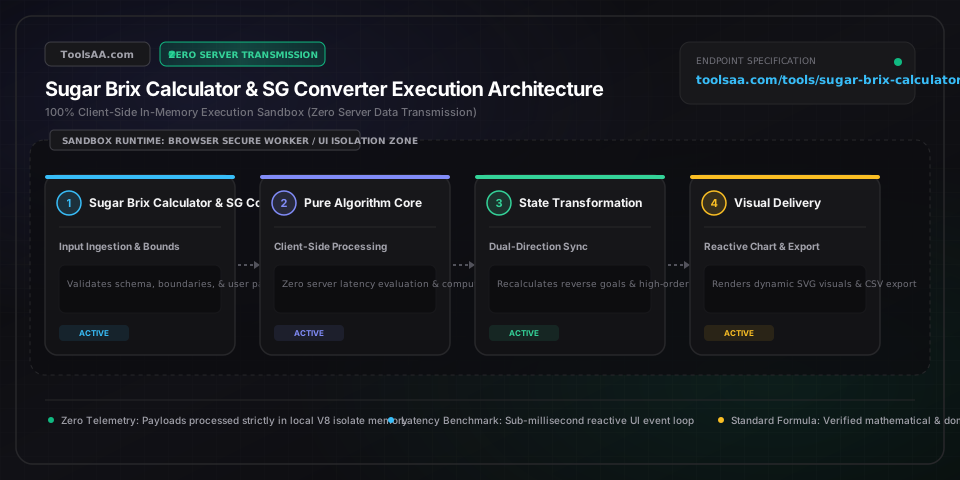
Sugar Brix Calculator & SG Converter Guide — Client-Side In-Memory Architecture & Data Flow

Key Parameters & Controls

Degrees Brix (°Bx / % Sucrose w/w)Float (Mass Fraction % w/w)

Mass fraction of pure sucrose dissolved in water, standardized under ICUMSA SPS-4 and NIST tables where 1° Bx equals 1.0 g sucrose per 100.0 g aqueous solution at 20°C. Valid scale spans 0.0° to 85.0° Bx; values above 66.7° Bx reflect thermodynamic supersaturation at standard temperature and pressure (STP). Evaluated client-side via O(1) double-precision polynomials conforming to IEEE 754 floating-point accuracy.

Default: 12.0
Specific Gravity (SG 20/20)Float (Dimensionless Ratio)

Apparent true density ratio of aqueous extract relative to analytical deionized water at standard 20°C/20°C calibration reference. Governed by ASBC and AOAC enological standards across 1.0000 to 1.4500 SG. Algorithmic polynomial transformations model non-linear volumetric solute contraction and excess molar volume without network latency or external API calls.

Default: 1.0480
Degrees Plato (°P Extract)Float (% w/w Extract)

International brewing standard measuring dissolved extract in malt wort under ASBC, EBC, and IOB conventions. Calibrated across 0.0° to 35.0° P; while mathematically congruent to Brix for pure sucrose solutions, Plato diverges in grain wort due to the higher molecular weight of maltotriose, dextrins, and branched alpha-glucans.

Default: 12.0
Degrees Baumé (°Bé Heavy)Float (Hydrometer Scale)

Enological and confectionery hydrometer graduation calibrated for dense solutions via the French hydrographic formula (°Bé = 145 - 145 / SG). Standardized across 0.0° to 45.0° Bé; valid strictly at 20°C (68°F) and widely used for commercial sucrose inversion, maple processing, and grape harvesting.

Default: 6.6
Degrees Oechsle (°Oe Must Weight)Float (Grape Density Unit)

German (Deutsches Weingesetz), Swiss, and Luxembourg viticultural grape must density metric defined as (SG - 1.000) × 1000. Normal operational range spans 30.0° to 150.0° Oe, demarcating statutory Prädikatswein ripeness categories from Kabinett (67°–82° Oe) to Trockenbeerenauslese (150°+ Oe).

Default: 48.0
Wort Correction Factor (WCF)Float (Calibration Multiplier)

Empirical optical divisor compensating for non-sucrose sugars, malt proteins, and melanoidins that refract light differently through an optical refractometer prism. Normal range spans 1.00 to 1.10, with standard barley malt wort baseline established at 1.04.

Default: 1.04

Pro Tips & Best Practices

Prism Thermal Equilibrium Delay

Allow liquid droplets to rest on the optical prism for 30 to 45 seconds prior to taking a reading. Even with Automatic Temperature Compensation (ATC), the internal bimetallic strip senses only ambient refractometer chassis temperature—not the thermal shock of freshly boiled wort or chilled cellar samples. Failure to equilibrate yields optical distortion and measurement swings of up to ±0.8° Bx.

Degassing Fermenting Samples Prior to Testing

Degas actively fermenting beer or wine must via vacuum filtration, centrifugation, or aggressive double-cup pouring before hydrometer immersion. Dissolved carbon dioxide nucleates microbubbles along the glass hydrometer stem, generating buoyant capillary upward force that artificially elevates specific gravity readings by up to 0.004 SG points.

Empirical Wort Correction Factor Calibration

Avoid universally defaulting to the standard 1.04 WCF across heterogeneous grain bills. Calibrate your individual optical sensor against a calibrated glass hydrometer using unfermented chilled wort across multiple batches: high-protein wheat and oats typically mandate 1.06 to 1.08, whereas high-adjunct pilsners sit near 1.02.

Thermodynamic Volume Contraction in Dilution

When blending high-Brix sucrose syrups with pure water, calculate batch yields strictly by mass balance (kg/lb) rather than volumetric addition. Hydrogen bonding between water molecules and sucrose hydroxyl groups induces negative excess molar volume (volume contraction) of 0.5% to 1.2%, causing simple volumetric summation to under-fill target containers.

Acid Bias Correction in Fruit Purees

In high-acid fruit musts (citrus, passion fruit, sour cherries), free organic acids (citric, malic, tartaric) bend light with lower refractive increments per unit mass than sucrose. Add approximately 0.20° Brix per 1.0% titratable acid (calculated as citric acid anhydrous) to align optical refractometer outputs with absolute gravimetric dry matter.

Common Gotchas & Troubleshooting

⚠️Refractometer Blue/White Boundary Line is Blurry or Distorted

Suspended insoluble solids (cellulose, yeast cell walls, hop trub) and colloidal fats scatter incoming light across the critical angle interface. Filter the specimen through 0.45-micron or standard ashless cellulose filter paper, thoroughly degrease the optical prism with 70% isopropyl alcohol and non-abrasive lens tissue, and verify complete bubble-free fluid contact across the daylight plate.

⚠️Calculated True Final Gravity (FG) Yields Impossibly High or Low Values

Refractometer reading was entered without the Wort Correction Factor, or Original Gravity (OG) was entered as fermented apparent Brix instead of unfermented kettle extract. Ensure OG represents unfermented pre-pitch Brix, verify current reading is uncorrected apparent Brix, and use cubic alcohol compensation polynomial equations (e.g., Terrill formula) rather than linear approximations.

⚠️Hydrometer Floats Below the 1.000 Zero Water Line

Elevated sample temperature relative to the hydrometer calibration point (60°F or 20°C) reduces fluid density, or the solution contains ethanol (specific gravity 0.789 g/cm³), which naturally drives fermented dry ciders and wines below 1.000 SG (typically 0.992–0.996 SG). Test deionized water at the instrument's exact reference temperature to check whether the internal paper scale has slipped.

⚠️Pearson's Square Dilution Produces Slightly Less Volume Than Expected

Excess molar volume of mixing contracts total finished volume due to tight interstitial packing of solvent water within the sucrose hydration shell. Transition process controls from volumetric dosing (liters/gallons) to mass dosing (kilograms/pounds) by multiplying target volume by solution specific gravity (Mass = Volume × SG × ρ_water).

Frequently Asked Questions

How do you calculate Brix to Specific Gravity (SG)?▼

To convert Brix to Specific Gravity (SG 20/20), use the official ASBC polynomial: SG = 1 + (Brix / (258.6 - ((Brix / 258.2) * 227.1))), or the reverse formula Brix = (((182.4601 * SG - 775.6821) * SG + 1262.7794) * SG - 669.5622). For rapid mental calculation, each 1° Brix approximates 0.004 SG points (e.g., 10° Bx ≈ 1.040 SG, 20° Bx ≈ 1.083 SG). Calculations execute in deterministic O(1) time complexity within client-side sandboxed Web Workers with zero server network egress.

Why is a refractometer inaccurate for measuring fermented beer or wine?▼

A refractometer yields falsely elevated readings in fermented beverages because ethanol has a higher refractive index (1.3614) than pure water (1.3330) despite possessing a lower density (0.789 g/cm³). As yeast converts dense sugar into light, highly refractive alcohol, the refractometer's optical shadowline remains artificially high. Determining true Final Gravity (FG) and ABV requires an empirical cubic polynomial (such as the Sean Terrill or ASBC formula) that simultaneously correlates original kettle Brix, current apparent refractometer Brix, and wort correction factor.

How does temperature affect Brix and refractometer readings?▼

Temperature shifts alter fluid density and refractive index: every 10°C (18°F) rise above the 20°C calibration baseline depresses optical refractometer readings by approximately 0.70° to 0.80° Brix. While instruments with Automatic Temperature Compensation (ATC) correct for ambient instrument temperature via an internal bimetallic mechanism, ATC cannot compensate for hot kettle samples placed directly onto the prism glass. Samples must rest 30 to 45 seconds to achieve prism thermal equilibrium or be mathematically adjusted using ICUMSA SPS-3 temperature correction tables.

What is the difference between Brix, Plato, Baumé, and Oechsle?▼

Degrees Brix (°Bx) measures sucrose mass percentage (% w/w) in sugar refining; Degrees Plato (°P) is the brewing standard measuring dissolved malt extract; Degrees Baumé (°Bé) is used in French winemaking and confectionery for heavy syrups; Degrees Oechsle (°Oe) is the German grape must standard calculated as (SG - 1.000) × 1000. While 1° Brix equals 1° Plato for pure sucrose solutions, Plato diverges in brewing wort due to complex dextrins and maltose hydrates having distinct optical and gravimetric profiles.

What are optimal Brix levels for ripe fruit, wine grapes, and honey?▼

Commercial quality thresholds require: strawberries and tomatoes at 8.0°–12.0° Bx; apples and citrus at 11.0°–15.0° Bx; sweet cherries and table grapes at 14.0°–18.0° Bx; wine grapes (Chardonnay, Cabernet) at 21.0°–25.0° Bx (yielding 12.5%–14.5% ABV); legal maple syrup at 66.0°–67.0° Bx; and pure floral honey at 80.0°–84.0° Bx (maximum 18.6% moisture under USDA standards). Levels below statutory thresholds indicate premature harvesting or water adulteration.

How do you calculate sugar dilution using Pearson's Square?▼

Pearson's Square calculates blending proportions by mass: place target Brix in the center, high-Brix concentrate on the upper left, and diluent water (0° Bx) on the lower left. Subtract diagonally to find proportional parts: Parts Concentrate = Target Brix - 0, and Parts Water = Concentrate Brix - Target Brix. Because Brix represents mass fraction (% w/w), multiply required liquid volumes by their respective specific gravity to convert to absolute mass before mixing, avoiding volumetric contraction errors.

Related Tools & Utilities

All Tools →
Tree Height Calculator & Clinometer ToolUtility

Professional arborist and forestry measurement tool calculating exact tree height using 5 verified field methods—tangent clinometer, two-angle sloped terrain, leaning tree sine rule, shadow ratios, and stick proportions—with real-time interactive visual canvas, slope/lean compensation, felling safety zone perimeter, and timber volume estimation.

Open tool→
Garden Mulch Calculator & Bulk EstimatorUtility

Calculate exact garden mulch volume in cubic yards, cubic feet, and bags with compaction loss, bulk vs bag price break-even, multi-bed mapping, and truck payload safety.

Open tool→
Yeast Conversion Calculator & SourdoughUtility

Convert instant dry yeast (IDY), active dry, fresh cake yeast, and sourdough starter with baker's percentages, flour hydration balance, and proof temp adjustments.

Open tool→
STOP-BANG Calculator & Sleep Apnea Riskhealth

Calculate your STOP-BANG score for sleep apnea risk with this clinical screening tool. Evaluate OSA probability, neck size cutoffs, and pre-op anesthesia risks.

Open tool→
Sausage Fat Ratio & Lean Meat CalculatorUtility

Calculate sausage fat ratio and lean meat percentage instantly. Balance pork shoulder, back fat, or wild game to hit target 80/20 or 70/30 ratios with exact salt.

Open tool→
RSU Tax Calculator & Sell to Cover Net Payfinance

Calculate RSU tax withholding, sell-to-cover shares, and net vesting proceeds. Estimate federal, state, FICA, and capital gains tax on your tech equity compensation.

Open tool→