Short title

Greenhouse Heating Calculator & BTU Sizer

Greenhouse heating calculator to size heater BTU/hr and Watts. Calculate surface heat loss, glazing U-values, air infiltration, and winter fuel heating costs.

Lbl quick presets
Kpi design loss
73,302Unit btu hr
83% Lbl cond short · 13% Lbl infil short
Kpi heater rating
102,802Unit btu hr
Lbl input at 82% AFUE
Kpi peak cost
$3.20/Unit hour
~$24.02/Unit cold night
Kpi buffer time
2.3Unit hours
Lbl to freeze alert
Lbl cross section title
GABLE · ΔT 52Unit deg f
4x Unit barrelsR5 XPSLbl std windLbl inside: 62Unit deg fLbl outside: 10Unit deg fLbl floor ground
Lbl conduction loss
60,978 Unit btu hr

Lbl roof gable walls (83%)

Lbl infiltration loss
9,828 Unit btu hr

1.25 ACH Lbl air exchanges (13%)

Lbl perimeter loss
2,496 Unit btu hr

120 Lbl linear ft (4%)

Lbl thermal loss share100% Lbl total envelope
Lbl conduction glazing (83%)Lbl air leakage (13%)Lbl slab ground (4%)
Col envelope sectionCol area volumeCol u valueCol heat loss
Row roof glazing894.4 Unit sq ftU: 0.6027,906 Unit btu hr
Row sidewalls gables1,060.0 Unit sq ftU: 0.6033,072 Unit btu hr
Row air volume8,400 Unit cu ft1.25 ACH @ standard9,828 Unit btu hr
Row foundation edge120 Unit ftF-factor: 0.42,496 Unit btu hr
Lbl elec current draw:125.5 A run · 160 A breaker

Lbl breaker note

Stat intensity title
91.6 BTU/hr-ft²

Stat intensity desc

Stat ueff title
U: 0.60 BTU/hr-ft²-°F

Stat ueff desc

Stat ach vol title
10,500 Unit cu ft

Stat ach vol desc

Client-Side Processing

High-performance calculation executed entirely in browser memory.

Zero Server Upload Privacy

All payloads remain strictly local with zero external server communication.

Production Ready Export

Clean, optimized output formats ready for immediate deployment.
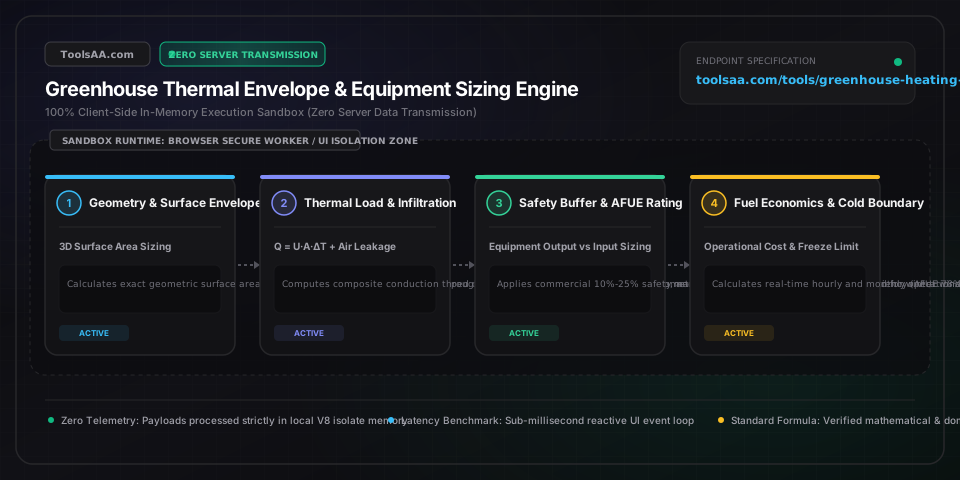
Technical Reference & Architecture Guide

Greenhouse Heating Calculator & BTU Sizer Guide

Greenhouse heating calculator to size heater BTU/hr and Watts. Calculate surface heat loss, glazing U-values, air infiltration, and winter fuel heating costs.

Greenhouse Heating Calculator & BTU Sizer Guide — Client-Side In-Memory Architecture & Data Flow

Key Parameters & Controls

Glazing Thermal Transmittance U-ValueBTU/(hr·ft²·°F) or W/(m²·K)

Rate of non-solar heat transmission through the glazing envelope. Commercial standard values: Single Glass = 1.13, Corrugated Polycarbonate = 1.20, Air-Inflated Double Poly = 0.70, Twin-Wall Polycarbonate 8mm = 0.58, Triple-Wall Polycarbonate 16mm = 0.42. Lower U-values dramatically diminish overnight fuel burn.

Default: 0.60 BTU/(hr·ft²·°F)
Design Temperature Delta (ΔT)Degrees Fahrenheit or Celsius

Absolute difference between target nocturnal indoor canopy temperature (e.g., 62°F for tomatoes/cucumbers, 45°F for cold greens) and the local 99% ASHRAE winter design outdoor dry-bulb minimum. Sizing equipment to daytime averages causes catastrophic midnight freeze kills.

Default: 52°F (62°F Inside - 10°F Outside)
Air Changes per Hour (ACH)Infiltration volume exchanges / hr

Frequency of total greenhouse air volume replacement via seam leakage, overlapping glass laps, and vent clearances. NGMA benchmark ranges: Continuous rubber-gasketed aluminum = 0.75 ACH, taped double-poly hoop houses = 1.0 to 1.5 ACH, unsealed lap glass or weathered wooden frames = 2.0 to 3.5 ACH.

Default: 1.25 ACH
Wind Velocity Drag Coefficient MultiplierDimensionless scaling factor

Convective stripping coefficient. Infiltration and outer boundary film resistance degrade rapidly under heavy wind. Standard heating formulas presume 15 mph baseline. Sites exposed to continuous 25-35 mph winter gales require an empirical 1.15x to 1.25x heat multiplier.

Default: 1.00 (15 mph benchmark)
Appliance Thermal Efficiency (AFUE)Percentage (%)

Annual Fuel Utilization Efficiency rating. Standard gravity-vented unit heaters operate at 78%-82% AFUE. Power-vented commercial units deliver 83%-88%. High-efficiency condensing units achieve 93%-96%. Electric resistance achieves 100%, and inverter heat pumps deliver effective 200%-300% (COP 2.0-3.0).

Default: 82%

Pro Tips & Best Practices

Radiant Sky Temperature is Far Colder Than Ambient Air

On cloudless winter nights, greenhouse glazing radiates thermal energy directly toward the deep upper atmosphere (-40°F effective radiative sky temperature). Bare single-pane glass and polyethylene films (which are transparent to long-wave infrared) can experience leaf canopy temperatures 3°F to 6°F lower than measured ambient room air. Always utilize IR-inhibited films or close an aluminized thermal curtain at dusk to bounce long-wave radiation back to the benches.

Air Stratification Can Rob 20% of Bench-Level Heat

Warm air rises into the greenhouse ridge, creating a temperature gradient where the peak is 10°F to 15°F hotter than the crop root zone. Because heat loss is proportional to peak temperature, unmixed ridge air bleeds costly energy through the roof. Install horizontal airflow (HAF) fans rated to circulate 2 to 3 greenhouse volumes per minute to eliminate stratification and keep hot air down where plants respire.

Never Burn Unvented Gas or Kerosene in an Occupied Greenhouse

While unvented portable burners deliver 100% nominal thermal efficiency by venting combustion gases directly into the structure, burning 1 gallon of propane releases 0.8 gallons of water vapor along with carbon monoxide, ethylene, and sulfur dioxide. Ethylene concentrations as low as 0.05 ppm cause severe leaf epinasty, flower abortion, and twisted growth. Always install sealed-combustion power-vented appliances that draw outside intake air.

Double-Poly Inflation Blowers Must Draw Dry Outside Air

When inflating double-layer polyethylene film, always direct the squirrel-cage blower intake tube to draw dry outdoor air rather than humid internal greenhouse air. Drawing moist interior air deposits gallons of liquid condensation between the film sheets within weeks, causing persistent fogging, slime accumulation, light transmission loss of up to 18%, and premature outer layer collapse.

Common Gotchas & Troubleshooting

⚠️Heater runs continuously all night but greenhouse temperature stagnates 10°F below setpoint

Verify actual burner orifice delivery pressure with a manometer (propane requires 11 inches water column; natural gas requires 3.5 to 7 inches w.c.). Check for severe cold air siphonage through motorized intake shutters that fail to seat tightly. If mechanical equipment is firing at full BTU capacity, immediate emergency mitigation requires installing temporary 4-mil bubble wrap over end-walls or closing an internal floating row cover canopy.

⚠️Severe condensation continuously dripping onto foliage, inducing botrytis blight

Dripping indicates interior glazing surface temperature has dipped below the indoor air dew point. Increase thermal resistance with double glazing or anti-condensate surfactants (which force water to sheet out into gutters rather than form dripping beads). Run an automated 10-minute purge cycle: open upper exhaust vents slightly while firing the heater to replace water-saturated warm air with cold, dry outside air.

⚠️High temperature variance between north and south greenhouse benches

Uneven heating is rarely a heater sizing defect; it is a distribution airflow failure. Position two fractional-horsepower HAF fans in a racetrack configuration (one on each side wall, blowing in opposite directions at 1/4 the house width) to establish a continuous circular air vortex at 40-50 ft/min without creating direct chilling drafts on foliage.

Frequently Asked Questions

How many BTU do I need to heat a greenhouse?▼

Heater BTU requirements depend directly on total exposed surface area, glazing U-value, and maximum design temperature difference (ΔT). Use the formula: BTU/hr = Surface Area (sq ft) × Glazing U-Value × (Inside Target Temp - Outside Minimum Temp) × 1.20 (for infiltration and safety buffer). For example, a 10×12 ft hobby greenhouse (approx. 450 sq ft envelope) with twin-wall polycarbonate (U=0.60) maintaining 60°F against a 10°F winter night requires: 450 × 0.60 × 50 × 1.20 = 16,200 BTU/hr (or approx. 4.75 kW).

What is the formula to calculate greenhouse heat loss?▼

The engineering heat loss equation follows the NGMA standard: Total Heat Loss (Q_total) = Conduction Loss (Q_c) + Infiltration Loss (Q_i). Conduction is calculated as Q_c = A × U × ΔT, where A is surface area in square feet, U is thermal transmittance, and ΔT is temperature differential in °F. Infiltration is calculated as Q_i = Volume (cu ft) × ACH × 0.018 × ΔT, where ACH is air changes per hour (typically 1.0 to 1.5) and 0.018 is the volumetric heat capacity of air.

Single pane glass vs twin-wall polycarbonate greenhouse heat loss: which is better?▼

Twin-wall polycarbonate cuts heat loss by almost 50% compared to single-pane glass. Single-strength float glass has a U-value of 1.13 BTU/(hr·ft²·°F) (R-value ~0.88), losing vast amounts of heat overnight. In contrast, 8mm twin-wall polycarbonate has a U-value of 0.58 to 0.60 (R-value ~1.7), halving nightly heater fuel consumption while providing superior light diffusion and hail impact resistance.

How do I calculate greenhouse heating cost per month?▼

To calculate monthly heating cost: (Total Hourly BTU Loss / Fuel Energy Content per Unit) × (Heater Duty Cycle Hours per Month / AFUE Efficiency) × Unit Fuel Cost. In a 20×48 hoop house losing 120,000 BTU/hr at peak, running an average of 8 effective full-load hours per night over 30 days (240 run-hours) on propane (91,500 BTU/gallon, 82% AFUE, $2.75/gal): Fuel Gallons = (120,000 × 240) / (91,500 × 0.82) = 383.8 gallons, equaling approximately $1,055/month.

Can an undersized greenhouse heater be saved with thermal curtains or bubble wrap?▼

Yes. Adding an internal aluminized thermal night screen or suspended polyethylene curtain cuts roof radiation and conduction loss by 30% to 45%. Lining inner walls with 5/16-inch clear bubble wrap reduces heat loss by an additional 25% by creating an insulating dead air boundary layer (dropping a single glass U-value from 1.13 to ~0.70). These measures can save an undersized heater during brief, extreme cold snaps.

How does wind speed affect greenhouse heating requirements?▼

Wind dramatically accelerates both conductive surface stripping and physical air infiltration. Standard greenhouse heat calculations assume a calm 15 mph breeze. At wind speeds of 30 mph, infiltration volume exchanges (ACH) often double due to static pressure differentials across structure seams, increasing total heating demand by 25% to 35%. Growers in open windy plains should install windbreak plantings or hedge rows 30 to 50 feet upwind.

Related Tools & Utilities

All Tools →
EC to PPM Converter & Hydroponic Calculatorconverter

Universal Electrical Conductivity (EC) to Parts Per Million (PPM / TDS) bidirectional converter for hydroponics, soil runoff, and water quality. Supports 500 (Hanna/USA), 700 (Truncheon/AU), and 640 (EU) international conversion scales.

Open tool→
Wine Chaptalization Calculator & Sugar ToolUtility

Calculate precise sugar additions for wine chaptalization with liquid volume displacement, Brix and SG conversion, EU and TTB compliance, and staged feeding.

Open tool→
Sugar Brix Calculator & SG ConverterUtility

Convert Sugar Brix to Specific Gravity, Plato, and Baumé. Accurately calculate refractometer temperature corrections, fermentation ABV, and sugar additions.

Open tool→
Tree Height Calculator & Clinometer ToolUtility

Professional arborist and forestry measurement tool calculating exact tree height using 5 verified field methods—tangent clinometer, two-angle sloped terrain, leaning tree sine rule, shadow ratios, and stick proportions—with real-time interactive visual canvas, slope/lean compensation, felling safety zone perimeter, and timber volume estimation.

Open tool→
Garden Mulch Calculator & Bulk EstimatorUtility

Calculate exact garden mulch volume in cubic yards, cubic feet, and bags with compaction loss, bulk vs bag price break-even, multi-bed mapping, and truck payload safety.

Open tool→
Yeast Conversion Calculator & SourdoughUtility

Convert instant dry yeast (IDY), active dry, fresh cake yeast, and sourdough starter with baker's percentages, flour hydration balance, and proof temp adjustments.

Open tool→