Tip reading type
Lbl water to add: 5.56 Unit gal (Lbl resulting vol 55.6 Unit gal).
Lbl drain and fill: 5.00 Unit gal Lbl dumped replaced (Lbl top off water ec 0 Unit ms cm).
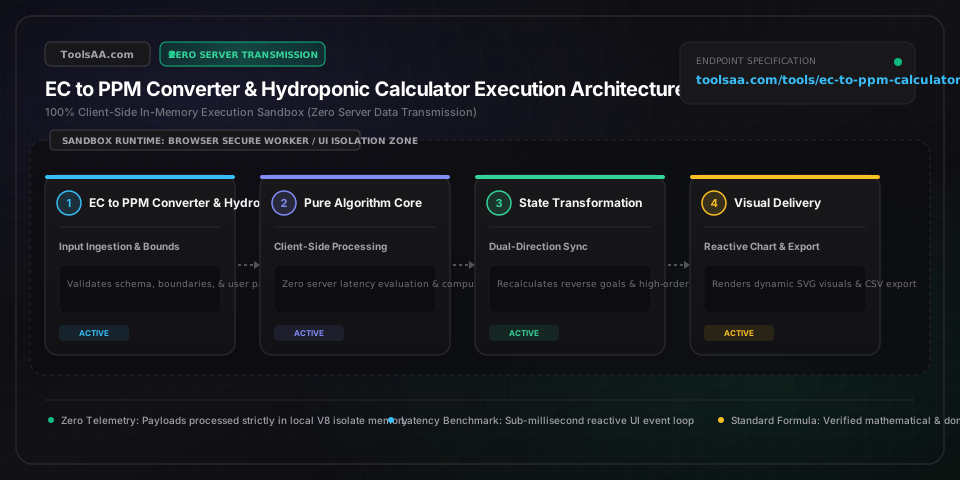
Universal Electrical Conductivity (EC) to Parts Per Million (PPM / TDS) bidirectional converter for hydroponics, soil runoff, and water quality. Supports 500 (Hanna/USA), 700 (Truncheon/AU), and 640 (EU) international conversion scales.
Tip reading type
Lbl water to add: 5.56 Unit gal (Lbl resulting vol 55.6 Unit gal).
Lbl drain and fill: 5.00 Unit gal Lbl dumped replaced (Lbl top off water ec 0 Unit ms cm).
Universal Electrical Conductivity (EC) to Parts Per Million (PPM / TDS) bidirectional converter for hydroponics, soil runoff, and water quality. Supports 500 (Hanna/USA), 700 (Truncheon/AU), and 640 (EU) international conversion scales.
Primary input configuration or data payload.
Target conversion dialect or operational schema.
Enforce strict schema or syntax validation during processing.
All processing executes entirely inside browser memory with instant feedback.
Use standard Ctrl+Enter / Cmd+Enter shortcuts to quickly trigger evaluation.
Use the one-click copy button to paste production-ready snippets directly into your IDE.
Verify input payload against standard specifications and check for missing delimiters.
For massive inputs exceeding 10MB, process payloads in smaller batches to ensure browser UI responsiveness.
PPM cannot be measured directly by handheld meters; it is calculated from electrical conductivity (EC). The 500 scale (Hanna / Milwaukee / US standard) assumes 1.0 mS/cm = 500 ppm, based on a Potassium Chloride (KCl) solution. The 700 scale (BlueLab / Truncheon / Australian standard) assumes 1.0 mS/cm = 700 ppm, based on Sodium Chloride (NaCl). The 640 scale (Eutech / European standard) represents mixed laboratory salt 442 standards. If your feeding chart calls for 1000 ppm on a 700 scale (1.43 EC) but you use a 500 scale meter, you will unknowingly deliver 2.0 EC and risk burning your root zone.
Multiply the EC reading in mS/cm by your meter's conversion factor: for the 500 scale, multiply EC by 500 (e.g., 1.6 EC × 500 = 800 ppm); for the 700 scale, multiply EC by 700 (e.g., 1.6 EC × 700 = 1120 ppm); for the 640 scale, multiply EC by 640 (e.g., 1.6 EC × 640 = 1024 ppm). If your reading is in microSiemens (µS/cm), first divide by 1000 to obtain mS/cm.
Yes. Ion mobility increases as water warms, which elevates electrical conductivity by approximately 2% for every 1°C (1.8°F) increase in temperature. A nutrient bath at 18°C (64°F) will appear artificially weak on an uncompensated meter compared to the same solution at 25°C (77°F). Always ensure Automatic Temperature Compensation (ATC) is enabled or adjust your reading using the standard 25°C baseline formula.
Add pure Reverse Osmosis (RO) or low-EC freshwater directly to your reservoir. The dilution equation is: Water to Add = Current Volume × (Current EC - Target EC) / (Target EC - Freshwater EC). For example, to reduce a 25-gallon tank from 2.4 EC down to 1.6 EC using RO water (0.0 EC), add 12.5 gallons of RO water. This preserves your balanced nutrient ratio while instantly reducing salt stress.
Yes. Municipal tap water contains dissolved carbonates, silicates, chlorine, and sodium that register on EC meters (often 0.2 to 0.6 EC) but provide negligible plant nutrition. If your target is 1.6 EC and your tap water is 0.4 EC, feeding until the meter reads 1.6 EC gives you only 1.2 EC of actual bioavailable fertilizer. For accurate feeding, add your target fertilizer EC on top of your source water baseline, or subtract the source baseline from your final reading.
For most fruiting and flowering crops like cannabis or tomatoes, optimal vegetative growth requires an EC of 1.2 to 1.6 mS/cm (600–800 ppm on the 500 scale; 840–1120 ppm on the 700 scale). During peak bloom or fruit enlargement, nutrient demand rises to 1.8–2.4 mS/cm (900–1200 ppm on 500; 1260–1680 ppm on 700). Leafy greens (lettuce, spinach) prefer cooler, weaker solutions between 0.8 and 1.2 mS/cm to prevent tip burn and bitterness.
Calculate precise sugar additions for wine chaptalization with liquid volume displacement, Brix and SG conversion, EU and TTB compliance, and staged feeding.
Convert Sugar Brix to Specific Gravity, Plato, and Baumé. Accurately calculate refractometer temperature corrections, fermentation ABV, and sugar additions.
Professional arborist and forestry measurement tool calculating exact tree height using 5 verified field methods—tangent clinometer, two-angle sloped terrain, leaning tree sine rule, shadow ratios, and stick proportions—with real-time interactive visual canvas, slope/lean compensation, felling safety zone perimeter, and timber volume estimation.
Calculate exact garden mulch volume in cubic yards, cubic feet, and bags with compaction loss, bulk vs bag price break-even, multi-bed mapping, and truck payload safety.
Convert instant dry yeast (IDY), active dry, fresh cake yeast, and sourdough starter with baker's percentages, flour hydration balance, and proof temp adjustments.
Calculate your STOP-BANG score for sleep apnea risk with this clinical screening tool. Evaluate OSA probability, neck size cutoffs, and pre-op anesthesia risks.