Vegetable Garden Yield Calculator & Planner

Vegetable Garden Yield Calculator & Planner

Badge living nutrition

Comprehensive vegetable garden harvest calculator for home gardeners, homesteaders, and self-sufficiency planners. Estimates total yield in pounds and kilograms across 30+ crops, family servings, required raised bed area, and nutritional calories.

Lbl quick presets

Parameters & Inputs

Lbl bed config
Lbl available area64.0 Unit sq ft
Lbl environment settingsEfficiency: 85%
Lbl pest loss rate15% loss allowance
Lbl crop allocation64 / 64 sq ft (100%)
🍅
Heirloom Vining Tomato
~12 lbs/sqft
12sqft
🍒
Sweet Cherry / Grape Tomato
~9.5 lbs/sqft
8sqft
🥒
Prolific Zucchini & Summer Squash
~5.5 lbs/sqft
8sqft
🫑
Sweet Crisp Bell Peppers
~5.5 lbs/sqft
8sqft
🥒
Crisp Trellised Salad Cucumbers
~8 lbs/sqft
8sqft
🫛
Tender Bush Green Snap Beans
~3.8 lbs/sqft
8sqft
🥗
Crisp Romaine & Mesclun Lettuce
~3.2 lbs/sqft
8sqft
🌿
Genovese Sweet Culinary Basil
~3.6 lbs/sqft
4sqft
Lbl financial breakdownTotal: $115
Lbl status readyLbl fully planted
Metric total yield
497.4 lbs
117 plants sown
Metric retail value
$2,550
Organic Store
Metric net savings
$2,435
ROI: 2117%
Lbl daily servings
~12.1
43,271 kcal total
Harvest Allocation Weight Distribution8 Varieties
🍅🍒🥒🫑🥒🫛🥗
Heirloom Vining Tomato: 122.4 lbs
Sweet Cherry / Grape Tomato: 64.6 lbs
Prolific Zucchini & Summer Squash: 52.4 lbs
Sweet Crisp Bell Peppers: 37.4 lbs
Crisp Trellised Salad Cucumbers: 87.0 lbs
Tender Bush Green Snap Beans: 56.8 lbs
Crisp Romaine & Mesclun Lettuce: 52.2 lbs
Genovese Sweet Culinary Basil: 24.5 lbs
CropSpacePlantsYieldGrocery ValueDays
🍅Heirloom Vining Tomato12 sqft6122.4 lbs$61178d
🍒Sweet Cherry / Grape Tomato8 sqft464.6 lbs$41965d
🥒Prolific Zucchini & Summer Squash8 sqft352.4 lbs$13052d
🫑Sweet Crisp Bell Peppers8 sqft637.4 lbs$16875d
🥒Crisp Trellised Salad Cucumbers8 sqft1087.0 lbs$28658d
🫛Tender Bush Green Snap Beans8 sqft4856.8 lbs$25554d
🥗Crisp Romaine & Mesclun Lettuce8 sqft3252.2 lbs$31348d
🌿Genovese Sweet Culinary Basil4 sqft824.5 lbs$36745d
Lbl total yield prefix 497.4 lbsLbl savings prefix $2,435
Primary Metric
497.4 lbs

Lbl sufficient for 2,171 Lbl fresh human servings across 8 Lbl crop types

Efficiency / Capacity
$2,435

Lbl net home savings desc

Net Output
100%

64 Lbl sq ft cultivated with 117 Lbl healthy organic food plants

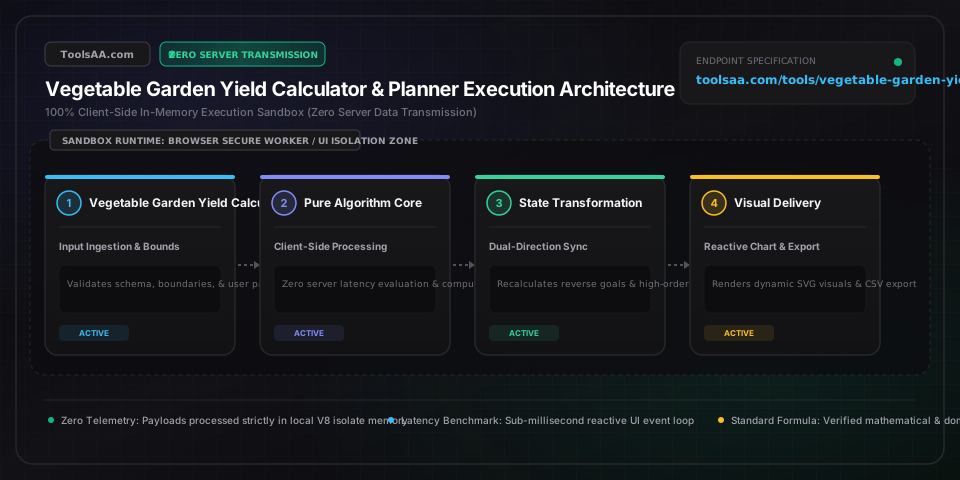
Client-Side Processing

High-performance calculation executed entirely in browser memory.

Zero Server Upload Privacy

All payloads remain strictly local with zero external server communication.

Production Ready Export

Clean, optimized output formats ready for immediate deployment.

Disclaimer organic
Technical Reference & Architecture Guide

Vegetable Garden Yield Calculator & Planner Guide

Calculate vegetable garden harvest yield in pounds or kilograms, space requirements, succession sowing dates, grocery retail savings, and reverse family food quotas for 35+ crops across raised beds, containers, and in-ground rows.

Vegetable Garden Yield Calculator & Planner Guide — Client-Side In-Memory Architecture & Data Flow

Key Parameters & Controls

gardenBedFootprintPhysical Cultivation Footprint (sq ft / m²)

Total unobstructed planting area inside raised beds, container perimeters, or tilled in-ground rows. Standard 3 to 4 foot (0.9 to 1.2 m) bed widths prevent soil compaction by allowing gardeners to reach center plantings without stepping onto the rhizosphere, preserving an optimal loose soil bulk density between 1.1 and 1.3 g/cm³ across an 8 to 12 inch root depth.

Default: 32 sq ft (4x8 ft raised bed)
cropSpacingDensityBiointensive Horticultural Grid (plants / sq ft)

Square Foot Gardening grid allocation based on mature canopy radius and root architecture. Ranges from 1 plant per 9 square feet for sprawling winter squash and pumpkins, down to 16 plants per square foot for compact taproots like Nantes carrots and French breakfast radishes. Calibrated to maximize canopy light capture while preserving laminar air circulation against fungal blight.

Default: 1 plant / sq ft (Indeterminate Trellised)
dailySunlightExposureDirect Solar Radiation Window (hours / day)

Duration of unobstructed direct sunlight hitting the garden canopy daily. Fruiting crops (tomatoes, sweet peppers, cucumbers, melons) demand an absolute physiological minimum of 6.0 to 8.0 hours of direct sun (>30 Daily Light Integral) to set floral buds, whereas leafy brassicas, chard, and herbs produce dependable vegetative yields with 3.5 to 5.0 hours of dappled or partial sun.

Default: 6 to 8 hours (Full Sun)
soilOrganicMatterIndexSoil Organic Matter Tier (SOM percentage)

Biological soil quality rating and finished compost enrichment level. High-yielding biointensive beds target 6% to 10% Soil Organic Matter (SOM) with a balanced pH range between 6.2 and 6.8, providing high cation-exchange capacity (CEC), beneficial mycorrhizal fungi colonies, and a 30% higher natural water-retention buffer compared to depleted mineral garden soils (<2% SOM).

Default: High Organic Blend (6% - 10% SOM)
successionHarvestRotationsAnnual Crop Successions (cycles / season)

Number of staggered planting rounds cycled through each square foot during the regional frost-free calendar. Fast-turnaround spring crops (40-day spinach, 25-day radishes) rotated into warm-season nightshades (tomatoes, peppers) and followed by frost-hardy winter greens (lacinato kale, mâche) expand total annual square-foot food biomass by 200% to 280%.

Default: 2 succession cycles per growing season
householdNutritionalTargetFamily Dietary Coverage (headcount quota)

Household produce planning quota based on dietary consumption benchmarks (2.5 to 3.0 cups of fresh vegetables per person daily). Reverse-calculates the required cultivated square footage (typically 35 to 50 sq ft of high-intensity bed per individual) and crop plant headcounts to fulfill fresh table dining alongside home canning, freezing, and cold-storage goals.

Default: 4 Persons (2 Adults, 2 Children)

Pro Tips & Best Practices

Prevent Blossom-End Rot by Regulating Water Transpiration Rather than Adding Soil Calcium

Over 85% of home gardeners mistake black blossom-end rot in tomatoes and sweet peppers for an absolute soil calcium deficiency, mistakenly adding crushed eggshells, bone meal, or agricultural lime. In over 95% of garden soils, ample calcium is already present; the rot occurs because calcium is a non-motile ion that travels exclusively through passive xylem water transpiration. Irregular irrigation cycles, rapid drying of raised bed edges, and shallow watering starve fast-growing distal fruit cells of calcium. Applying 2 to 3 inches of clean wheat or alfalfa straw mulch and setting automated drip irrigation for consistent root moisture resolves the condition completely without altering soil pH.

Anchor Vertical Trellises Exclusively on North and East Bed Perimeters to Eliminate Shadow Stunting

Trellising vining crops vertically (such as indeterminate tomatoes, cucumbers, and runner beans) increases harvest yield per square foot of soil footprint by over 300%. However, installing 6-to-8-foot trellis nets along southern or western edges creates massive cast shadows, starving compact crops of critical photosynthetic energy. Always place vertical structural supports along the northernmost (or northeastern) boundary of your garden beds. This allows full southern solar exposure to bathe lower-profile peppers, bush beans, eggplants, and root crops throughout peak midday hours.

Eliminate 'Lush Foliage Zero Fruit' Syndrome by Restricting High-Nitrogen Fertilization

Applying high-nitrogen synthetic plant foods or uncomposted poultry manure causes vegetative shoot gigantism: thick green stalks and luxuriant foliage that deceive gardeners while biochemically inhibiting floral bud formation. Fruiting vegetables like tomatoes, squash, and peppers prioritize leaf expansion over fruit setting when soil nitrogen is overly abundant, frequently dropping their blossoms prematurely. Once plants transition from early seedling establishment to crown flowering, switch immediately to organic amendments featuring a high phosphorus and potassium balance (such as a 1:2:2 N-P-K formulation or sulfate of potash and bone meal) to trigger heavy, continuous fruit set.

Harvest Tender Greens and Herbs Before 8:30 AM to Lock in Peak Turgor and Natural Sugars

Vegetable foliage harvested during midday heat loses up to 15% of its cellular water volume through active stomatal transpiration, which degrades structural crispness and triggers heat-stress bitterness (such as milky lactucarium in heading lettuces). Harvesting cut-and-come-again greens, spinach, sweet basil, and snap peas in the early morning—between 6:00 AM and 8:30 AM—captures cellular turgor pressure at its daily zenith. Immersing harvested leaves in a cold ice-water bath (50°F / 10°C) for 10 minutes stops post-harvest respiration, extending refrigerator crisper freshness by up to 14 days.

Common Gotchas & Troubleshooting

⚠️Tomato and pepper plants produce abundant flowers, but blossoms dry up, turn yellow, and drop off without setting any fruit.

Blossom drop is primarily caused by temperature extremes that deactivate pollen viability. When sustained daytime temperatures exceed 90°F (32°C) or nighttime temperatures remain above 75°F (24°C), solanaceous pollen turns sterile and cannot fertilize flower ovaries. During midsummer heat waves, install a 30% knitted white or aluminet shade cloth suspended 2 feet above the canopy to reduce foliage heat by 8°F to 12°F. Maintain soil root moisture with morning deep-drip cycles, and interplant nectar-rich companion blooms (sweet alyssum, cosmos, borage) to attract native bumblebees that perform high-frequency buzz pollination.

⚠️Indoor and early-season seedlings become tall, pale, and thread-like, collapsing across the soil surface (etiolation and damping-off).

Spindly, weak seedling stems occur when light levels fall below the threshold required to suppress elongation hormones (auxins), forcing stems to stretch toward distant windows. Position full-spectrum LED grow lights 2 to 4 inches (5 to 10 cm) above seedling leaf tops on an automated 14-to-16-hour daily timer. To eliminate fungal damping-off (water mold pathogens like Pythium and Rhizoctonia), bottom-water seedlings in sterile seed-starting mix, run an oscillating room fan on low speed to create gentle air currents that strengthen plant cellulose, and allow the top layer of vermiculite to dry between waterings.

⚠️Cool-season crops (spinach, cilantro, radishes, butterhead lettuce) suddenly shoot up tall central stalks with bitter, unpalatable leaves.

This is premature bolting, a genetic survival reflex triggered when daily photoperiods lengthen past 14 hours and soil root temperatures surpass 75°F (24°C). Once floral stem elongation starts, leaf sugars convert into bitter defensive compounds and cannot be reversed; harvest remaining leaves immediately. For subsequent plantings, select slow-bolt certified cultivars (such as 'Bloomsdale Long Standing' spinach or 'Santo' cilantro), plant spring rotations 4 weeks before the final spring frost date, and sow autumn successions in late summer beneath the protective shade cast by mature vining crops.

Frequently Asked Questions

How much vegetable yield can you get from a 4x8 raised bed?▼

A well-managed 4x8 foot raised bed (32 square feet) yields an average of 75 to 140 pounds (34 to 64 kg) of fresh produce per typical 5-month growing season when using intensive Square Foot Gardening techniques. If high-density, high-yielding vertical crops like indeterminate tomatoes, trellised pole beans, and bush zucchini are prioritized alongside succession greens (spinach, looseleaf lettuce, radishes), harvests can exceed 180 pounds (82 kg), representing over $450 to $700 in organic supermarket produce value.

How many vegetable plants do I need to feed a family of 4?▼

To provide fresh seasonal vegetables plus modest pantry storage for 2 adults and 2 children, university agricultural extensions (Purdue, Cornell) recommend planting: 8 to 12 indeterminate tomato plants (fresh eating + sauce), 6 to 10 bell and sweet peppers, 4 bush zucchini/summer squash plants, 30 to 40 pole bean plants on trellises, 80 to 100 storage onions, 60 to 80 carrots (sown in 3 succession batches), 24 heads of looseleaf/romaine lettuce, and 30 seed potatoes. This total requires approximately 140 to 200 square feet of dedicated raised bed area, or roughly four to five 4x8 or 4x10 foot beds.

What is the formula to calculate vegetable garden yield?▼

The comprehensive horticultural formula for vegetable yield is: Net Yield (lbs) = [Plant Population × Average Extension Yield Per Plant (lbs) × Succession Harvest Cycles] × Gardener Experience Modifier (0.65 to 0.98) × Sunlight Coefficient (0.65 to 1.00) × Irrigation Reliability (0.75 to 1.00) × (1 - Pest and Disease Loss Rate). For Square Foot Gardening, Plant Population is calculated as: Allocated Bed Square Footage × Spacing Density (e.g. 1 per sq ft for tomatoes, 9 per sq ft for bush beans or spinach, 16 per sq ft for carrots or radishes).

Which vegetables produce the highest yield per square foot?▼

When measured by weight per square foot of soil footprint, vertical trellised indeterminate tomatoes lead with 12 to 18 lbs/sq ft, followed by trellised slicing cucumbers (10 to 14 lbs/sq ft) and pole beans (9 to 12 lbs/sq ft). When measured by economic retail value per square foot, culinary herbs like Genovese basil and flat-leaf parsley rank highest ($60 to $80/sq ft equivalent), followed by cut-and-come-again specialty salad greens ($30 to $45/sq ft) and gourmet hardneck garlic ($15 to $22/sq ft).

How much money does a vegetable garden actually save on groceries?▼

A standard 100 to 150 square foot home garden generates between $600 and $1,400 in net grocery savings annually if focused on high-markup crops (organic heirloom tomatoes, specialty peppers, fresh culinary herbs, berries, and gourmet salad mixes). After deducting seed/transplant costs ($40-$80), organic compost and amendments ($30-$60), and municipal water overhead ($25-$50), the average return on investment exceeds 300% to 500% starting in year two, once initial bed construction lumber or raised bed frames have been paid off.

How does square foot gardening yield compare to traditional row planting?▼

Square Foot Gardening (SFG) produces 100% to 300% more vegetable yield per total square foot of backyard property compared to traditional single-row agriculture. Traditional farming layouts sacrifice 50% to 65% of the total bed footprint to compacted walking aisles between rows. SFG eliminates interior pathways completely by keeping beds 3 to 4 feet wide (accessible from perimeter edges) and spaces plants equidistantly in deep, high-organic-matter soil, achieving identical individual plant vigour while doubling overall harvest density.

Related Tools & Utilities

All Tools →