Steps per mm Calculator & E-Steps

Hero badge•Lbl sub zero float

Steps per mm Calculator & E-Steps

Calculate theoretical and measured steps per mm, steps per inch, or Klipper rotation distance for 3D printers and CNCs. Calibrate GT2 belts, T8 leadscrews, ballscrews, and geared E-steps.

Lbl presets

Section kinematics

Hint gt2
Hint teeth
1:1 (1:1)
Lbl motor teeth
Lbl driven teeth
150 mm/s
5 mm/s (Extrusion)150 mm/s (Standard Print)500 mm/s (Rapid Travel)

Section calibration

Badge feedback
Hint m92
Hint g1 cmd
Hint caliper reading
Lbl steps per mm
80.00
Lbl exact theoretical
Lbl klipper rot dist
40.0000
Lbl mm per rev
Lbl resolution
12.50μm
Lbl standard fine
Lbl step frequency
12.0kHz
Mcu status safe
Lbl svg desc40.00 mm / rev
X Axis Carriage20T Pulley (2mm Pitch)Linear Advance: 40.00 mm / turn
Lbl total microsteps3200 Lbl u steps per rev
Lbl travel per rev40.000 mm
Lbl gear multiplier1.000x
Lbl positional res12.500 μm
Stat microsteps rev

3,200 Lbl u steps

Stat travel per rev

40.000 mm / turn

Stat theoretical resolution

12.500 Lbl um per microstep

Client-Side Processing

High-performance calculation executed entirely in browser memory.

Zero Server Upload Privacy

All payloads remain strictly local with zero external server communication.

Production Ready Export

Clean, optimized output formats ready for immediate deployment.

Footer rights
Technical Reference & Architecture Guide

Steps per mm Calculator & E-Steps Guide

Calculate theoretical and measured steps per mm, steps per inch, or Klipper rotation distance for 3D printers and CNCs. Calibrate GT2 belts, T8 leadscrews, ballscrews, and geared E-steps.

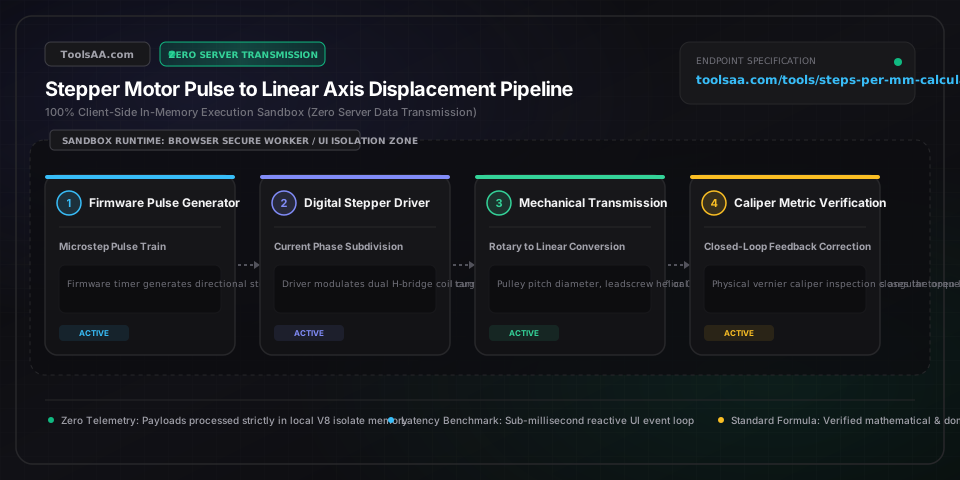
Steps per mm Calculator & E-Steps Guide — Client-Side In-Memory Architecture & Data Flow

Key Parameters & Controls

Motor Step Angle (Theta)Mechanical Degrees

Defines the physical rotor detent resolution: 1.8° yields 200 full steps per revolution; 0.9° yields 400 full steps per revolution for twice the native positional resolution.

Default: 1.8° (200 full steps)
Microstepping Factor (uStep)Sine/Cosine Current Interpolation

Electronic division of full steps performed by the stepper driver (A4988, DRV8825, TMC2209). 1/16 is the golden industry standard balancing audible acoustic quieting with motor torque retention.

Default: 16 (1/16)
Drive Pulley Tooth Count (Z)Integer Tooth Index

Directly sets linear carriage travel per turn on belt-driven axes. A 20-tooth GT2 pulley moves 40 mm/turn (80 steps/mm at 1/16); a 16-tooth GT2 pulley moves 32 mm/turn (100 steps/mm at 1/16).

Default: 20 teeth
Leadscrew Lead vs PitchLinear Dimension (mm)

Lead = Pitch * Starts. For a classic T8x8 screw, pitch is 2.0 mm across 4 independent helical starts, giving 8.0 mm linear advance per rotation (400 steps/mm). Confusing lead with pitch causes 400% Z-scaling errors.

Default: 8.0 mm lead (2mm pitch x 4 starts)
Hobbed Filament Drive Gear DiameterEffective Pitch Radius (mm)

The root bite diameter where hardened steel teeth bite into the plastic filament strand. Ranges between 5.5 mm (compact extruders) and 7.5 mm (standard dual-drive gears).

Default: 7.3 mm
Calibration RatioUnitless Multiplier

Empirical correction scalar derived by dividing target commanded displacement by precision caliper measured displacement: New_Steps = Old_Steps * (Commanded / Measured).

Default: 1.0000

Pro Tips & Best Practices

Never Calibrate Extruder E-Steps With Hotend Backpressure

Calibrating E-steps through a hot nozzle conflates motor steps with thermal nozzle viscosity, die swell, and extruder tooth slippage. Always disconnect the PTFE Bowden tube or remove the nozzle and measure free-air filament extrusion into ambient air first to establish pure mechanical steps/mm. Adjust filament flow rate (extrusion multiplier in the slicer) separately for dimensional tuning.

Klipper Rotation Distance Is Inversely Proportional to Steps/mm

Marlin steps/mm defines how many electrical pulses equal 1 mm of travel, whereas Klipper's rotation_distance defines how many millimeters the mechanical axis advances in one complete 360° motor turn. The exact direct conversion formula is: rotation_distance = (full_steps_per_rev * microsteps) / (steps_per_mm). Note that Klipper does not change rotation_distance when microstepping is altered!

Beware the T8x2 vs T8x4 vs T8x8 Leadscrew Pitfall

Trapezoidal 8mm leadscrews look visually indistinguishable from the outside. Inspect the cut end of the rod and count the starting thread grooves: 1 start = T8x2 (2mm lead, 1600 steps/mm at 1/16); 2 starts = T8x4 (4mm lead, 800 steps/mm); 4 starts = T8x8 (8mm lead, 400 steps/mm). Using 400 steps/mm on a T8x2 produces prints that are only 25% of their intended height.

The 1/256 Microstepping Holding Torque Fallacy & Clock Choke

Setting stepper drivers to 1/256 microstepping does not increase positional print accuracy—incremental holding torque between adjacent microsteps drops to less than 0.78% of peak torque, causing the motor to settle onto nearby full-step magnetic detents anyway. Furthermore, 1/256 microstepping at 200 mm/s can overwhelm microcontroller step-pulse generation clocks (requiring >250 kHz). Use 1/16 with driver-side 256 interpolation (TMC stealthChop) instead.

Common Gotchas & Troubleshooting

⚠️Extruder clicks, skips steps, or underextrudes during physical calibration

Verify hotend temperature is adequate for the commanded extrusion speed (do not exceed 5 mm/s or 300 mm/min during test). Check stepper driver VREF current to ensure motor receives adequate torque, check for a cracked plastic idler tension arm, and confirm drive gears are clear of stripped plastic debris.

⚠️Printed calibration cube height (Z-axis) is exactly half or double expected CAD dimensions

This is a classic mismatch between physical leadscrew starts (e.g., T8x4 vs T8x8) or driver microstepping jumpers (1/8 vs 1/16). Check whether your firmware EEPROM has 400 or 800 steps/mm configured. Update with M92 Z[CorrectValue] and commit to permanent memory with M500.

⚠️Axis stalls, screeches, or skips steps when travel speed exceeds 150 mm/s

Check your microcontroller step-pulse frequency. 8-bit Atmega2560 boards ceiling at 40 kHz, limiting an 80 steps/mm axis to 500 mm/s, but a 1600 steps/mm leadscrew to only 25 mm/s. If microstepping is set to 1/32 or higher, lower it to 1/16 or reduce max feedrate in firmware.

⚠️Klipper carriage moves microscopic distance after pasting Marlin steps/mm

Klipper does not use steps/mm in printer.cfg. If your Marlin steps/mm was 400 with 16 microsteps and a 1.8° motor, your Klipper rotation_distance is (200 * 16) / 400 = 8.0. If you enter '400' into rotation_distance, the carriage will barely move.

Frequently Asked Questions

How to calculate steps per mm formula?▼

The universal theoretical formula is: Steps_per_mm = (Motor_Steps_Per_Rev * Microstepping_Divisor * Gear_Ratio) / Axis_Travel_Per_Motor_Rev. For a standard GT2 belt with a 20-tooth pulley, 1.8° motor (200 steps), and 1/16 microstepping: (200 * 16 * 1) / (2mm * 20 teeth) = 3200 / 40 = 80 steps/mm.

How to calibrate extruder E-steps with calipers?▼

Mark the filament with a fine marker pen exactly 120 mm above your extruder body entrance. Heat the hotend (or disconnect the Bowden tube for free-air testing) and command 100 mm of extrusion via G-code 'G1 E100 F100'. Measure the remaining distance from the extruder entrance to your mark with digital calipers. Actual extruded length = 120 mm - Remaining distance. Calculate: New_E_Steps = (Current_E_Steps * 100) / Actual_Extruded. Save to EEPROM with 'M92 E[New_Value]' followed by 'M500'.

How to convert Marlin steps per mm to Klipper rotation distance?▼

To convert Marlin steps/mm to Klipper rotation_distance, use the equation: rotation_distance = (Full_Steps_Per_Rev * Driver_Microstepping) / Marlin_Steps_Per_Mm. For example, a Z-axis with 400 steps/mm, 1.8° motor (200 steps), and 16 microsteps converts to: (200 * 16) / 400 = 8.0 mm rotation_distance. In Klipper, rotation_distance represents mechanical carriage advance per motor turn and remains constant regardless of what microstepping you configure.

What is the difference between T8x2, T8x4, and T8x8 leadscrews?▼

All three have an 8mm outer diameter and 2mm pitch between adjacent threads, but differ in thread starts: T8x2 has 1 start (2mm lead per turn, 1600 steps/mm at 1/16); T8x4 has 2 starts (4mm lead per turn, 800 steps/mm); T8x8 has 4 starts (8mm lead per turn, 400 steps/mm). Using T8x8 firmware settings on a T8x2 screw produces printed objects that are only 25% of their intended height.

Why does high microstepping reduce stepper motor holding torque?▼

Microstepping creates intermediate electrical positions between full-step detents by modulating sine and cosine currents through motor coils. The incremental holding torque between consecutive microsteps degrades exponentially as subdivision increases: at 1/16 microstepping, incremental torque is 9.8% of peak torque, while at 1/256 it drops to just 0.78%. External friction or cutting loads easily deflect the rotor to the nearest full-step detent.

How to calculate CNC steps per inch from leadscrew TPI?▼

For an imperial CNC axis, Steps_per_inch = (Motor_Steps_Per_Rev * Microstepping * Gear_Ratio) * TPI. For example, a 1.8° stepper motor (200 full steps), 1/8 microstepping (1,600 microsteps/rev), 1:1 direct drive, and a 1/2"-10 ACME single-start leadscrew (10 TPI) yields: 1,600 * 10 = 16,000 steps per inch (or 629.92 steps/mm).

Related Tools & Utilities

All Tools →