Time Card Calculator (Hours & Overtime Pay)

Time Card Calculator (Hours & Overtime Pay)

Calculate employee time card hours and overtime pay with break deductions. Accurately compute gross wages across daily and weekly overtime under FLSA labor laws.

Lbl load sample

Title workplace config

$
Night Shift Diff0%
Extra pay premium for hours worked 10PM - 6AM
Est. Tax & Withholding15%
Estimated tax & payroll deduction for net take-home

Title time card entries

Th dayTh shift inTh lunch outTh lunch inTh shift outTh daily net
8.00h
8.00h
8.00h
8.00h
8.00h
0.00h
0.00h
Kpi total hours40.00Kpi unpaid breaks: 2.50h
Kpi total gross$1,000.00Kpi effective rate: $25.00/h
Kpi regular hours40.001.0x Base Rate
Kpi overtime hours0.000.0h OT / 0.0h DT
Lbl weekly thresholdStatus compliant
0h40h Standard48h Max LimitLbl scale
Tab timeline
Regular (1.0x)Overtime (1.5x)Double (2.0x)
8hMon8.0Tue8.0Wed8.0Thu8.0Fri8.0SatSun
Tab timesheet
Th dayTh shift inTh shift outTh unpaid breakKpi regular hoursKpi overtime hoursKpi double time hoursTh daily netTh daily pay
Mon8:30 AM5:00 PM30m8.00h----8.00h$200.00
Tue8:30 AM5:00 PM30m8.00h----8.00h$200.00
Wed8:30 AM5:00 PM30m8.00h----8.00h$200.00
Thu8:30 AM5:00 PM30m8.00h----8.00h$200.00
Fri8:30 AM5:00 PM30m8.00h----8.00h$200.00
Sat------------0.00h$0.00
Sun------------0.00h$0.00
TOTALS40.00h0.00h0.00h40.00h$1,000.00
Kpi total hours40.00 Unit hours
Kpi total gross$1,000.00
Estimated Net Take-Home$850.00
Technical Reference & Architecture Guide

Time Card Calculator (Hours & Overtime Pay) Guide

Calculate employee time card hours and overtime pay with break deductions. Accurately compute gross wages across daily and weekly overtime under FLSA labor laws.

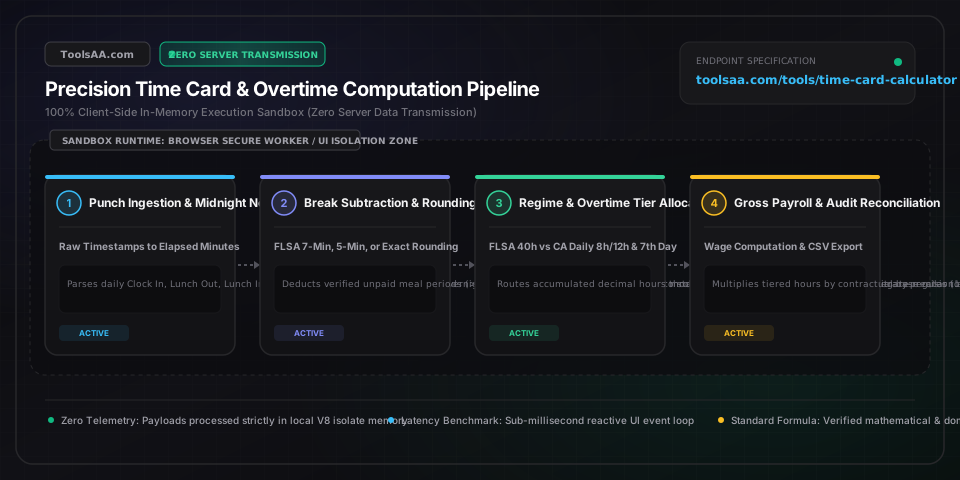
Time Card Calculator (Hours & Overtime Pay) Guide — Client-Side In-Memory Architecture & Data Flow

Key Parameters & Controls

Standard Regular Work HoursDecimal Hours

Base hours worked within statutory non-premium thresholds (typically up to 40.0 hours per workweek under federal US FLSA § 207, or 8.0 hours per workday under California Labor Code § 510). Paid at standard 1.0x hourly wage.

Default: 40.00 hrs
Time-and-a-Half Overtime (1.5x)Decimal Hours

Statutory premium hours paid at 150% (1.5x) of regular hourly rate. Triggered when weekly hours exceed 40.0 under federal law, or when daily hours exceed 8.0 (up to 12.0) in California and Alaska.

Default: 0.00 hrs
Double-Time Premium (2.0x)Decimal Hours

Mandatory statutory premium hours paid at 200% (2.0x) of regular hourly rate. Under California Labor Code § 510, triggered for all work hours in excess of 12.0 hours in a single workday, or beyond 8.0 hours on the 7th consecutive day of the workweek.

Default: 0.00 hrs
Bona Fide Meal Break DeductionClock Duration (Minutes)

Unpaid rest period where the employee is completely relieved of all job duties for at least 30 continuous minutes (under 29 CFR § 785.19). Rest periods of 5 to 20 minutes are compensable as hours worked by federal statute.

Default: 30 mins
FLSA 7-Minute Rounding WindowClock Increment Rule

Standard 15-minute payroll rounding under 29 CFR § 785.48(b). Punches between 1 and 7 minutes past the quarter-hour round down; punches between 8 and 14 minutes round up to the nearest 15-minute increment (0.25 hours).

Default: 7-minute rule
Base Hourly WageMonetary Currency

Contractual gross base hourly rate before overtime multipliers, mandatory statutory payroll deductions (FICA, federal, state taxes), or voluntary benefit withholdings.

Default: $25.00 / hr

Pro Tips & Best Practices

The FLSA 7-Minute Rounding Asymmetry Trap

Under 29 CFR § 785.48(b), employers may round timecard punches to the nearest quarter-hour only if the rule is administered neutrally. If an employer rounds clock-ins at 8:07 down to 8:00 but rounds clock-outs at 17:07 down to 17:00, the rounding systematically favors the employer over time, creating substantial legal liability for unpaid wage theft.

Bi-Weekly 80-Hour Overtime Averaging is Illegal

Under federal FLSA rules, each workweek of 7 consecutive 24-hour periods stands entirely on its own. An employee working 48 hours in Week 1 and 32 hours in Week 2 has 80 total hours, but the employer legally owes 8 hours of overtime pay for Week 1. Averaging the two weeks to avoid overtime violates federal wage and hour laws.

Short Rest Breaks (5-20 Mins) Are Legally Compensable

Federal regulation 29 CFR § 785.18 explicitly states that rest periods of short duration—running from 5 minutes to about 20 minutes—must be counted and paid as compensable work hours. Only bona fide meal periods where the worker is entirely relieved from duty for 30 minutes or longer may be deducted from timecards.

Graveyard Midnight Crossing Split Failures

When calculating shifts that cross midnight (e.g. 10:00 PM to 6:30 AM), basic spreadsheet subtraction (=Out - In) returns negative numbers or errors unless the formula adds +1 or wraps 24 hours. For payroll tax allocation, hours must be attributed to the workday when the shift commenced or consistent with the employer's established 24-hour workday definition.

Common Gotchas & Troubleshooting

⚠️Clock-out time earlier than clock-in results in negative or zero hours worked.

This occurs during overnight graveyard shifts crossing midnight (e.g., 22:00 to 06:00). Toggle the 'Night Shift / Crosses Midnight' option, which adds 24 hours to the terminal timestamp, yielding exactly 8.0 elapsed hours.

⚠️Decimal hours don't match clock minutes (e.g., 8 hours 45 minutes showing as 8.45 instead of 8.75).

Clock minutes run on a base-60 sexagesimal system, whereas payroll software calculates in base-100 decimal hours. Divide minutes by 60: 45 minutes / 60 = 0.75 hours, producing 8.75 decimal hours.

⚠️Daily overtime not calculating despite working 10 hours in a single shift.

Under Federal FLSA, overtime is strictly assessed on a weekly cumulative basis (>40.0 hours/week), not daily. To calculate daily overtime after 8.0 hours, switch the Regime Selector to 'US - California'.

⚠️Lunch break deduction deducted twice or showing zero duration.

Ensure that Lunch In is later than Lunch Out. If you input both individual meal punch timestamps AND a manual break minute value, the calculator prioritizes the punch timestamps to prevent double-deduction.

Frequently Asked Questions

How do you calculate time card hours with lunch breaks?▼

To calculate total timecard hours with lunch breaks, determine the morning elapsed time (Lunch Out minus Clock In) and the afternoon elapsed time (Clock Out minus Lunch In), then sum the two intervals. Alternatively, subtract total unpaid break minutes from the total elapsed shift duration: Total Hours = (Clock Out - Clock In) - Break Minutes. For payroll, convert remaining minutes to decimal by dividing by 60.

What is the 7-minute rule for payroll time cards?▼

The 7-minute rule is a standard payroll practice authorized by FLSA 29 CFR § 785.48(b) that rounds employee punch times to the nearest 15-minute quarter-hour (0.25 decimal hours). If an employee clocks in 1 to 7 minutes past the quarter-hour (e.g., 8:07), the time rounds back to 8:00. If they clock in 8 to 14 minutes past (e.g., 8:08), it rounds forward to 8:15.

How do you convert time card minutes to decimal hours?▼

Convert minutes to decimal hours by dividing the exact number of minutes worked by 60. For example: 15 minutes is 15/60 = 0.25 hours; 30 minutes is 30/60 = 0.50 hours; 45 minutes is 45/60 = 0.75 hours. In tenth-hour (6-minute) systems used by legal and industrial firms, every 6 minutes equals exactly 0.10 decimal hours.

Can an employer average hours over two weeks to avoid paying overtime?▼

No. Under Section 7 of the Fair Labor Standards Act (FLSA), overtime must be calculated on a single workweek basis of 168 consecutive hours. An employer cannot average hours across a 2-week bi-weekly pay period (such as 48 hours in week one and 32 hours in week two) to claim an 80-hour total with zero overtime; the employee must be paid 8 hours of overtime for week one.

What is the difference between daily overtime and weekly overtime?▼

Daily overtime triggers after working a set number of hours in a single 24-hour workday (such as over 8.0 hours at 1.5x and over 12.0 hours at 2.0x under California Labor Code § 510), whereas weekly overtime applies only after exceeding 40.0 cumulative regular hours in a standard 7-day workweek under federal US FLSA law. Federal law does not mandate daily overtime, so employees in non-daily overtime states only qualify for premium pay once weekly hours exceed 40.0 regardless of shift duration.

Related Tools & Utilities

All Tools →