Short title

Wire Rope Tension & Rigging Calculator

Professional engineering calculator for wire rope tension, crane multi-part reeving efficiency, bridle sling vector forces, winch snatch blocks, and catenary guy wire sag-tension. Complies with ASME B30.5, ASME B30.9, OSHA 1926.1414, and EN 12385 standards with dynamic D/d bending derates and reverse safety factor sizing.

Select preset

Sec forward inputs

20,000 lbf
lbf
Lbl catalog mbl 47,250 lbf

Sec reverse solver

5.00:1
Kpi recommended diameter5/8" (0.625")
Kpi required mbl31,790 lbf
Kpi actual mbl32,813 lbf
Kpi lead line tension
5,267lbf
Lbl static reference
Kpi dynamic peak tension
6,358lbf
1.15Lbl impact accel
Kpi reeving efficiency
97.8%
CMAA 70 Losses
Kpi design safety factor
7.43:1
Status compliant

Sec visual cockpit

Kpi design safety factor
7.43:1/ 5.0:1 req
Status compliant
Sec sheave passes
Pass #15,11225.6%
Pass #25,03725.2%
Pass #34,96224.8%
Pass #44,88924.4%

Sec sensitivity table

Lbl parameterDetailStatic (lbf)Peak (lbf)Lbl efficiencyLbl safety factorStatus
1 Parts1 Lines20,60424,874100.0%1.90:1critical
2 Parts2 Lines10,37912,52999.3%3.77:1critical
3 Parts3 Lines6,9718,41598.5%5.62:1compliant
4 Parts4 Lines5,2676,35897.8%7.43:1compliant
5 Parts5 Lines4,2455,12497.1%9.22:1compliant
6 Parts6 Lines3,5634,30196.4%10.98:1compliant
7 Parts7 Lines3,0773,71495.7%12.72:1compliant
8 Parts8 Lines2,7123,27495.0%14.43:1compliant
9 Parts9 Lines2,4282,93194.3%16.12:1compliant
10 Parts10 Lines2,2012,65793.6%17.78:1compliant
11 Parts11 Lines2,0162,43392.9%19.42:1compliant
12 Parts12 Lines1,8612,24792.3%21.03:1compliant
13 Parts13 Lines1,7302,08991.6%22.62:1compliant
14 Parts14 Lines1,6181,95490.9%24.18:1compliant
15 Parts15 Lines1,5211,83790.3%25.73:1compliant
16 Parts16 Lines1,4371,73489.6%27.25:1compliant

Sec logbook summary

===============================================================
TOOLSAA RIGGING & WIRE ROPE LIFT TICKET (ASME / OSHA AUDIT)
===============================================================
Tool: Wire Rope Tension & Rigging Calculator
Compliance Standards: ASME B30.5 / ASME B30.9 / OSHA 1926.1414 / EN 12385
Mode: Tab crane reeving
Measurement System: Regime imperial
---------------------------------------------------------------
1. OPERATIONAL & RIGGING INPUTS
- Total Suspended / Hook Load: 20,000 lbf
- Wire Rope Construction: 6x19 IWRC EIPS
- Nominal Rope Diameter: 3/4" (0.750")
- Dynamic Amplification: Accel 1.60 ft/s², Shock Factor 1.15x
- Parts of Line (N): 4
- Sheave Bearing: Opt roller bearing
- Lead Deflection Sheaves: 2
- Reeving Efficiency (CMAA 70): 97.8%
---------------------------------------------------------------
2. CERTIFIED ENGINEERING DERIVATIONS
- Primary Static Line Pull: 5,267 lbf
- Dynamic Peak Line Tension: 6,358 lbf
- Catalog Breaking Strength (MBL): 47,250 lbf
- Target Design Safety Factor: 5.00:1
- Required Breaking Force (MBL_req): 31,790 lbf
- Realized Operating Safety Factor: 7.43:1
- Recommended Catalog Rope Size: 5/8" (0.625")
- Safety Compliance Status: Status compliant
---------------------------------------------------------------
3. SIGN-OFF VERIFICATION BLOCKS
[X] Certified Rigger / Specialist: ___________________________
[X] Equipment / Crane Operator:     ___________________________
[X] Designated Lift Supervisor:     ___________________________
Date & Operational Sign-off:        ___________________________
===============================================================
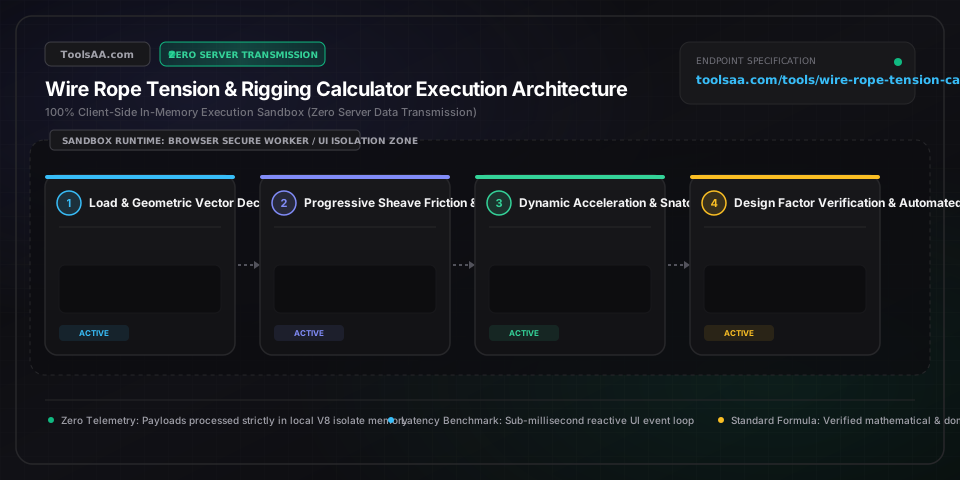
Technical Reference & Architecture Guide

Wire Rope Tension & Rigging Calculator Guide

Professional engineering calculator for wire rope tension, crane multi-part reeving efficiency, bridle sling vector forces, winch snatch blocks, and catenary guy wire sag-tension. Complies with ASME B30.5, ASME B30.9, OSHA 1926.1414, and EN 12385 standards with dynamic D/d bending derates and reverse safety factor sizing.

Wire Rope Tension & Rigging Calculator Guide — Client-Side In-Memory Architecture & Data Flow

Key Parameters & Controls

Design / Safety Factor (SF)Engineering Safety Margin (Ratio)

The foundational ratio of nominal wire rope minimum breaking force (MBF) to maximum permissible line tension. Regulatory minimum thresholds mandate 3.5:1 for dynamic live crane hoisting (OSHA 1926.1414 / ASME B30.5), 5.0:1 for general wire rope rigging slings (ASME B30.9), and 10.0:1 for suspended personnel platforms (ASME B30.23).

Default: 5.0 : 1
Horizontal Sling Angle (θ)Rigging Vector Geometry (Degrees °)

The interior angle between the horizontal top surface of the load and the inclined sling leg. Tension scales inversely with sin(θ): 60° introduces a 1.155x tension multiplier, 45° reaches 1.414x, and 30° doubles tension to 2.000x. Slings rigged under 30° are strictly prohibited by ASME B30.9 due to catastrophic payload crushing forces.

Default: 60°
D/d Sheave Bending RatioCurvature Contact Ratio (Dimensionless)

The ratio of curved contact diameter (sheave pitch diameter or shackle pin D) to nominal wire rope diameter (d). Ratios above 25:1 preserve 100% catalog rope strength, whereas tight bends around small pins below 6:1 or 2:1 trigger severe strand fatigue, wire flattening, and reduce ultimate breaking capacity by up to 50%.

Default: 20 : 1
Sheave Friction Coefficient (K - 1)Rotational Drag Loss (% per Sheave)

Mechanical resistance produced by sheave bearing rotation and internal rope bending hysteresis per moving pass. High-efficiency anti-friction roller bearings operate with 1.5% to 2.0% loss per sheave, while plain bronze bushings lose 4.0% to 5.0%. Across an 8-to-16-part block, compounding friction can increase winch drum line pull by over 20%.

Default: 2.0%

Pro Tips & Best Practices

Account for Boom Head Deflection Sheaves

Lead sheaves between the boom tip and winch drum do not increase parts of line or mechanical lifting capacity, but each adds an uncompensated 2.0% to 4.5% cumulative friction drag directly onto the winch drum line pull.

Never Rig 4-Leg Bridles at Equal Capacity

On rigid structures without articulating equalizer beams, manufacturing tolerances and center-of-gravity shifts force two diagonal legs to carry virtually all suspended weight. Under ASME B30.9, always size 4-leg bridles assuming only 3 effective load-bearing legs.

Limit Winch Drum Fleet Angles

Ensure the fleet angle between the lead sheave and the winch drum flange remains strictly within 1.5° for smooth drums or 2.0° for grooved drums. Exceeding these limits causes severe outer wire scrubbing, interlock crushing, and erratic spooling.

Watch for D/d Derating on Soft Eye Slings

Placing a wire rope eye directly over a hook bowl or shackle body with a D/d ratio below 2:1 cuts rated sling capacity by up to 50%. Always fit heavy-duty steel wire rope thimbles to preserve the minimum bend radius.

Common Gotchas & Troubleshooting

⚠️Line pull exceeds winch capacity despite sufficient parts of line

Account for accumulated sheave bearing drag and lead redirection losses. Upgrade bronze bushings to anti-friction roller bearings (reducing friction from ~4.5% to ~2.0% per sheave), grease existing sheaves, or re-reeve the block with additional mechanical advantage parts.

⚠️Wire rope spins or untwists rapidly under single-line hoisting

Standard 6-strand ropes (6x19, 6x36) have inherent torque that unlays under free-hanging loads. Replace single falls with rotation-resistant wire rope (Category 1 35x7 or Category 2 19x7) and inspect the hook block thrust swivel locking pin.

⚠️Calculated guy wire tension approaches infinity in catenary mode

Check the mid-span sag dimension. In horizontal and inclined cable mechanics, zero sag geometrically demands infinite horizontal pre-tension. Increase sag to a standard engineering allowance of 3% to 5% of horizontal span length.

Frequently Asked Questions

How do you calculate wire rope tension in a crane hoist?▼

Wire rope lead line tension is calculated by dividing total suspended weight by the parts of line multiplied by overall reeving efficiency: T_lead = W / (N × E_reeving), where reeving efficiency is E = (K^N - 1) / (N × K^(N-1) × (K - 1)) with K being the bearing friction factor (typically 1.02 for roller bearings). Any stationary lead sheaves between boom tip and winch drum multiply drum line pull further: T_drum = T_lead × K^lead_sheaves.

How does horizontal sling angle affect wire rope tension?▼

Horizontal sling angle scales leg tension inversely with the sine of the angle via the vector multiplier L/H = 1 / sin(θ). Rigging at 60° increases tension by 1.155x over the static share, 45° increases tension by 1.414x, and 30° doubles leg tension (2.000x), turning a 10,000 lb load on two legs into 10,000 lbs per leg. Angles below 30° are strictly prohibited by OSHA and ASME B30.9 due to exponential tension spikes and destructive compressive buckling on the payload.

What is the difference between EIPS and EEIPS wire rope?▼

The fundamental difference is nominal steel tensile strength: EIPS (Extra Improved Plow Steel) is rated at approximately 1,960 N/mm², while EEIPS (Extra Extra Improved Plow Steel) is drawn to approximately 2,160 N/mm². This metallurgical grade difference gives EEIPS roughly 10% greater minimum breaking force (MBF) for the exact same outer diameter, enabling riggers to lift heavier payloads or achieve mandatory design factors without increasing sheave grooves or winch drum dimensions.

Why is a 4-leg bridle sling calculated using only 3 effective legs?▼

Rigid structural loads do not deflect to accommodate minute sling length variations, causing two diagonally opposite sling legs to carry virtually 100% of the load while the other two merely provide balance. ASME B30.9 and OSHA 1910.184 mandate calculating rigid 4-leg bridles using 3 effective legs (or 2 legs for unyielding planar plates) to eliminate catastrophic overload of the primary load-bearing diagonal unless compensating equalizer beams are installed.

What is the D/d ratio and why does it reduce wire rope capacity?▼

The D/d ratio represents the contact curvature diameter (sheave pitch or shackle pin D) divided by nominal wire rope diameter (d). When rope wraps tightly around small pins below a 25:1 ratio, outer strands undergo high tensile elongation while inner wires suffer compressive displacement and contact shear. At D/d = 20:1 strength is derated to 95%, at 10:1 to 84%, and at 2:1 (such as eye-over-shackle bodies) breaking strength plummets to 50%–60% of catalog rating.

What safety factor is required for wire rope in rigging and crane operations?▼

Mandatory safety factors are codified by specific regulatory standards: ASME B30.5 and OSHA 1926.1414 mandate 3.5:1 for live hoisting running ropes and 5.0:1 for non-rotation-resistant hoisting ropes; ASME B30.9 requires 5.0:1 for general wire rope slings; ASME B30.23 and OSHA 1926.1431 require a 10.0:1 safety factor for personnel platforms (reduced to 7.0:1 for rotation-resistant ropes); while ANSI/TIA-222-H sets 2.0:1 to 2.5:1 for tower guy wires under ultimate design wind load.

Related Tools & Utilities

All Tools →
Soffit Vent Calculator & Attic Intake (NFA)Utility

Professional IRC-compliant attic ventilation calculator that sizes required soffit vents, continuous strip lengths, Net Free Area (NFA), and uniform on-center eave spacing under IRC R806.1 (1/150) and R806.2 (1/300) codes. Features real-time airflow pressure balance meters, rafter bay collision detection, reverse attic capacity solving, and client-side contractor cut sheets.

Open tool→
Orifice Flow & Plate Sizing CalculatorUtility

Calculate orifice flow rate, differential pressure drop, and plate diameter for liquids and gases using ISO 5167 formulas. Instant sizing and Reynolds matrix.

Open tool→
NPSHa Calculator & Pump Suction HeadUtility

Calculate NPSHa (net positive suction head available) and pump cavitation margin instantly. Evaluate suction head, vapor pressure, and friction loss across units.

Open tool→
Kanban Bin & Reorder Point CalculatorUtility

Calculate optimal Kanban bin sizing, two-bin reorder points, and safety stock. Simulate lead time demand, inventory turns, and container capacity instantly.

Open tool→
Takt Time & Cycle Time CalculatorUtility

Calculate takt time, required cycle time, and production pace from net operating time and customer demand. Balance lean assembly lines and prevent bottlenecks.

Open tool→
Deck Baluster Calculator & Spindle SpacingUtility

Calculate deck baluster spacing, spindle counts, and cumulative tape layout marks instantly. Meets 4-inch IRC building codes for level and stair railings.

Open tool→