Short title

Takt Time & Cycle Time Calculator

Calculate takt time, required cycle time, and production pace from net operating time and customer demand. Balance lean assembly lines and prevent bottlenecks.

Lbl load preset
Lbl param input
Lbl shift schedule details6.67 Lbl hr unit Lbl working time
8.0 Lbl hr unit
Lbl min unit
Lbl min unit
Lbl min unit
Lbl min unit
Lbl min unit
Lbl total downtime min:80 Lbl min unit / Lbl per shift
Lbl customer demand
Lbl units
2.0 Lbl percent
Lbl effective demand:918 Lbl units
Lbl total work content8.00 Lbl min unit (480 Lbl sec short)
Lbl sec unit

Lbl work content hint

88 Lbl percent
5 Lbl percent
Lbl unit pieces
Lbl takt time seconds
52.3Lbl sec short
0.87 Lbl min unit / Lbl units
Lbl target cycle time
43.7Lbl sec short
0.73 Lbl min unit (88% Lbl oee short)
Lbl required operators
11Lbl operators unit
Lbl exact staffing: 10.99
Lbl units per hour
69/ Lbl hr unit
459 / Lbl per shift
Lbl metronome beat
Lbl rhythm paceLbl pace high velocity
Lbl takt time seconds52.27 Lbl sec short
Lbl pitch time17.42 Lbl min unit(20 Lbl units)
Lbl target line: 43.7 Lbl sec shortLbl takt line: 52.3 Lbl sec short
Lbl downtime breakdown
83.3%Lbl working time
Lbl working time
400 Lbl min unit
Lbl lunch
30 Lbl min unit
Lbl rest breaks
20 Lbl min unit
Lbl maintenance
10 Lbl min unit
Lbl team huddles
10 Lbl min unit
Lbl changeover
10 Lbl min unit
Technical Reference & Architecture Guide

Takt Time & Cycle Time Calculator Guide

Calculate takt time, required cycle time, and production pace from net operating time and customer demand. Balance lean assembly lines and prevent bottlenecks.

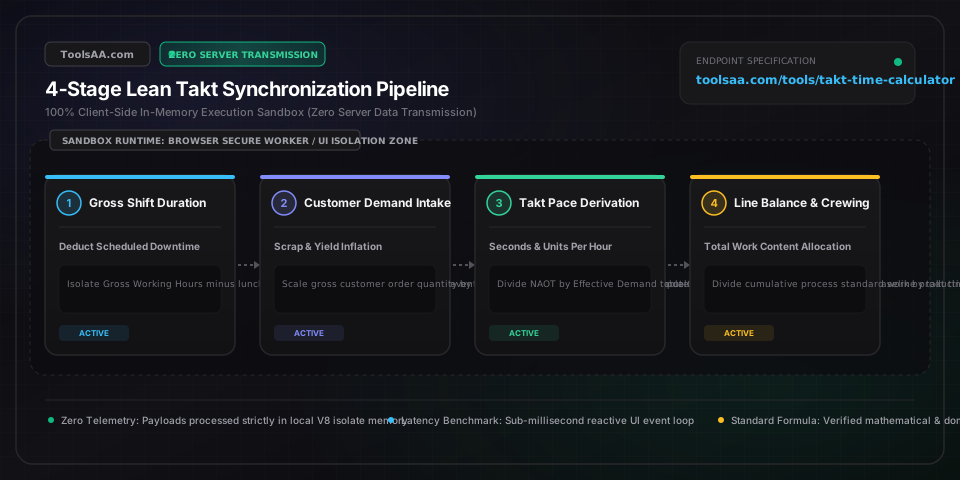
Takt Time & Cycle Time Calculator Guide — Client-Side In-Memory Architecture & Data Flow

Key Parameters & Controls

Net Available Operating Time (NAOT)Operating Duration (Seconds or Minutes per Shift)

Total gross shift duration strictly deducted by planned, predictable non-production events such as meal breaks, team huddles, and scheduled preventive maintenance. Never deduct unexpected equipment breakdowns or emergency stops here, as doing so distorts true customer cadence.

Default: 25,200 seconds (7.0 hours)
Customer Demand VolumeTarget Units (Pieces per Shift or Day)

True external pull quantity required by downstream consumers or final purchasers within the scheduled operating window, establishing genuine pull production without speculative overproduction.

Default: 450 units
First-Pass Yield & Scrap Factor (%)Quality Yield Rate (Percentage)

Anticipated production defect allowance. If 2% of assemblies fail end-of-line verification, entering your scrap rate automatically inflates the gross build target so actual net shipments match customer commitments.

Default: 2.0%
Total Cumulative Work ContentStandard Work Duration (Cumulative Seconds)

The sequential manual assembly and machine processing seconds required to build one finished unit from initial raw part staging to final quality check and packaging.

Default: 360 seconds
Target Planned Cycle Time Buffer (%)Pacing Efficiency Ratio (Percentage of Takt)

Lean operational safety ratio. Industry gold standards recommend engineering station cycle times between 85% and 92% of takt time to absorb normal human motion variance, minor tool adjustments, and component restocking without halting the line.

Default: 85.0%

Pro Tips & Best Practices

Never Deduct Unplanned Equipment Breakdowns from NAOT

Takt time represents the rhythm of customer demand, not machine availability. Deducting unplanned machine stoppages or material shortages from available time artificially accelerates the required cycle speed, forcing operators into unsustainable sprints and concealing line waste (muda).

Calibrate Station Cycle Time to 85%–92% of Takt Time

Designing workstation cycle times to match 100% of takt time guarantees missed shift quotas due to micro-stops, ergonomic fatigue, and parts loading. Setting target cycle times at 85% to 92% of takt provides the critical breathing room needed to sustain stable single-piece flow.

Schedule Kanban Replenishment Using Pitch Multiples

Takt time paces single-piece completion, but materials move in standard container packs. Calculate Pitch = Takt Time × Container Quantity (e.g., 50s Takt × 24 pieces in a tote = 20-minute pitch) to trigger predictable visual replenishment routes without micromanaging stations.

Rebalance Workstations Only for Sustained Demand Shifts

Avoid re-engineering assembly cells for short-term daily sales swings of ±5%. Absorb minor demand ripples using a finished-goods kanban buffer, and formally reallocate operator balance sheets only when structural demand shifts by more than 15% to 20% over a multi-week horizon.

Common Gotchas & Troubleshooting

⚠️Workstation cycle time exceeds takt time (bottleneck starvation)

Split the longest operation across two parallel workstations, offload ancillary preparation (kitting, label scanning, part unpacking) to a material-runner water spider, or apply point kaizen to shave manual handling seconds below the takt ceiling.

⚠️Theoretical operator calculation yields an inefficient fractional head (e.g., 3.3 operators)

Staffing 4 operators for a 3.3-person workload drops line balance efficiency to roughly 82%. Eliminate 15 to 20 seconds of non-value-added motion to operate cleanly with 3 operators, or assign the fourth operator a hybrid role supporting line changeovers and material delivery.

⚠️Automated curing, welding, or thermal cycle time is longer than takt time

When physical processing limits (adhesive curing, heating, chemical bonding) cannot be reduced, introduce multiple parallel tooling fixtures or dual-nest stations so alternating machines feed the line at the continuous single-piece takt cadence.

⚠️Frequent product changeovers disrupt calculated takt cadence on mixed-model lines

Apply Single-Minute Exchange of Die (SMED) techniques to convert internal setup steps into external prep completed while the line runs. If substantial downtime remains unavoidable, deduct scheduled changeover hours from NAOT to calculate dedicated batch takt speeds.

Frequently Asked Questions

How do you calculate takt time in lean manufacturing?▼

Takt time is calculated using the formula: Takt Time = Net Available Operating Time / Customer Demand. For example, if a plant operates an 8-hour shift (28,800 seconds) with 60 minutes of planned breaks and meetings (3,600 seconds), net available time is 25,200 seconds. If customer demand is 504 units per shift, Takt Time = 25,200 / 504 = 50 seconds per unit.

What is the difference between takt time and cycle time?▼

Takt time is the pace of customer demand representing how often a finished unit must be produced, whereas cycle time is the actual elapsed time required for an operator or machine to complete one unit. In a balanced lean line, actual cycle time is purposefully engineered to be 8% to 15% faster than takt time to absorb natural human and mechanical variance.

How do you calculate the number of operators needed from takt time?▼

The minimum operator count is calculated as: Required Operators = Total Work Content Time / Takt Time. If building a product requires a cumulative 320 seconds of manual labor across all stations and your calculated takt time is 40 seconds, you need exactly 320 / 40 = 8 operators. If the quotient is fractional (such as 8.2), you either staff 9 operators or eliminate non-value-added motions to run safely with 8.

Should lunch breaks and machine downtime be included in takt time?▼

Planned non-working events such as lunch breaks, rest periods, and scheduled 5S huddles must be deducted from gross shift time to establish Net Available Operating Time. In contrast, unplanned downtime like machine breakdowns, tool failures, and part shortages must never be deducted; subtracting them falsely inflates the required production speed and conceals equipment unreliability.

What is the difference between takt time, lead time, and pitch?▼

Takt time measures the drumbeat cadence of unit completion (e.g., 45 seconds per unit), manufacturing lead time measures the total calendar duration an individual part takes to journey from raw material staging to shipping dock (e.g., 36 hours), and pitch is the rhythmic schedule for transferring container batches, calculated as Takt Time × Container Pack Size (e.g., 45 seconds × 40 parts = 30-minute replenishment pitch).

Related Tools & Utilities

All Tools →