Hint dio formula
Hint dso formula
Hint dpo formula
Title timeline
Desc timeline
Cfa assessment negative
Calculate Cash Conversion Cycle (CCC), Days Inventory Outstanding (DIO), Days Sales Outstanding (DSO), and Days Payable Outstanding (DPO). Free trapped working capital with interactive scenario modeling.
Hint dio formula
Hint dso formula
Hint dpo formula
Desc timeline
Cfa assessment negative
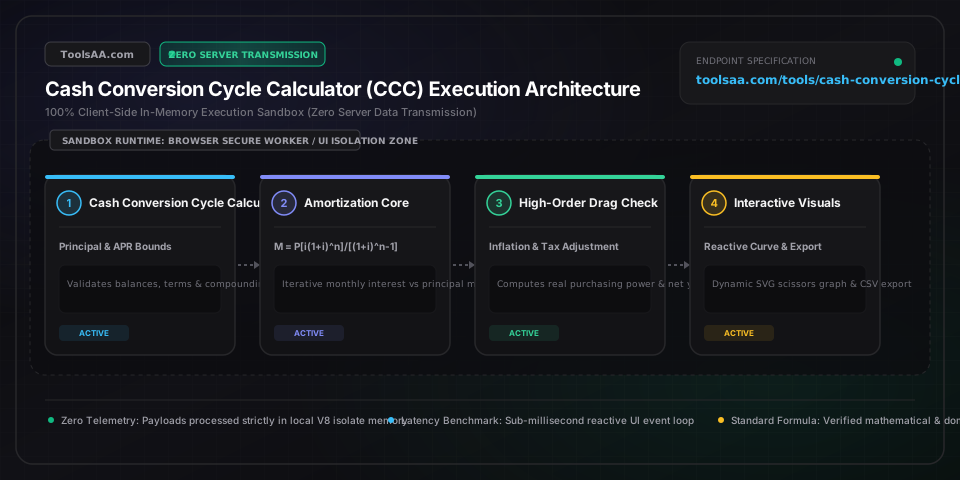
High-performance calculation executed entirely in browser memory.
All payloads remain strictly local with zero external server communication.
Clean, optimized output formats ready for immediate deployment.
Calculate Cash Conversion Cycle (CCC), Days Inventory Outstanding (DIO), Days Sales Outstanding (DSO), and Days Payable Outstanding (DPO). Free trapped working capital with interactive scenario modeling.
Gross accounts receivable less allowances for expected credit losses under ASC 326 (CECL) or IFRS 9. Calculated as the arithmetic average of beginning and ending period balances, or ideally a 13-month weighted average to strip out seasonal window-dressing. Operating targets typically span 30 to 45 days of sales; balances exceeding 60 days indicate collection degradation and elevated default exposure.
Total recognized revenue generated strictly on trade credit terms over the measurement horizon (standard annual period of 365 days). Point-of-sale cash receipts, upfront wire transfers, and immediate credit card settlements must be excluded from this denominator to avoid artificially deflating Days Sales Outstanding (DSO).
Cumulative carrying value across raw materials, work-in-process (WIP), and finished goods inventory. For entities applying US GAAP LIFO costing, analysts must adjust this balance by adding back the disclosed LIFO Reserve to normalize inventory valuation to current economic replacement costs (FIFO equivalent) for cross-company comparability.
Direct procurement, direct labor, and manufacturing overhead costs recognized during the reporting period, strictly excluding operating expenses (SG&A). COGS serves as the standardized denominator for both Days Inventory Outstanding (DIO) and Days Payable Outstanding (DPO) to enforce correct matching against balance sheet carrying costs.
Trade obligations owed to vendors for raw materials, component supplies, and direct production services on deferred payment terms. Accrued liabilities, payroll taxes, short-term debt tranches, and deferred revenue must be excluded to isolate purely operational, non-interest-bearing trade credit extended by vendors.
Exact day count of the accounting period under analysis: 365 days for standard annual cycles, 366 days for leap years, 90 or 91.25 days for quarterly cycles, or 30 days for monthly reviews. When analyzing quarterly reports, failure to multiply period flow variables by the corresponding day fraction skews cycle calculations by roughly 400%.
Foregoing vendor prompt-payment discounts to artificially lengthen DPO destroys economic value. Under standard '2/10 net 30' trade credit terms, paying on day 30 instead of taking the 2% discount on day 10 carries an annualized borrowing cost of 44.59% APY: ((1 + 2/98)^(365/20)) - 1 = 44.59%. Unless your enterprise cost of capital or alternative return on cash exceeds 44.6% APR, delaying payment to maximize DPO is a net-negative capital allocation decision. Extend payable terms solely via structural negotiation (e.g., net 60 or supply chain reverse factoring) rather than forfeiting early settlement incentives.
Computing CCC using point-in-time annual balance sheets produces material reporting distortions. Corporate treasuries systematically slash procurement orders, deplete safety stock, and factor receivables immediately prior to fiscal year-end audits to artificially compress reported CCC and inflate operating cash flow. To ascertain authentic operational throughput, compute DIO, DSO, and DPO using a rolling 13-month average or quarterly weighted balances: Average Balance = (Opening + 2*Q1 + 2*Q2 + 2*Q3 + Closing) / 8. Single-point analyses routinely underestimate peak intra-year working capital demands by 25% to 45%.
Shortening your CCC by 15 days on $50 million annual sales releases exactly $2,054,795 in permanently unlocked liquidity (15 * ($50M / 365)). Directing this released capital toward extinguishing a revolving credit facility yielding SOFR + 350 bps (e.g., 8.5% floating APR) produces $174,658 in immediate pre-tax recurring interest expense savings. This non-dilutive liquidity injection directly expands enterprise EBITDA-to-FCF conversion efficiency without incurring restrictive debt covenants or taxable capital events.
While maintaining a negative Cash Conversion Cycle allows companies like Amazon and Apple to fund operational growth using supplier capital float, unilaterally stretching DPO past 90 days creates supplier vulnerability. Overextended suppliers frequently respond by padding future component bids with hidden 3% to 5% liquidity surcharges, deprioritizing delivery allocations during supply shocks, or demanding letters of credit under deteriorating credit terms. Negative CCC must be driven primarily by high inventory velocity (low DIO) and rapid receivables capture (low DSO), rather than predatory payable stalling.
Companies reporting under US GAAP frequently employ Last-In, First-Out (LIFO) inventory accounting, which systematically depresses balance sheet inventory valuations and inflates COGS during inflationary periods, artificially deflating calculated DIO by 15 to 35 days compared to IFRS competitors where LIFO is strictly prohibited. To reconcile: extract the disclosed 'LIFO Reserve' from the balance sheet footnotes, compute Adjusted Inventory = Reported LIFO Inventory + Ending LIFO Reserve, and adjust COGS = Reported COGS - Net Change in LIFO Reserve before calculating DIO.
When omnichannel retailers or hybrid B2B/B2C enterprises aggregate cash receipts, debit cards, and deferred credit sales into a single 'Total Revenue' denominator, DSO appears artificially low, masking deep structural aging and bad-debt risk within the credit-extended customer cohort. Correct this reporting defect by isolating Gross Credit Sales as the exclusive denominator: True DSO = (Average Accounts Receivable / Gross Credit Sales) * Period Days. If credit-specific sales are unsegregated, cross-reference DSO against aging schedules, specifically tracking the percentage of AR aged beyond 60 and 90 days.
Standard financial screening algorithms occasionally flag a negative CCC as an error because DPO exceeds the combined Operating Cycle (DIO + DSO). In high-throughput operating models (e.g., FMCG, subscription manufacturing, mass retail), a negative CCC is an elite treasury indicator demonstrating that customer receipts fund upstream supply liabilities before supplier invoices come due. Verify that the enterprise maintains an adequate Quick Ratio (Cash + Marketable Securities + Receivables / Current Liabilities > 0.8) to ensure short-term solvency if supply disruptions compress vendor credit lines.
To calculate the Cash Conversion Cycle, sum Days Inventory Outstanding (DIO) and Days Sales Outstanding (DSO), then subtract Days Payable Outstanding (DPO): CCC = DIO + DSO - DPO. First, calculate DIO = (Average Inventory / COGS) * 365, which reflects the average days inventory sits before being sold. Second, calculate DSO = (Average Accounts Receivable / Total Credit Sales) * 365, measuring the average days required to collect customer receivables. Third, calculate DPO = (Average Accounts Payable / COGS) * 365, quantifying the days taken to pay vendors. The net result expresses the exact number of days a firm's operational cash remains illiquid.
A competitive Cash Conversion Cycle varies structurally by business model: fast-moving consumer goods (FMCG) and e-commerce leaders frequently operate between -10 and -30 days, while heavy capital goods, aerospace, and specialized manufacturing typically range from +60 to +120 days due to lengthy fabrication intervals. For example, discount retailers collect from consumers in 1 to 3 days (DSO) and turn inventory in 25 days (DIO), while securing 45-day vendor payment terms (DPO), yielding a highly efficient CCC of -17 days. An optimal benchmark is any continuous downward trend relative to an industry peer group that does not compromise product availability or damage supplier goodwill.
Yes, a negative Cash Conversion Cycle occurs when Days Payable Outstanding (DPO) exceeds the aggregate Operating Cycle (DIO + DSO), meaning the company collects revenue from customers before it is obligated to pay vendors for the underlying inventory. For instance, if a company maintains a 15-day DIO, a 5-day DSO, and negotiates 50-day vendor payment terms (DPO), its CCC equals 15 + 5 - 50 = -30 days. This 30-day structural window generates an interest-free working capital float funded entirely by trade creditors, enabling rapid self-funded enterprise scaling without relying on commercial paper, revolving debt, or dilutive equity offerings.
The Operating Cycle measures the gross operational timeframe required to purchase inventory, manufacture goods, and convert sales into collected cash (Operating Cycle = DIO + DSO), while the Cash Conversion Cycle measures only the net duration during which the company's internal liquid capital remains trapped after accounting for supplier-provided trade financing (CCC = Operating Cycle - DPO). While the Operating Cycle evaluates commercial and production velocity, the CCC evaluates working capital liquidity and treasury funding efficiency.
A company shortens its CCC by executing targeted operational adjustments across three primary levers: 1) Slashing DIO through just-in-time (JIT) manufacturing, automated reorder triggers, and discounting obsolete inventory; 2) Accelerating DSO by implementing electronic invoicing, offering tiered prompt-settlement terms (e.g., 1/10 net 30), and tightening customer credit limits based on real-time credit bureau data; and 3) Expanding DPO by formalizing vendor payment schedules to contract boundaries (e.g., transitioning from net 30 to net 60) or deploying reverse-factoring supply chain finance programs to maintain vendor cash flow.
Disclaimer: This tool is provided strictly for educational and informational purposes only and does not constitute formal financial advice or a binding loan commitment. Please consult a qualified financial advisor before making decisions. Extending Accounts Payable directly increases DPO, compressing the Cash Conversion Cycle day-for-day and immediately releasing cash back to the balance sheet. For an enterprise generating $36.5 million in annual Cost of Goods Sold ($100,000 daily COGS), extending negotiated payment terms from 30 days to 60 days increases DPO by 30 days and cuts CCC by 30 days, instantly unlocking $3,000,000 in trapped liquid cash ($100,000 * 30 days). This structural liquidity permanently reduces reliance on short-term revolving credit lines, directly lowering interest expense.
Calculate safe withdrawal rates, retirement nest egg, Guyton-Klink guardrails, Trinity Study benchmarks, fee drag, and sequence of returns risk.
Calculate your SaaS Rule of 40 score with revenue growth rate and profit margin. Benchmark against public SaaS multiples, solve target growth, and model FCF.
Professional SaaS Net Revenue Retention (NRR / NDR) and Gross Revenue Retention (GRR) intelligence calculator. Models customer cohort ARR/MRR dynamics including expansion upsells, contraction downgrades, and churn cancellations. Features an ARR movement waterfall bridge, SaaS Quick Ratio efficiency rating, 5-year compounding cohort decay projection, reverse expansion target solver, and sensitivity matrix benchmarked against top-decile BVP and OpenView SaaS standards.
Calculate trench drain channel size, peak storm runoff (Q=CIA), Manning flow capacity, and outlet pipe diameter with imperial and metric engineering precision.
Interactive Roof Pitch Multiplier & Rafter Slope Factor Calculator with real-time client-side analysis and visualization.
Calculate post hole depth, diameter, and concrete bags for fence posts, decks, and pergolas. Includes frost line depths, gravel drainage, and 1/3 rule sizing.