/

Short title

Badge tier•Hero standard sub

Subfloor Adhesive Calculator & Tube Estimator

Calculate subfloor adhesive tubes and joist glue coverage instantly. Input floor dimensions, joist spacing, bead diameter, and panel seams for exact project yield.

Lbl unit system

ft
ft
Lbl floor area320.0 sq ft (10 Unit sheets)
38.1 ft/tube
+10%
5% (Waste exact)10% (Waste standard)15% (Waste rough)25% (Waste heavy)
$
Kpi total tubes
12Unit tubes
Lbl net tubes: 11.22
Kpi total linear footage
460Unit feet
13 Lbl framing lines
Kpi estimated cost
$107.76
$0.34/sq ft
Kpi area per tube
26.7sq ft
1 Lbl cases needed
Lbl visualizer titleLbl visualizer subtitle
20 x 16 ft
16 ft (Lbl joist spacing short: 16 in OC)20 ft
Legend field joist (0.375 in)
Legend tg seam
Legend rim board
Legend staggered panels
Lbl bead gauge titleLbl bead gauge subtitle
Gauge extrudedGauge joist flangeØ 0.375 in
Gauge panel clamping➔Gauge fastened
Gauge compressedGauge subfloor panelGauge joist flange~1.2 in Gauge contact width
Lbl sensitivity matrix titleLbl sensitivity matrix subtitle
Th spacing1/4"5/16"3/8"1/2"
12 in OC7 Unit tubes10 Unit tubes14 Unit tubes24 Unit tubes
16 in OC6 Unit tubes8 Unit tubes12 Unit tubes20 Unit tubes
19.2 in OC5 Unit tubes8 Unit tubes11 Unit tubes18 Unit tubes
24 in OC5 Unit tubes7 Unit tubes9 Unit tubes16 Unit tubes
Technical Reference & Architecture Guide

Subfloor Adhesive Calculator & Tube Estimator Guide

Calculate subfloor adhesive tubes and joist glue coverage instantly. Input floor dimensions, joist spacing, bead diameter, and panel seams for exact project yield.

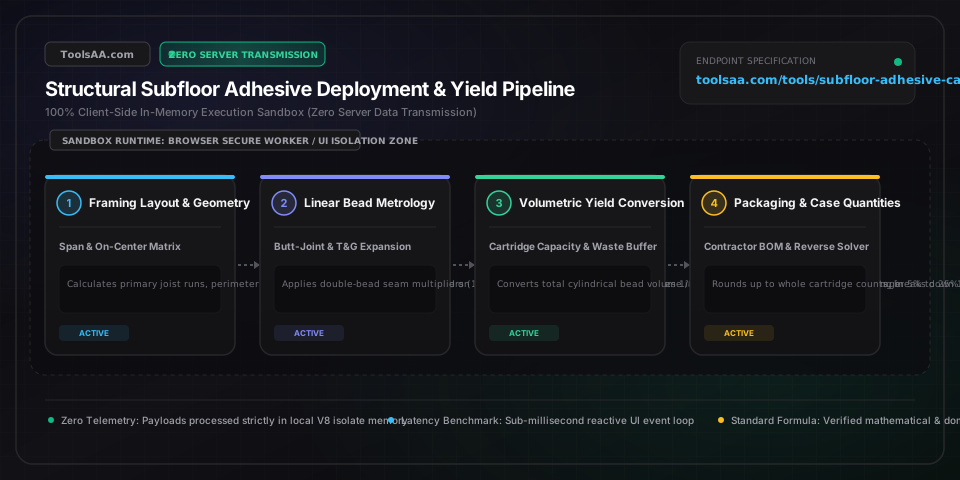
Subfloor Adhesive Calculator & Tube Estimator Guide — Client-Side In-Memory Architecture & Data Flow

Key Parameters & Controls

Cartridge Volumetric CapacityFluid Ounces or Milliliters

Net adhesive volume per dispenser container. Standard contractor tubes contain 28 fl oz (828 mL) or 29 fl oz (858 mL), standard consumer cartridges contain 10 fl oz (296 mL), and commercial pneumatic or manual barrel guns use 20 fl oz (591 mL) or 600 mL foil sausage packs.

Default: 28 fl oz (828 mL)
Extruded Bead DiameterFractional Inches or Millimeters

Nozzle aperture cut size controlling cross-sectional adhesive deposition. The American Plywood Association (APA AFG-01) mandates a continuous 3/8-inch (9.5 mm) bead on structural joists, or a 1/4-inch (6.4 mm) bead where double beads are applied at panel butt joints.

Default: 3/8 inch (9.5 mm)
Joist On-Center (OC) SpacingInches or Millimeters

Perpendicular distance between centerlines of adjacent framing members. Common architectural intervals are 16 inches (406 mm) for dimensional lumber, 19.2 inches (488 mm) for engineered I-joists (yielding exactly 5 bays per 8-foot panel), and 24 inches (610 mm) for structural floor trusses.

Default: 16 inches (406 mm)
Panel Butt-Joint Double-Bead AllowanceGeometric Seam Multiplier

Application of two parallel beads or a continuous serpentine pattern on joists where two 4x8 subfloor panels meet. On a standard 1-1/2 inch framing flange, adjacent panels share only 3/4 inch of bearing surface each, requiring dedicated glue beads for both sheet edges.

Default: Double Parallel Bead
Tongue-and-Groove (T&G) Seam GluingLinear Edge Bead Requirement

Deposition of a 1/8-inch (3.2 mm) continuous adhesive bead inside the female groove before sliding panels together. Eliminates friction squeaks from floor deflection and enhances diaphragm shear resistance.

Default: Enabled (1/8-inch bead)
Jobsite Waste & Squeeze-out ContingencyVolumetric Safety Factor Percentage

Compensates for nozzle purges, tube heel residue (unusable adhesive left in nozzle and plunger), framing lumber irregularities, and squeeze-out compression. Professional framing standards dictate a 10% buffer under normal conditions and 15% to 20% on wet or cupped framing.

Default: 10%

Pro Tips & Best Practices

Respect the 15-Minute Open Time to Prevent Hydraulic Squeaks

Never apply subfloor adhesive more than one or two panels ahead of installation. Most polyurethane and solvent-based adhesives develop a surface skin within 15 to 20 minutes depending on ambient temperature and relative humidity. Fastening subfloor panels over skinned-over adhesive prevents mechanical wetting, leaving an elastic lump that creates permanent squeaks and uneven floor height under finished hardwood or tile.

Maintain 1/8-Inch Panel Edge Gaps Despite Adhesive

Even when applying adhesive inside tongue-and-groove joints, always maintain a 1/8-inch (3.2 mm) expansion gap at all panel end butt joints and side seams. Forcing panels drum-tight against each other eliminates room for seasonal moisture expansion; subsequent panel swelling will shear the adhesive bond and cause floor buckling.

Double-Bead Panel Butt Joists Instead of Centering a Single Bead

A single 3/8-inch bead placed down the exact center of a 1-1/2-inch wide 2x joist flange leaves only 3/16 inch of glue for each panel edge when sheets meet. Run two distinct parallel 1/4-inch beads or an aggressive sinusoidal serpentine bead so each panel bears on its own independent adhesive bed.

Match Polymer Chemistry to Joist Moisture Content

If framing lumber is wet from rain or snow (moisture content > 19%), standard solvent-based construction adhesives will fail to cure and bond. Use moisture-curing 100% polyurethane subfloor adhesives conforming to ASTM D3498 and APA AFG-01; polyurethane chemistry utilizes moisture in wet lumber to trigger cross-linking and expand into cell voids.

Common Gotchas & Troubleshooting

⚠️Extruded bead squashes out excessively past panel edges onto the upper subfloor surface

The bead diameter is cut too large for the joist flange or panels are being slid horizontally rather than dropped into place. Cut cartridge nozzles at a 90-degree angle to produce an exact 3/8-inch bead, keep the bead centered 3/8-inch away from joist edges, and install panels using a rolling drop motion to prevent pushing glue forward.

⚠️Subfloor squeaks persist after adhesive application and screw installation

Floor squeaks after gluing occur because fasteners did not pull the subfloor sheathing into full contact with the joist before the adhesive cured, creating a gap where the subfloor flexes along the screw shank. Verify that screws feature a smooth upper shank (preventing thread jacking) and ensure all fasteners are driven within the adhesive open-time window.

⚠️Adhesive is too stiff to extrude from cartridge gun in cold weather (<40°F / 4°C)

Heavy-duty subfloor adhesives increase dramatically in viscosity at low temperatures. Store cartridges in a heated jobsite box, truck cab, or warm water bucket prior to gunning. Never heat cartridges with direct open flames or heat guns, which degrades polyurethane cross-linkers.

⚠️Solvent-based adhesive softens or telegraphs through resilient vinyl or luxury vinyl plank (LVP)

Solvent adhesives off-gas volatile organic compounds through subfloor pores, which can chemically react with vinyl plasticizers, creating yellow discoloration and surface bubbling. Always utilize low-VOC polyurethane or advanced hybrid polymer subfloor adhesives when resilient vinyl or direct-glue flooring is specified.

Frequently Asked Questions

How many tubes of subfloor adhesive do I need per sheet of plywood?▼

For a standard 4x8 ft (32 sq ft) subfloor panel installed on 16-inch on-center joists with a 3/8-inch bead, you need approximately 0.85 contractor-size (28 oz) tubes per sheet, which includes framing joists, double-beaded butt joints, and a 10% waste buffer. If using 10 oz standard consumer cartridges, you need approximately 2.4 tubes per 4x8 panel. If gluing tongue-and-groove edges with an additional 1/8-inch bead, budget 1 full 28 oz tube per 4x8 sheet.

How many linear feet does a 28 oz tube of subfloor adhesive cover?▼

A 28 fl oz (828 mL) cartridge yields approximately 86 linear feet when extruded at a 1/4-inch (6.4 mm) continuous bead, and approximately 38 linear feet when extruded at an APA-specified 3/8-inch (9.5 mm) heavy bead. In metric units, a 28 oz tube provides 26.2 meters of 1/4-inch bead or 11.6 meters of 3/8-inch bead.

Should you glue tongue and groove subfloor seams?▼

Yes, building science and APA Engineered Wood Association standards strongly recommend gluing tongue-and-groove seams with a continuous 1/8-inch (3.2 mm) bead applied inside the groove before mating panels. Gluing T&G seams locks adjacent panel edges together, eliminating vertical edge deflection and wood-on-wood friction squeaks between joists while substantially increasing diaphragm shear strength.

What is the difference between polyurethane and solvent-based subfloor adhesive?▼

Polyurethane subfloor adhesive cures by reacting with atmospheric and lumber moisture, expands slightly to bridge framing gaps up to 1/8 inch, adheres reliably to wet or frozen lumber, and remains permanently elastomeric without shrinking. Solvent-based adhesives dry via solvent evaporation, shrink slightly as solvents dissipate, become brittle over decades, and lose adhesion if applied to wet or frost-covered joists.

How long can subfloor adhesive sit before laying plywood?▼

Subfloor adhesive has an open working time of 15 to 20 minutes under standard conditions (70°F / 21°C, 50% relative humidity). In hot, dry weather (above 85°F / 29°C), the open working time drops to under 10 minutes. If the adhesive skins over or becomes tack-free before the panel is dropped and fastened, you must scrape off the bead and reapply fresh adhesive.

Related Tools & Utilities

All Tools →
DPO Calculator & Days Payable Outstandingfinance

Interactive DPO Calculator (Days Payable Outstanding & AP Turnover) with real-time client-side analysis and visualization.

Open tool→
Freight Class Calculator (NMFC & Density)Utility

Calculate freight class and NMFC density instantly from pallet dimensions and weight. Estimate LTL shipping class, cubic feet, and bumping rule cost savings.

Open tool→
Cash Conversion Cycle Calculator (CCC)finance

Calculate Cash Conversion Cycle (CCC), Days Inventory Outstanding (DIO), Days Sales Outstanding (DSO), and Days Payable Outstanding (DPO). Free trapped working capital with interactive scenario modeling.

Open tool→
Safe Withdrawal Rate Calculator (FIRE & SWR)finance

Calculate safe withdrawal rates, retirement nest egg, Guyton-Klink guardrails, Trinity Study benchmarks, fee drag, and sequence of returns risk.

Open tool→
Rule of 40 Calculator (SaaS Growth & Margin)finance

Calculate your SaaS Rule of 40 score with revenue growth rate and profit margin. Benchmark against public SaaS multiples, solve target growth, and model FCF.

Open tool→
Net Revenue Retention Calculator & NDRfinance

Professional SaaS Net Revenue Retention (NRR / NDR) and Gross Revenue Retention (GRR) intelligence calculator. Models customer cohort ARR/MRR dynamics including expansion upsells, contraction downgrades, and churn cancellations. Features an ARR movement waterfall bridge, SaaS Quick Ratio efficiency rating, 5-year compounding cohort decay projection, reverse expansion target solver, and sensitivity matrix benchmarked against top-decile BVP and OpenView SaaS standards.

Open tool→